
Iridium Communications Faces Strategic Transition Amid Rocket Lab Merger and Aireon Acquisition
Iridium’s unique LEO satellite mesh network and expansive wholesale channel underpin its global communication services, now evolving through a pending merger and recent acquisition.
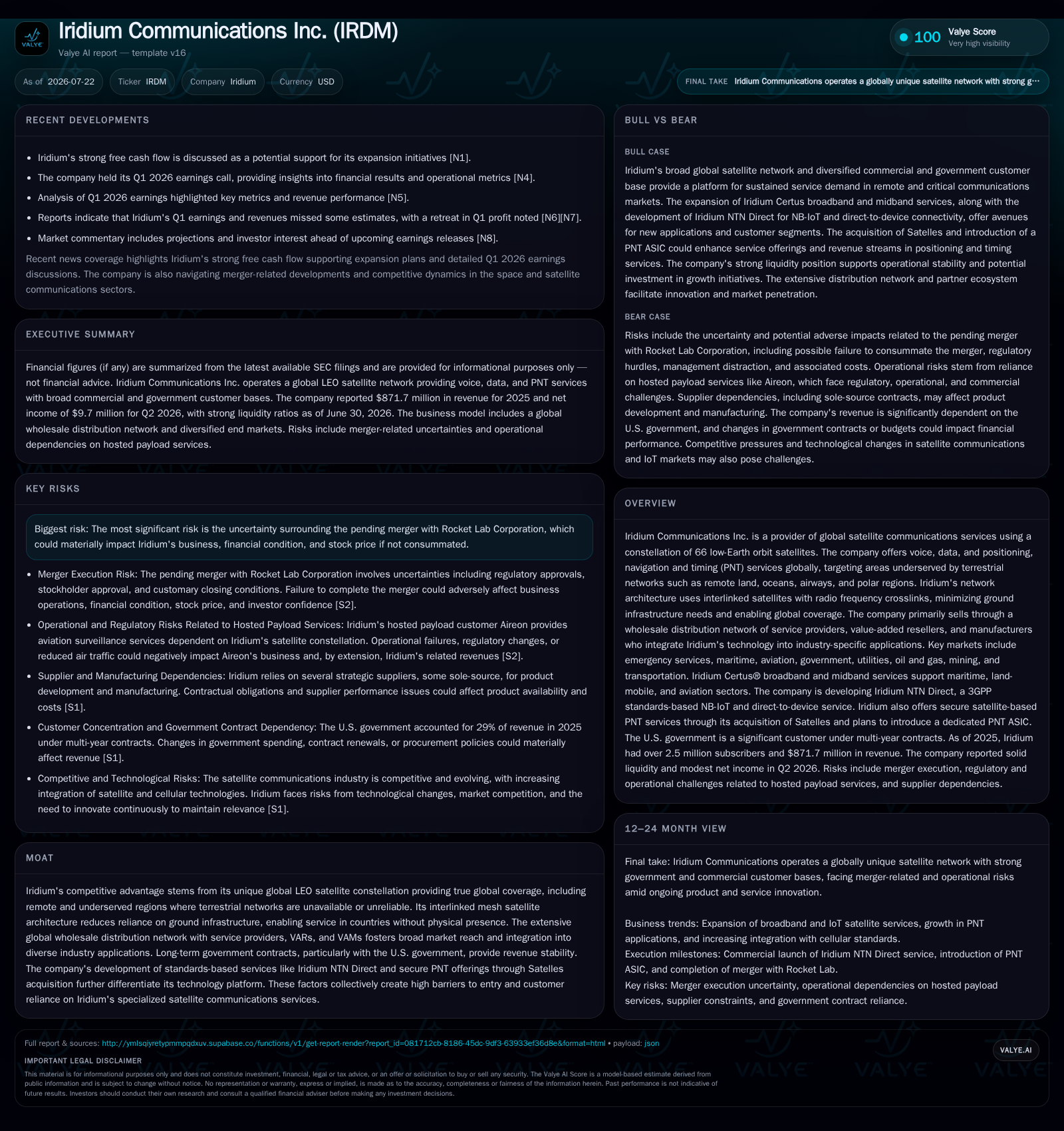
Iridium Communications Inc. operates a distinctive global low-Earth orbit (LEO) satellite constellation delivering voice, data, and positioning services worldwide. Its interlinked satellite mesh architecture enables true global coverage with minimal ground infrastructure, serving commercial sectors like maritime, aviation, government, and remote industries via a broad wholesale distribution network. In the latest quarter ending June 2026, Iridium disclosed ongoing uncertainty around its announced merger with Rocket Lab Corporation, which dominates near-term strategic risk due to execution hurdles and potential operational distraction. Concurrently, Iridium completed acquisition of full ownership in Aireon LLC, enhancing its positioning/navigation/timing (PNT) capabilities but also adding associated debt. The company remains capital-intensive but benefits from a high-margin recurring revenue base anchored by government contracts and diversified end markets.
Latest Operating Update and Merger Uncertainty
In its Q2 2026 filing dated July 22nd [S2], Iridium Communications emphasized significant uncertainties surrounding the anticipated merger with Rocket Lab Corporation. The transaction is conditional upon regulatory clearances and shareholder approvals that remain pending. Failure to close or delays could materially disrupt Iridium's operations by diverting management focus away from day-to-day business activities. Additionally, the company has incurred substantial legal and advisory fees related to the merger process that will not yield returns should the deal fail to consummate. This environment may weaken investor confidence and strain relations with customers and suppliers sensitive to strategic uncertainty.
The ongoing merger-related distraction presents a near-term execution risk potentially clouding operational momentum despite Iridium’s solid underlying fundamentals.
Business Model: Unique Satellite Architecture Meets Wholesale Distribution
Iridium operates the only commercial satellite constellation that provides truly global coverage using its constellation of 66 operational low-Earth orbit satellites complemented by inter-satellite radio frequency crosslinks forming a mesh network architecture [S1]. This architectural design minimizes dependence on terrestrial ground stations (feeder links), which results in an unmatched footprint extending to poles, oceans, airways, and remote land regions underserved by terrestrial wireless or wireline networks.
This mesh architecture adds resilience against localized outages or geopolitical disruptions where robust ground infrastructure is unavailable.
Unlike direct-to-consumer models common among some competitors (e.g., SpaceX Starlink), Iridium primarily generates revenue through an extensive wholesale distribution ecosystem comprising approximately 120 service providers alongside roughly 310 value-added resellers (VARs) and 90 value-added manufacturers (VAMs) [S1]. These partners integrate Iridium’s voice, data, and PNT capabilities into vertical-specific solutions addressing industry needs.
End markets span emergency response teams requiring reliable comms in crises; maritime operators needing broadband beyond shore-based signals; aviation sectors for cockpit connectivity; government bodies demanding secure communications; industrial fields like oil & gas or mining conducting operations in remote sites; transportation fleets tracking assets; and utilities monitoring infrastructure.
Revenue derives mostly from subscription fees paid indirectly by end users through wholesale contracts. Growth levers include increasing the number of active devices/subscriptions supported by VARs/VAMs adopting new applications powered by Iridium’s network.
Industry Structure and Competitive Positioning
The satellite communications services industry consists of operators who maintain LEO or geostationary satellite constellations to deliver connectivity targeting niche or underserved segments inaccessible by terrestrial networks. Peers such as Globalstar or Inmarsat offer complementary regional coverage or differing orbital models but lack Iridium’s fully meshed global LEO constellation.
Emerging broadband-focused LEO networks like Starlink pose longer-term competitive pressures due to their potential for lower latency high-throughput consumer broadband. However, Starlink’s more ground-dependent architecture contrasts with Iridium’s model optimized for reliability in extreme environments rather than pure consumer broadband speed.
Iridium reinforces differentiation through unique PNT services enhanced by its full acquisition of Aireon LLC mid-2026 — an acquisition extending its portfolio into secure satellite-based navigation timing critical for defense and safety-of-life applications [S25][S27]
Government contracts remain pivotal for revenue stability given long contract lengths and budgeted spending supporting secure communications in defense and space operations sectors.
Growth Drivers
Several structural trends undergird sustained demand for Iridium’s offerings:
- Expansion of Connectivity Needs in Underserved Regions: Increasing digital reliance requires constant voice/data links even in politically unstable or infrastructure-poor geographies.
- Sector-Specific Application Development: Value-added resellers continuously create vertical solutions (e.g., fisheries compliance monitoring or industrial IoT telemetry) leveraging the network’s ubiquitous reach.
- Broadband Service Expansion: The evolution of midband broadband over its L-band spectrum supports the maritime sector's appetite for enhanced ship-to-shore data transmission.
- IoT/Machine-to-Machine Growth: Proliferation of connected sensors in transportation fleets or remote equipment drives volume usage on subscription platforms.
- PNT Services Leveraging Aireon Acquisition: Secure positioning/timing services become increasingly valuable amid rising complexities in navigation for defense agencies as well as commercial aviation.
- Emergency/Disaster Response Utilization: Dependable communication during crises where terrestrial systems fail ensures irreplaceable relevance.
- Government Contract Backlog: Large multi-year programs underpin durable cash flow visibility despite cyclical pressures elsewhere.
Risks and Constraints
Capital intensity remains a central constraint — satellite construction/deployment cycles are typically measured over years requiring heavy upfront investments followed by operational ramp-up [S1]. Spectrum licensing poses regulatory risks that could influence service expansions or adaptations especially involving interference concerns or international coordination requirements.
Technology obsolescence risk exists as newer mega-constellations target higher throughput or lower latency potentially eroding market share if Iridium cannot keep pace technologically.
Dependency on hundreds of channel partners spreads market access but introduces complexity with potential channel conflicts or dilution of direct customer relationships.
Geopolitical tensions affecting export controls or spectrum access could limit certain government contract renewals or international sales opportunities. Satellite launch failures or in-orbit anomalies also present non-negligible hazards given irreplaceable capital assets deployed in space.
Finally, the current strategic transition involving the Rocket Lab merger incurs integration risks while creating uncertainties for customers assessing long-term relationships with Iridium until resolution occurs [S2].
What to Watch Next
Key upcoming milestones include progress toward satisfying closing conditions for the Rocket Lab merger including securing stockholder approvals and regulatory clearances—delays here could significantly affect near-term outlook dynamics [S2][S3]. Monitoring management commentary on integration planning will reveal how operational distractions are managed alongside core service delivery priorities.
Operational KPIs critical to track include metrics around active subscriber/device growth through wholesale partnerships and ARPU shifts signaling changes in monetization effectiveness. Equally important will be retention rates among VARs/VAMs developing industry applications leveraging Iridium’s network effects.
Technical updates about constellation health/expandability post-Aireon acquisition should indicate whether expanded PNT offerings gain traction alongside traditional voice/data lines. Government contract awards or renewals provide further visibility into durable base revenues underpinning free cash flow generation prospects.
Financial Profile Discussion
As of June 30, 2026 end-of-quarter [F1], Iridium maintained a healthy liquidity position evidenced by cash & equivalents totaling approximately $184 million paired with current assets exceeding current liabilities nearly threefold to yield a current ratio around 2.78 — indicative of solid short-term financial flexibility amidst ongoing integration costs related to acquisitions and transaction activities.
Total debt stood at roughly $1.77 billion as per latest available year-end balance sheet data through December 31, 2025 reflecting structural leverage partly attributable to capital expenditures tied to satellite infrastructure maintenance plus funding tranches related to acquiring Aireon LLC [F1][S25][S27]. Net debt adjusted for available cash approximated $1.59 billion highlighting significant financial commitments extendable beyond operating cash flows absent external refinancing efforts.
Overall leverage levels align with capital-intensive satellite communications peers although successful integration of aerospace vertical capabilities via Rocket Lab could reshape capital allocation priorities amid enhanced diversification opportunities if consummated smoothly.
Conclusion
Iridium Communications occupies a distinct niche within satellite communications through its unique mesh LEO constellation providing universal coverage optimized for mission-critical markets often overlooked by consumer-focused broadband players. Its expansive wholesale distribution ecosystem enables penetration across diverse commercial verticals while government contracts anchor financial stability. However, the near-term trajectory hinges heavily on successfully navigating merger execution risks posed by Rocket Lab integration alongside assimilating recent Aireon acquisition impacts financially and operationally. Observers should prioritize monitoring transaction developments alongside sustaining growth signals within wholesale subscriber bases to gauge durability behind this specialized satellite service provider's long-term thesis.
Disclaimer: This analysis does not constitute investment advice or research views. It is based exclusively on publicly available information from SEC filings dated up to July 2026.
Disclaimer: This is research-only, informational analysis and not investment advice. It may include AI-generated interpretation and general industry context. Always verify important details using primary sources.

Comments