
Akebia Therapeutics Turns Operating Profit as Vafseo Launch Reshapes Market Access
Akebia moves to operating profitability in 2025 driven by Vafseo's commercial rollout while managing legacy product pressures and loan covenants.
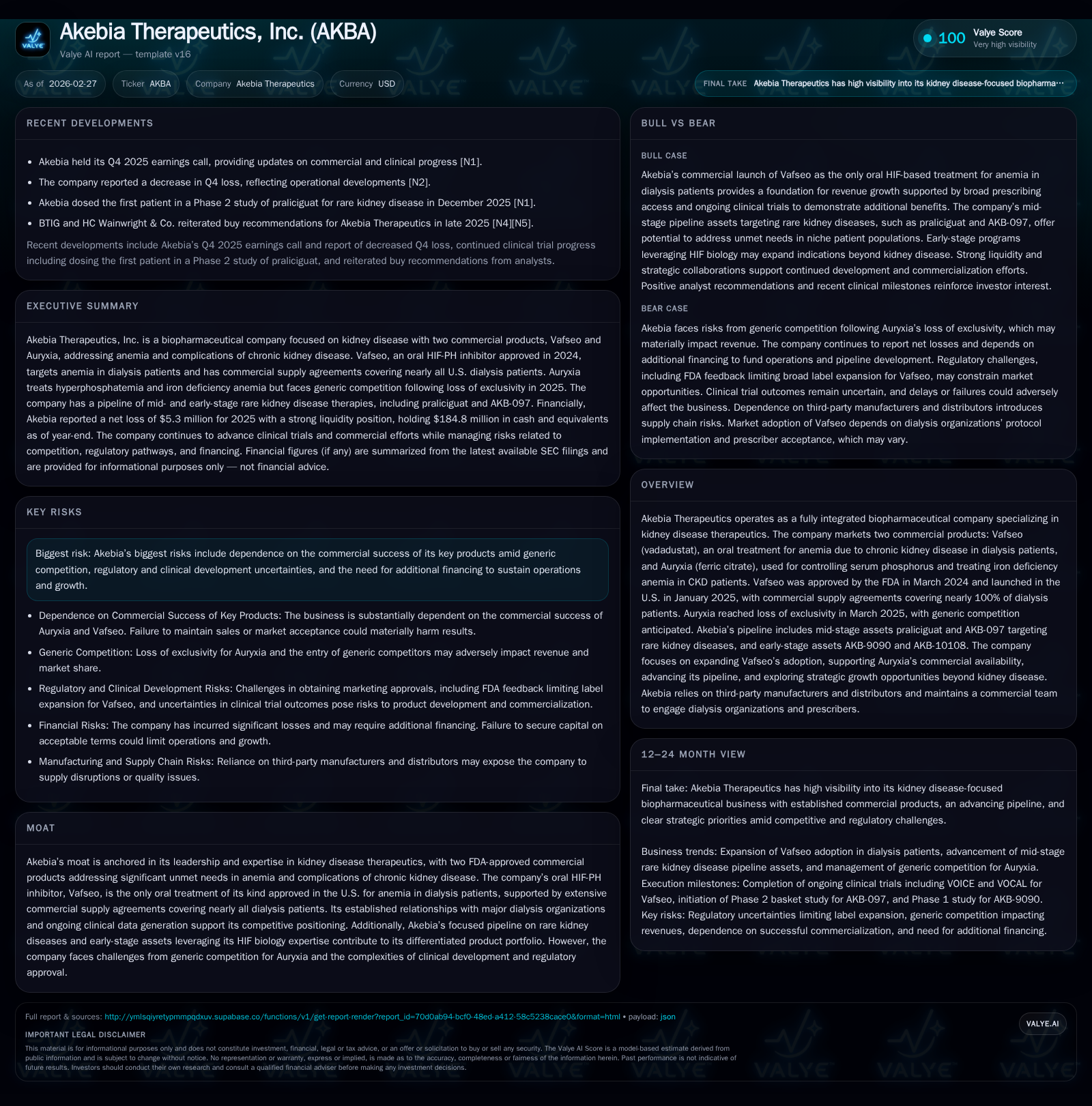
Akebia Therapeutics achieved a notable financial inflection in fiscal 2025, posting positive operating income for the first time driven by the FDA approval and U.S. launch of Vafseo, an oral HIF-PH inhibitor for anemia in dialysis patients. Despite operating profitability, the company’s net income remains negative due to prior costs and non-cash charges amid the ongoing impact of generic competition following Auryxia’s loss of exclusivity in early 2025. Akebia’s capital structure includes a $55 million senior secured term loan facility with covenants linked to minimum cash and revenue levels, highlighting liquidity management challenges. The mid-stage pipeline targeting rare kidney diseases offers strategic growth potential complementary to the established commercial portfolio.
From Losses to Operating Income Positive: Historical Financial Performance Overview
Akebia Therapeutics' financial profile unveiled a pronounced turnaround in fiscal year (FY) 2025. After enduring multiyear operating losses — peaking at an operating loss of approximately $80.8 million in FY2022 — the company achieved an operating income of $23.5 million by December 31, 2025 [F1]. This shift reflects successful commercialization efforts underpinned by new product launches.
Net income remains in negative territory at -$5.3 million for FY2025 but exhibits substantial improvement compared to -$69.4 million in FY2024 [F1]. The net loss reduction is attributable largely to increased revenues post-Vafseo approval balanced against non-cash expenses including amortization of intangibles and interest related to prior financing structures.
Operational cash flows reversed dramatically, exhibiting a positive inflow of approximately $68.0 million for FY2025 following severe outflows exceeding $40 million the prior year [F1]. Capital expenditures held steady and modest at roughly $291,000 — reflecting investments focused more on commercialization than expansive capacity or R&D expansion [F1].
Historical performance (annual)
| FY | Net ($mm) | CFO ($mm) | OpInc ($mm) | Capex ($) | Net YoY |
|---|---|---|---|---|---|
| 2025 | -5 | 68 | 23 | 291000 | +92.3% |
| 2024 | -69 | -41 | -50 | 33000 | -33.7% |
| 2023 | -52 | -23 | -46 | 0 | +44.9% |
| 2022 | -94 | -73 | -81 | 114000 |
Source: SEC companyfacts cache [F1].
Capital returns and efficiency (annual)
| FY | FCF ($mm) | ROE% |
|---|---|---|
| 2025 | 68 | -16.4 |
| 2024 | -41 | 141.1 |
| 2023 | -23 | 169.8 |
| 2022 | -73 | -1801.6 |
Source: SEC companyfacts cache [F1].
The absence of recognized revenue line items is consistent with accounting treatment; however operational metrics reflect underlying commercial progress as per disclosure[F1][S1].
Impact of Vafseo Launch and Market Dynamics on Revenue Growth Drivers
Central to Akebia's recent positive inflection is Vafseo (vadadustat), an oral hypoxia inducible factor prolyl hydroxylase (HIF-PH) inhibitor approved by the FDA in March 2024 for anemia due to chronic kidney disease (CKD) specifically in adult patients receiving dialysis [S1]. This modality differentiates from traditional erythropoiesis stimulating agents (ESA), offering ease of oral administration potentially improving compliance amid a market estimated near $1 billion based on ESA pricing.
Commercial launch commenced January 2025 with supply contracts covering nearly all U.S. dialysis patients (~290k individuals), facilitated through established relationships with major dialysis organizations including Fresenius Medical Care Rx and DaVita Inc., which command substantial share of dialysis volume nationally [S1][N1]. These prescriber protocol implementations within dialysis centers constitute critical uptake mechanisms driving adoption.
The novel oral HIF-PH inhibitor class positions Vafseo uniquely as the only approved oral therapy available for this patient segment within the U.S., signaling an important competitive advantage over injectable ESAs historically focusing on anemia management but often encumbered by route of administration burdens [S1]. Sustained education and clinical data generation support ongoing integration into treatment paradigms.
Navigating Generic Erosion: Auryxia Loss of Exclusivity and Its Consequences
While Vafseo builds momentum as a growth engine, legacy product Auryxia (ferric citrate) faces significant headwinds following U.S. loss of exclusivity (LOE) status reached in March 2025 [N3][S1]. This oral agent indicated for serum phosphorus control in dialysis-dependent CKD patients and iron deficiency anemia management has historically contributed meaningful revenues.
Generic competition has materialized rapidly post-LOE with Teva Pharmaceuticals Ltd.'s tentative approval noted by January 22, 2026 signaling imminent erosion pressures likely impacting prescription volumes and associated gross margins [N3][S1]. Akebia maintains strategies to support continued availability during transition phases but lacks patent protection exclusivity which typically cushions biopharma companies' revenues pre-generic entry.
Consequently, revenue contribution visibility from Auryxia is expected to diminish over coming quarters necessitating reliance on other growth avenues including Vafseo uptake and pipeline development.
Mid-Stage Pipeline Focused on Rare Kidney Diseases: Growth Opportunities Ahead
Beyond marketed assets lies a strategically curated mid-stage pipeline emphasizing rare kidney disease therapeutics that could extend Akebia’s addressable market footprint.
Key programs include praliciguat and AKB-097 under clinical evaluation targeting conditions such as diabetic nephropathy or rare glomerulopathies where endothelial dysfunction or fibrosis play pathogenic roles—mechanisms complementary yet distinct from HIF-PH inhibition leveraged by Vafseo [S1][N1]. Early-stage candidates AKB-9090 and AKB-10108 explore innovative modalities reinforcing scientific breadth.
This focused portfolio diversification strategy addresses unmet medical needs within nephrology while positioning Akebia as a specialized player leveraging cross-organizational expertise on kidney pathophysiology providing potential competitive differentiation amidst crowded CKD complication treatment landscape.
Capital Structure and Liquidity: Scrutinizing Loan Facilities and Cash Position
Akebia’s financial flexibility is materially shaped by its senior secured BlackRock Credit Agreement signed January 29, 2024 encompassing three tranches aggregating up to $55 million: Tranche A ($37M), B ($8M), and C ($10M) funded through February 3, 2025 [S1][S4][S5]. Maturing January 29, 2028 with an initial maturity extension contingent upon Vafseo approval showcases lender confidence linked directly to regulatory milestones.
Interest accrues at SOFR plus a margin of approximately 6.75%, subject to a floor rate of ~4.25% and aggregated cap of ~15%. Interest-only payments continue through December 31, 2026 before principal amortization begins via equal monthly installments through maturity [S4][S6][S7]. Failure on covenant thresholds—requiring either maintaining monthly-end cash balances above $15M or trailing twelve-month revenue above $150M—can trigger default remedies including acceleration risking liquidity squeeze [S4][S8].
The facility is collateralized extensively against nearly all company assets including intellectual property representing both leverage risk mitigation tools but also operational constraints especially absent forecasted revenue scale nearing covenant thresholds currently unmet given nascent commercialization phase.
The facility includes equity-linked warrants exercisable over eight years providing potential issuer dilution upon exercise; notable cashless warrant exercises occurred mid-2025 easing immediate dilution concerns but underscores intricate balance between debt servicing and shareholder value considerations [S4][S7].
At December 31 2025 cash & equivalents totaled approximately $185 million against current liabilities near $163 million resulting in a current ratio above 1.55 confirming adequate short-term liquidity underpinned by capital raises totaling more than $66 million primarily from public offerings reflecting robust financing execution capability [F1][S12][S18].
The combination of debt maturities commencing principal paydown post-2026 coupled with required covenant compliance necessitates vigilant cash flow forecasting aligned with commercial traction progression.
Analyzing Returns: Operating Cash Flow Surge Amid Negative Net Income
Fiscal year-end results reveal an impressive jump in operating cash flows generating approximately $68 million compared with significant prior year outflows [-$40.7M] despite persisting small net losses underscoring strong operational improvements likely tied to scaling commercialization infrastructure rather than expanded R&D spend which remains controlled evidenced by sub-$300K capex focused on maintenance rather than growth initiatives [F1].[N1]
This divergence suggests operational leverage effects kicking in post-launch enabling cash generation even if accounting net income remains impacted by non-cash expenses such as intangible amortization and settlement royalties accrued at high effective rates creating timing differences between profitability measures [F1][S6].
Return on equity approximates negative ~16%, greatly improved from double-digit losses prior but highlighting ongoing steps needed toward sustained profitability expansion as equity base stabilizes following capital raises that partially offset accumulated deficits [F1].
Key Milestones to Monitor: Clinical Progress, Commercial Expansion, and Financing Needs
Investor focus will keenly track several developing fronts given transitionary company stage:
- Expanded label indications or prescriber protocols broadening Vafseo use beyond dialysis populations increasing addressable patient count;
- Progression timelines for pivotal trials on praliciguat/AKB-097 determining potential regulatory submissions impacting long-term revenue ramp;
- Market penetration metrics with major dialysis providers reflecting adoption velocity versus entrenched ESAs;
- Upcoming debt principal repayment periods starting post-December 31 2026 testing cash generation sustainability;
- Potential additional equity offerings or alternative financing triggered if covenant thresholds tighten amidst unexpected operating costs or slower market uptake. These milestones collectively form an essential monitoring framework blending clinical advancement with commercial execution aligning capital stewardship constraints [N1][S2][S3].
Risk Factors Centered on Commercial Dependency and Regulatory Uncertainties
Despite tangible progress risks remain material:
- Heavy reliance on dual-product revenue base exposes financial stability to patent cliffs notably Auryxia’s generic pressures eroding formerly meaningful cash inflows challenging offset timing through Vafseo adoption;
- Pipeline clinical failures or regulatory delays typical within biopharma could disrupt growth projections undermining investor confidence;
- The BlackRock Credit Agreement introduces operational covenants restricting strategic flexibility under downside scenarios risking enforcement actions upon breach;
- Persistent net losses despite operating profit imply need for ongoing financing potentially dilutive affecting shareholder value dynamics;
- Competition from alternative therapeutic classes or generics represents continuous external threat necessitating sustained clinical evidence generation. These layered risks are explicitly flagged within SEC filings underscoring inherent developmental-commercial balancing acts for emerging biopharma focused on specialty kidney disease treatment innovation [S1][S2][S15][S16]
This analysis synthesizes publicly available financial filings alongside company disclosures without offering investment guidance. It reflects conditions as of reported periods up to FY2025 ending December 31.
Disclaimer: This is research-only, informational analysis and not investment advice. It may include AI-generated interpretation and general industry context. Always verify important details using primary sources.

Comments