
Alchemy Investments Acquisition Corp 1: Navigating the SPAC Lifecycle Toward Litigation Finance Public Market Entry
With a pending merger to take Cartiga public, Alchemy Investments Acquisition Corp 1 embodies the typical SPAC challenges pre-combination, balancing liquidity strain and execution risk against the potential to pioneer a litigation finance asset management platform in public markets.
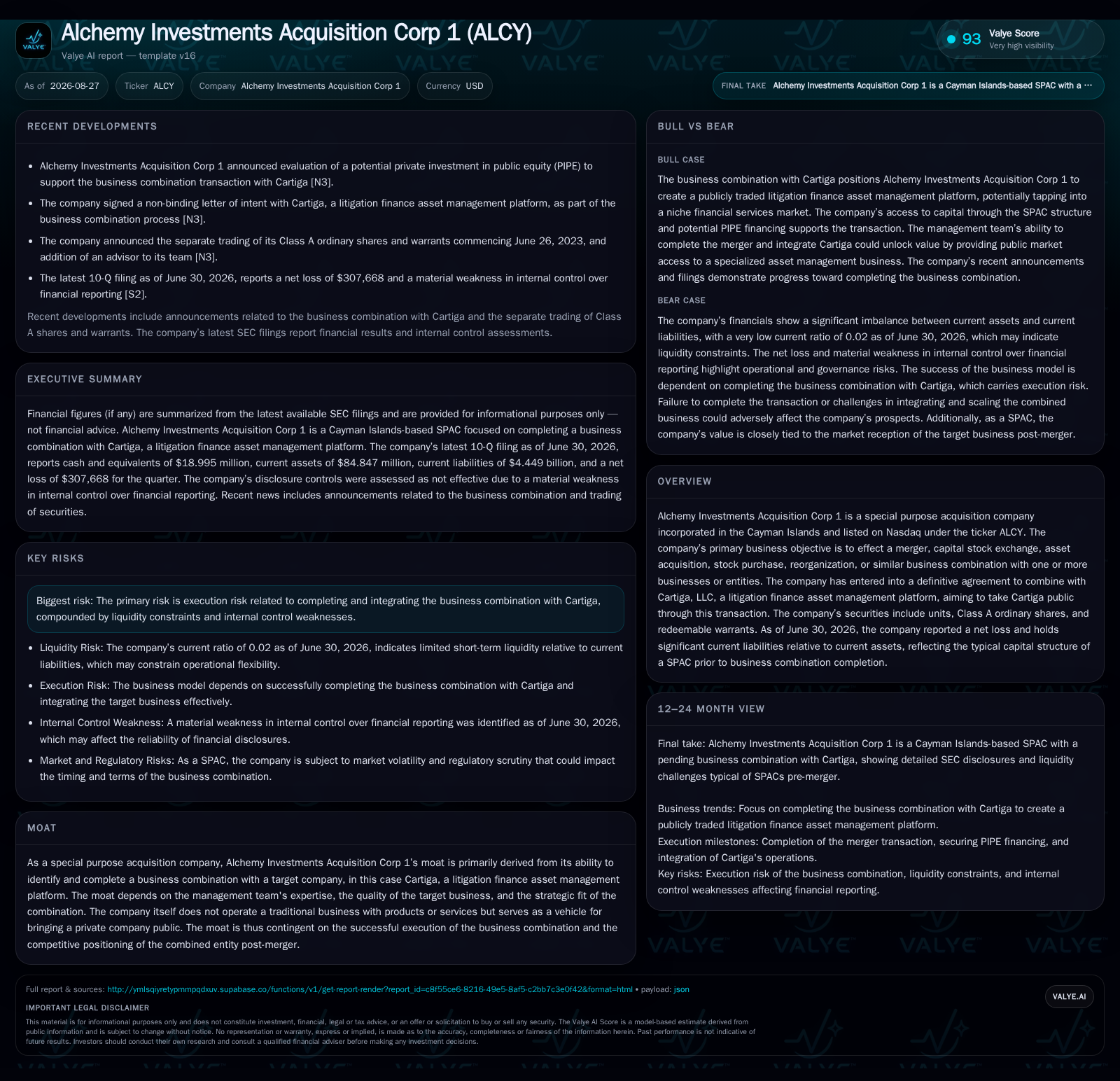
Alchemy Investments Acquisition Corp 1 (ALCY) is a Cayman Islands-incorporated SPAC focused on merging with Cartiga, a litigation finance asset manager, to create a publicly traded platform. It currently faces liquidity pressures and operational control gaps typical before a de-SPAC event. Its business model is transactional, relying on completing the merger and securing PIPE financing. The combined entity's success hinges on effective integration and market reception of litigation finance strategies, a niche with uncertain adoption curves and competitive dynamics. Key risks include execution failure and financial reporting weaknesses, while the upside depends on unlocking a new investment category in public markets.
Alchemy Investments Acquisition Corp 1 (ALCY) typifies the SPAC lifecycle stage prior to business combination: it holds limited operating assets, a constrained liquidity profile, and a strategic focus on completing a merger with Cartiga, a litigation finance asset management platform. This transition could open public market access to a specialized alternative asset class but hinges critically on execution and integration amid operational control challenges. The firm’s valuation and investor confidence will depend on its ability to convert the SPAC shell into a viable, transparent, and scalable public investment vehicle in litigation finance, a domain with complex risk and return dynamics.
Latest Operating Snapshot
As of June 30, 2026, Alchemy Investments Acquisition Corp 1 reported cash and cash equivalents of $18.995 million against current assets totaling $84.847 million, but current liabilities stood at a staggering $4.449 billion, yielding a current ratio of 0.02 and a cash ratio effectively at zero [S2]. This disparity underscores the typical capital structure of a SPAC before completing its business combination, where liabilities include redeemable warrants and other obligations associated with the trust account and financing arrangements.
The company has entered a definitive merger agreement with Cartiga, LLC, aiming to take this litigation finance-focused asset management platform public via the SPAC route [S1][N3]. Concurrently, Alchemy is evaluating a private investment in public equity (PIPE) to bolster capital for the transaction, a critical step given its current liquidity constraints [N3]. However, its latest 10-Q filing also reveals a net loss of $307,668 for the quarter and a material weakness in internal controls over financial reporting, highlighting governance and operational risks as it approaches the business combination milestone [S2].
Business Model and Unit Economics
Alchemy Investments Acquisition Corp 1 operates as a special purpose acquisition company (SPAC), generating value primarily through its ability to identify, finance, and consummate a merger with a target private company—in this case, Cartiga. The SPAC itself does not generate operating revenue or traditional unit economics. Instead, its business model is transactional and capital-intensive in the pre-merger phase, relying on capital raised in its IPO and any PIPE investments to fund operating expenses and the eventual merger consideration.
Post-merger, the economics will depend on Cartiga’s asset management fees, performance fees, and scale of litigation finance assets under management (AUM). Litigation finance typically involves non-correlated, high-risk, alternative assets where managers charge management fees on committed capital and performance fees on realized recoveries. Operating leverage could emerge if Cartiga scales AUM efficiently, but regulatory compliance and legal due diligence in litigation finance impose fixed-cost burdens. Switching costs may be moderate in asset management, but differentiated deal sourcing and track record can provide some client retention advantages. The key question is whether the merged company can achieve sufficient scale and fee structures to overcome the inherent capital intensity and operational complexity of litigation finance asset management.
Moat, Competition and Counterforces
As a SPAC, Alchemy Investments Acquisition Corp 1’s moat is limited and contingent on the management team’s ability to successfully close and integrate the Cartiga merger. The intrinsic moat will derive primarily from Cartiga’s competitive positioning in litigation finance asset management post-merger. Litigation finance is a niche alternative investment sector characterized by high barriers to entry due to the need for legal expertise, capital allocation acumen, and access to proprietary deal flow.
However, the sector is becoming increasingly competitive with emerging specialized funds, private equity entrants, and traditional asset managers expanding into litigation finance. Regulatory scrutiny and evolving legal frameworks create both barriers and risks to incumbency. The newly public entity will face pressure to demonstrate transparent governance and compliance to build investor trust. Market acceptance of litigation finance as a public asset class remains uncertain, potentially limiting pricing power and growth. Counterforces include liquidity risk inherent to SPACs, potential dilution from PIPEs and warrants, and competitive innovation in alternative asset management.
Bull Case
The bull case for Alchemy hinges on the successful closing of the Cartiga merger and the subsequent establishment of a publicly traded litigation finance asset management platform—a relatively untapped niche in public markets. If Cartiga can scale AUM by leveraging its specialized expertise, proprietary deal sourcing, and risk-adjusted return profile, the combined entity could capture investor interest seeking diversification and non-correlated alpha alternatives. Access to PIPE financing would ensure sufficient capital to support growth and operating leverage.
Confirming evidence would include timely merger completion, robust PIPE subscription, and early post-merger growth in AUM and fee income. Positive market reception reflected in share price appreciation and stable financial reporting controls would further support this scenario. Falsification would occur if the merger is delayed or fails, PIPE funding falls short, or early operating results demonstrate poor integration or weaker-than-expected asset performance, undermining investor confidence.
Base Case
In the base case, Alchemy completes the merger with Cartiga within the expected timeline, leveraging PIPE capital to shore up liquidity and operational capabilities. Post-merger, the combined company achieves moderate growth in litigation finance AUM and fee generation, reflecting gradual market acceptance of litigation finance as an asset class. The integration challenges are managed but limit rapid scaling, while internal control weaknesses are addressed over time without material restatements or governance issues.
This scenario assumes steady but unspectacular financial performance, with the SPAC’s initial liquidity constraints mitigated by transaction financing. Investor sentiment remains cautious but stable, with share price volatility reflecting typical post-SPAC market dynamics. Monitoring would focus on execution milestones, operational integration, and incremental improvement in financial controls and reporting transparency.
Bear Case
The bear case involves failure to complete the merger or severe setbacks during integration, exacerbated by Alchemy’s acute liquidity mismatch and internal control deficiencies. In this scenario, PIPE financing either is insufficient or fails to materialize, leaving the SPAC unable to fund operations or meet financial obligations. Operational governance weaknesses may lead to financial misstatements or regulatory scrutiny, further eroding investor confidence.
Additionally, market skepticism toward litigation finance as a nascent public asset class could depress valuation and impair access to capital. Confirming evidence includes prolonged merger delays, negative regulatory findings, deterioration in financial reporting reliability, and widening losses post-merger. Falsification would be successful transaction closure with improving controls and supportive investor response.
What Matters Next
Key near-term indicators include: (1) Completion status and timing of the Cartiga merger; (2) PIPE financing amount raised and terms secured; (3) Progress in remediating internal control material weaknesses and auditor assessments; (4) Litigation finance AUM growth and fee revenue reported post-merger; (5) Regulatory developments affecting litigation finance asset management; (6) Market reception measured through share price performance and trading volumes; (7) Updates on warrant exercises and dilution impact; and (8) Management disclosures regarding integration milestones and operational scaling plans.
These metrics will illuminate execution risk, operational progress, and market acceptance trajectory. Since many are not currently disclosed, investor attention to SEC filings, investor presentations, and earnings calls post-merger will be critical to assess evolving fundamentals and validate or refute the strategic thesis behind Alchemy’s transformation.
Disclaimer: This is research-only, informational analysis and not investment advice. It may include AI-generated interpretation and general industry context. Always verify important details using primary sources.

Comments