
Aldeyra Therapeutics' Prospects and Challenges in Dry Eye Disease Market
Aldeyra Therapeutics' clinical and regulatory journey with reproxalap critically shapes its financial health and strategic partnerships as it approaches a key FDA decision.
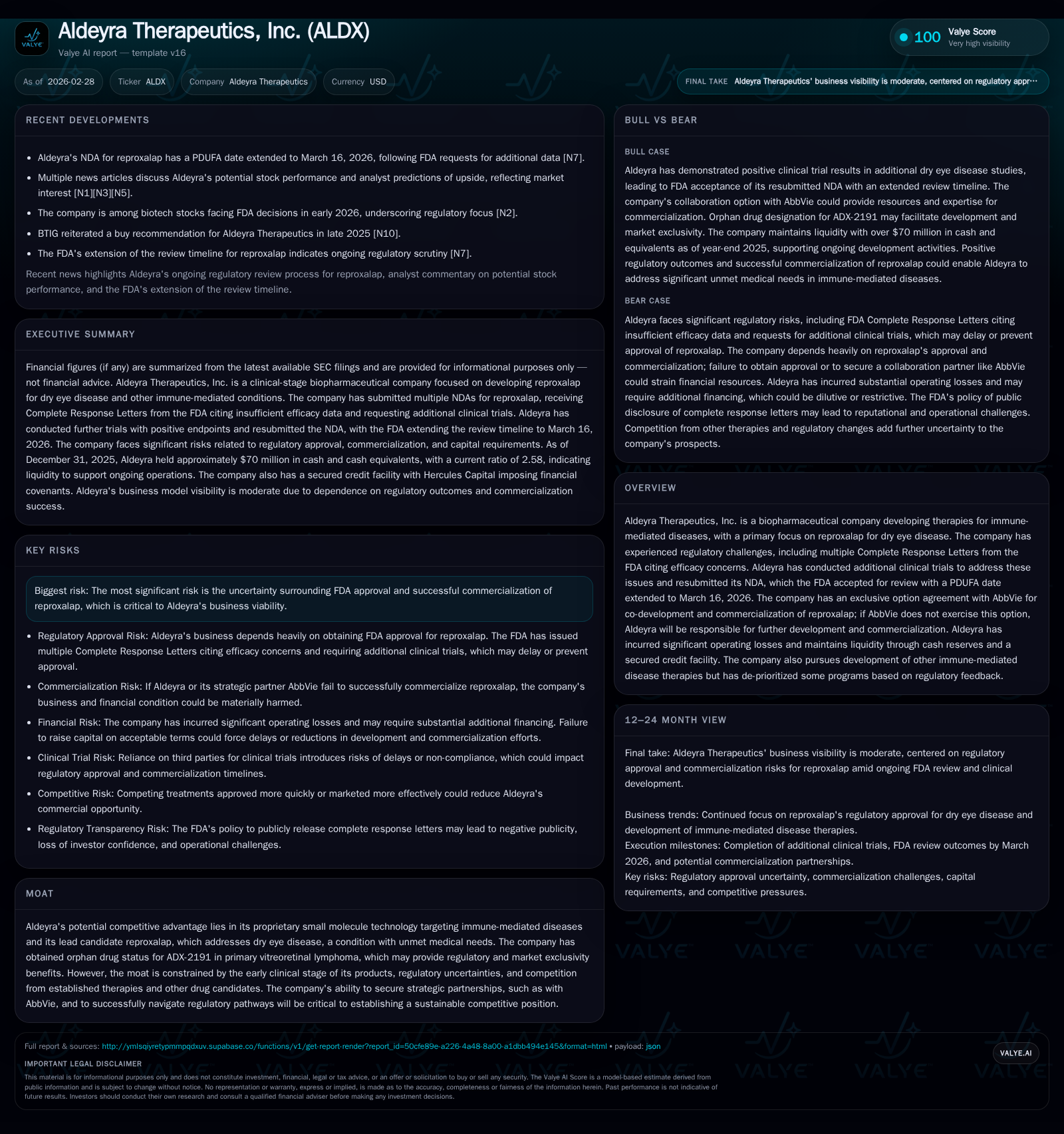
Aldeyra Therapeutics centers its development and commercial ambitions on reproxalap, a small molecule therapy targeting dry eye disease, facing significant regulatory hurdles evidenced by multiple Complete Response Letters from the FDA. The company’s historical operating losses persist, reflecting heavy R&D investment amid uncertainty over market approval and commercialization timelines. Partnerships, notably the exclusive option with AbbVie, offer strategic avenues to mitigate development risk but leave Aldeyra exposed if such collaborations do not materialize. Upcoming milestones include an FDA PDUFA date in March 2026, which will be pivotal for revenue prospects and capital allocation strategies. Beyond reproxalap, Aldeyra’s pipeline remains early stage with orphan drug status for ADX-2191 highlighting potential long-term diversification.
Historical Performance Backdrop: Operating Loss Trends and Development Investments
Aldeyra Therapeutics has sustained significant operating losses across recent years reflective of its focus on late-stage clinical development without commercial products generating revenue. From FY2022 to FY2025, operating income remained negative, though the scale of losses improved notably in FY2025 where operating loss narrowed by over 40% year-over-year to approximately -$35.3 million [F1]. Net losses followed a similar trend, reducing from about -$62 million in FY2022 to roughly -$33.8 million in FY2025 [F1]. These dynamics indicate some cost discipline or optimized spending patterns but still underscore heavy investment in advancing reproxalap through the regulatory gauntlet.
Operating cash flow also remains negative but displayed a similarly improved trajectory from approximately -$56.6 million in FY2022 to -$33.3 million in FY2025 [F1]. Capital expenditures have been negligible over this period, typically under $20,000 annually or zero most recently [F1], underscoring that Aldeyra's cash consumption is overwhelmingly operationally oriented rather than driven by fixed asset investment.
Historical Financial Performance Summary (FY2022-FY2025)
Historical performance (annual)
| FY | Net ($mm) | CFO ($mm) | OpInc ($mm) | Capex ($) | Net YoY |
|---|---|---|---|---|---|
| 2025 | -34 | -33 | -35 | +39.4% | |
| 2024 | -56 | -43 | -60 | -48.8% | |
| 2023 | -38 | -30 | -43 | 0 | +39.5% |
| 2022 | -62 | -57 | -63 | 16317 |
Source: SEC companyfacts cache [F1].
Capital returns and efficiency (annual)
| FY | FCF ($mm) | ROE% |
|---|---|---|
| 2025 | -76.5 | |
| 2024 | -78.7 | |
| 2023 | -30 | -31.3 |
| 2022 | -57 | -41.1 |
Source: SEC companyfacts cache [F1].
Key Growth Drivers to Date: Clinical Progress, FDA Feedback, and AbbVie Partnership Setup
Aldeyra's narrative has been increasingly shaped by its lead candidate reproxalap's progression through the FDA's regulatory scrutiny after original submissions resulted in multiple Complete Response Letters citing efficacy concerns [N1][N2][S1]. In response, Aldeyra conducted further clinical studies demonstrating efforts to address the agency's issues.
The resubmitted New Drug Application (NDA) was accepted by the FDA with a scheduled Prescription Drug User Fee Act (PDUFA) date extended to March 16, 2026 [N2][S1]. This milestone represents a binary event for market entry potential.
Strategically important is Aldeyra’s exclusive option agreement with AbbVie granting them rights for co-development and commercialization of reproxalap [N1][N2][S1]. While this partnership framework offers risk-sharing benefits and access to AbbVie's commercial infrastructure should they exercise their option, Aldeyra retains responsibility if AbbVie opts out — exposing it to direct development costs and commercialization challenges.
Regulatory Challenges and Their Impact on Revenue Prospects
Central to Aldeyra's future is overcoming persistent regulatory headwinds highlighted in filings [S1],[S2]. The Complete Response Letters previously issued by the FDA explicitly questioned reproxalap’s efficacy data necessitating further trials and evidence submission before reconsideration.
This underpins how FDA approval remains the defining bottleneck for transitioning Aldeyra from a development-stage entity into a revenue-generating biopharma company.
The timelines could be subject to delays should there be additional information requests from the agency or adverse outcomes from confirmatory trials.
Successful FDA approval will initiate downstream challenges including payer negotiations concerning pricing policies amidst tightening healthcare cost controls described within regulatory risk disclosures [S15]. Reimbursement uncertainties compound commercialization risks even post-approval.
Pipeline Prospects Beyond Reproxalap: Immunology Focus and Orphan Drug Potential
While reproxalap defines Aldeyra's immediate commercial narrative, its broader pipeline is nascent but carries strategic importance for diversification. Of particular note is ADX-2191 which holds orphan drug designation targeting primary vitreoretinal lymphoma — conferring exclusivity benefits that can extend market protection upon approval .
However, the early developmental stage limits its current contribution to business valuation or near-term financial impacts. Success here remains speculative though important as potential backstop growth beyond dry eye disease.
Capital Structure, Liquidity Position, and Cash Burn Dynamics
Financial stability at this clinical juncture depends on cash runway adequacy to sustain costly trials while managing operational overheads. As of FY2025 year-end, cash and equivalents totaled roughly $70 million supporting a current ratio above 2.5 which indicates solid short-term liquidity coverage [F1].
A secured credit facility with Hercules Capital supplements this reserve allowing access to debt capital if needed but entails operational covenants potentially restricting future flexibility [S8].
Cash burn has trended lower year-over-year correlating with reduced operating losses though remaining substantial near-$33 million levels annually [F1][S8]. This constant outflow underlines intense clinical-stage cash burn profiles typical among comparables pursuing late-phase approvals.
Return Metrics and Capital Allocation Strategy Amid Operating Losses
Reflecting sizable net losses against relatively diminished equity at approximately $44 million at fiscal year-end, the computed return on equity (ROE) stands near negative 76.5%, emblematic of developmental biotech companies yet to reach profitability [F1].
Capital allocation remains heavily skewed towards internal investments principally R&D rather than shareholder distributions; there are no dividends or share repurchase programs deployed indicating reinvestment priority given the critical development status.
This approach aligns well with industry norms where conserving funds for late-stage trial expense management typically supersedes direct owner returns.
Market Expectations and Analyst Sentiment Ahead of the PDUFA Decision
Market commentary evidences cautious optimism ahead of the upcoming PDUFA event scheduled March 16, 2026 [N3][N5]. Analysts estimate upside price potentials ranging broadly above 60%, anchoring expectations on positive clearance outcomes enabling commercialization pathways.
Investor interest has been notable considering Aldeyra's outperforming trend relative to medical sector peers year-to-date [N1][N6], reflecting speculative enthusiasm tethered primarily to regulatory catalysts rather than confirmed sales metrics given absence of marketed products.
Risks from Competition, Regulatory Delays, and Financing Needs
Risk factors documented extensively in the company’s most recent filings highlight multifaceted threats including intensified competition from alternative therapies under development targeting immune-mediated diseases that could erode market share if approved prior [S4][S5][S6].
Further regulatory uncertainties encompass potential delays beyond current expectations which could exacerbate capital requirements forcing additional financing rounds under less favorable terms.[S8]
Additionally, sales activities must conform strictly with anti-kickback provisions and other healthcare compliance regulations aimed at curbing fraudulent inducements—important legal risks that pose reputational damage threats or sanctions if breached inadvertently [S4][S10][S16].
These layered challenges emphasize prudence incumbent upon management as it navigates towards prospective value inflection points hinging on reproxalap’s successful USA market entry.
Disclaimer: This report synthesizes publicly available information including SEC filings and news sources without introducing forward-looking projections beyond provided data. It does not constitute investment advice or recommendations but aims to deliver an informed analytical perspective on Aldeyra Therapeutics’ business trajectory.
Disclaimer: This is research-only, informational analysis and not investment advice. It may include AI-generated interpretation and general industry context. Always verify important details using primary sources.

Comments