
Alpha Modus Accelerates Patent Monetization While Addressing Liquidity and Market Risks
The latest quarterly filing underlines Alpha Modus' intensified IP enforcement efforts alongside challenges in liquidity and operational losses.
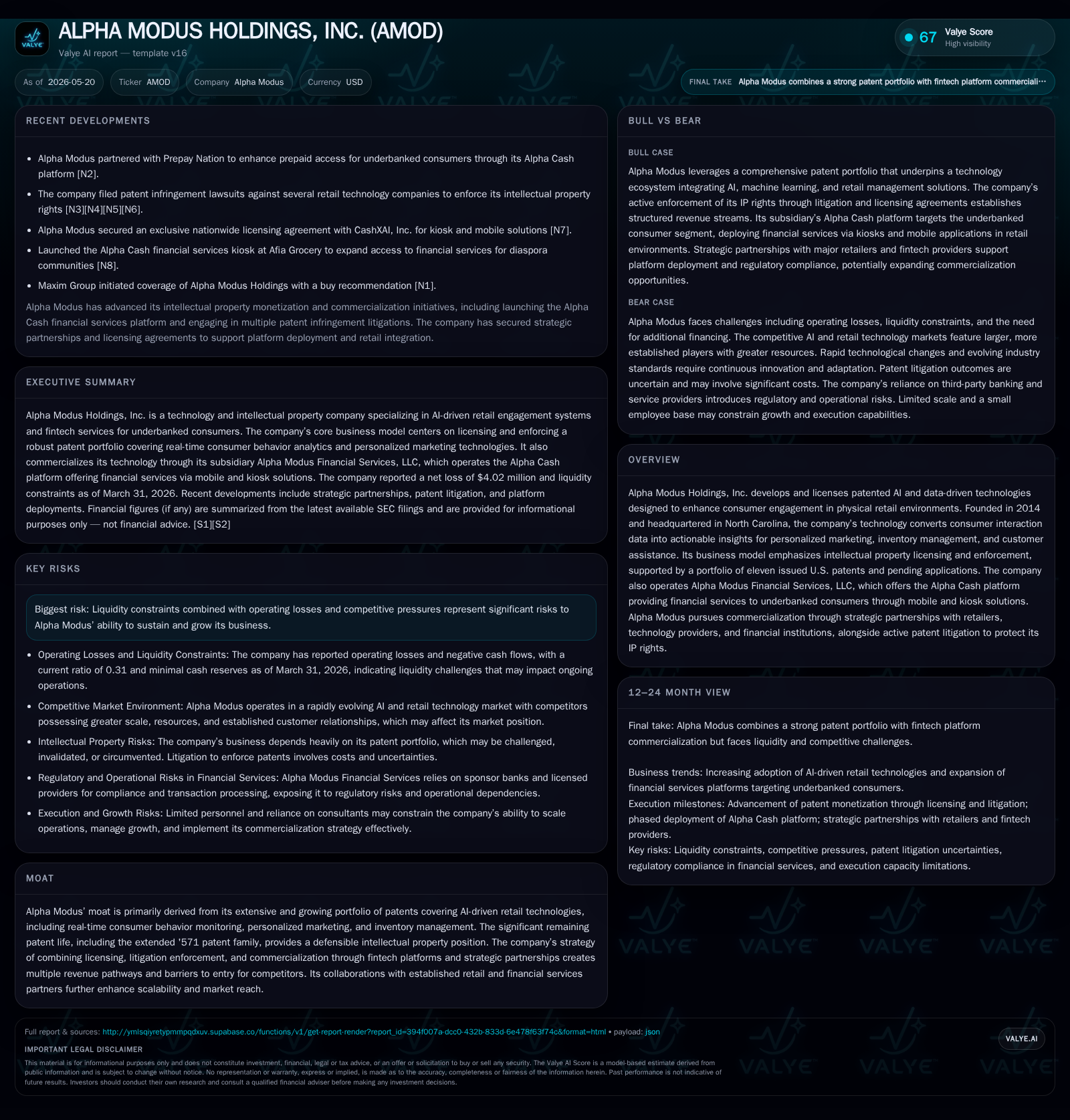
Alpha Modus Holdings, Inc. is sharpening its intellectual property monetization strategy as showcased in its May 14, 2026, quarterly filing, focusing on licensing and enforcing a growing portfolio of AI-driven retail patents. Concurrently, the company advances the commercialization of its Alpha Cash fintech platform designed for underbanked consumers. However, liquidity pressures are acute with a low current ratio and ongoing operating losses, raising near-term financial sustainability concerns. The path forward hinges on successful litigation outcomes, expanded fintech deployments, and securing additional financing.
Latest Quarterly Update Highlights and Significance
In its Form 10-Q filed May 14, 2026 [S2], Alpha Modus Holdings revealed an acceleration of its patent monetization strategy through active support of patent litigation via funding agreements. These arrangements aim to bolster the company’s ability to enforce its proprietary technologies through legal channels—a centerpiece of its revenue generation model. Concurrently, the filings reaffirm ongoing commercialization activities of the Alpha Cash platform managed by Alpha Modus Financial Services (AMFS), which focuses on delivering financial services to underbanked consumers through both mobile app and kiosk solutions deployed in retail environments.
Despite these business development strides, the company’s liquidity position appears notably stressed. The latest financials show current assets totaling approximately $2.51 million contrasted against current liabilities exceeding $8.05 million, yielding a current ratio near 0.31 — indicative of tight working capital conditions [F1]. This imbalance raises immediate concerns about the firm's short-term operational funding capabilities.
Moreover, continued operating losses were reported for fiscal year-end 2025 totaling over $5.24 million [F1], underscoring persistent cash flow challenges that accompany an intensive patent enforcement focus and early-stage fintech commercialization.
Business Model: Licensing AI-Driven Retail Patents and Fintech Platform
Alpha Modus’ business model is architected around monetizing a valuable intellectual property portfolio targeting artificial intelligence applications in physical retail environments. The company licenses patented systems that gather and analyze real-time consumer interaction data at or near points-of-sale to generate actionable insights supporting personalized marketing campaigns, dynamic inventory management (smart planograms), customer assistance alerts to reduce shrinkage, and tailored digital advertising [S1][S6][S7].
Revenue flows primarily from intellectual property licensing fees paid by retailers, advertising technology firms, brands leveraging digital engagement tools, and technology integrators authorized to resell or embed Alpha Modus’ patented innovations [S23]. Alongside licensing income is an enforcement dimension—patent litigation efforts against alleged infringement serve both as revenue drivers via settlements or awards and as barriers to unauthorized usage by competitors.
Parallel to this IP-centric axis is the fintech segment operated through AMFS delivering transaction-based financial services aimed at underbanked populations [S27]. Through the Alpha Cash platform—which includes proprietary kiosk hardware manufactured via partners like Genmega Inc. and integrated through software vendors such as Uptiq—the company offers check cashing, bill payments, prepaid products, mobile top-ups, event ticketing distribution (via agreements with Tickets For Less), money transfers, and related transactional services [S6][S12][S18]. Revenue here derives from service commissions and transaction fees fostered by partnerships with banking sponsors responsible for regulatory compliance.
The two-pronged model integrates licensing/licensing enforcement plus fintech commercial deployment within an ecosystem that leverages patented AI technology infrastructures for data analytics combined with networked service provision platforms.
Competitive Landscape and Intellectual Property Moat
Alpha Modus positions itself within a niche intersection of AI-enabled retail analytics and fintech servicing underserved consumer segments. Its competitive moat derives largely from an extensive portfolio of U.S. patents—eleven issued plus pending applications—that cover real-time shopper behavior monitoring technology implemented at physical retail points [Valye report excerpt; S1]. Central among these is the ‘571 patent family first issued in 2019 which lays foundational claims over methods transforming consumer interactions into personalized digital marketing cues.
This IP base affords strong legal leverage to pursue unauthorized users within complex retail ecosystems where incumbents increasingly deploy AI solutions but may infringe due to overlapping technological innovation zones. Litigation funding agreements notably enhance Alpha Modus’ capacity to sustain prolonged enforcement campaigns that smaller players might avoid due to cost or risk aversion [S4]
Strategic alliances further reinforce competitive positioning—partnering with established players like VSBLTY Groupe Technologies expands distribution channels while agreements with DXC Technology support enterprise deployment infrastructure [S6][S18]. These relationships create switching cost elements for customers considering alternative providers by embedding Alpha Modus IP deeply within their operational tech stacks.
Strategic Growth Drivers: Patent Monetization and Alpha Cash Expansion
Alpha Modus identifies two primary drivers fueling growth: expansion of licensed IP revenue via new partnerships/enforcement resolutions and scale-up of transaction volume through Alpha Cash rollout.
The licensing pipeline includes undisclosed confidential arrangements with technology integrators whose reselling rights broaden geographic reach while enabling cross-selling of additional services within their platforms [S23]. Litigation settlements or successful awards represent intermittent yet potentially sizable upsides contributing to lump-sum revenues or royalty streams.
On the fintech side, pilot programs initiated in 2026 with national retailer partners target staged deployment across multiple store locations subject to performance benchmarks [S18]. Partnership negotiations such as the non-binding letter of intent with SurgePays indicate ongoing efforts to extend service offerings into telecommunications payment markets [S12].
KPIs likely monitored include number of active kiosks/mobile users on Alpha Cash, transaction counts/value processed monthly, number of executed licensing contracts per quarter, royalty rate validation from resellers/licensees, plus milestones reached in enforcement resolutions.
Sector research corroborates these approaches’ relevance; industry data projects rapid AI adoption growth in retail signage/kiosks (~52% retailer penetration) along with doubled-digit CAGR forecasts (>18%) for financial service kiosks catering to underbanked demographics through 2028 [S20]
Key Risks and Constraints: Liquidity, Operating Losses, and Competition
Patent enforcement costs are inherently unpredictable and can consume resources without guaranteed successful recoveries [S26][S28]. Changes in U.S./foreign patent law also introduce uncertainties regarding enforceability scope or recovery levels particularly given ongoing debates surrounding AI-related intellectual property protections.
Competition exists not only from alternative AI analytics providers embedding heterogeneous machine-learning models at retail locations but also from emerging fintech platforms targeting convenience-oriented consumers. Larger incumbents possess scale advantages while some startups may offer more agile customer-facing service experiences.
The Company’s concentrated IP portfolio mandates continued investment in legal defenses alongside costly scaling of AMFS platform operations including compliance oversight across multiple jurisdictions—a dual pressure on financial resources exacerbated by limited cash reserves reported ($11.8K at end CY2023) versus debt levels near $629K as per latest available data [F1]. Without securing additional financing or generating substantial positive cash flow soon, growth could be materially hindered.
Upcoming Catalysts and Execution Milestones to Monitor
Key indicators supporting valuation views or operational momentum include: - Resolution outcomes from ongoing patent litigations potentially increasing royalty inflows or one-time settlement gains. - Expansion progress of the Alpha Cash platform beyond pilot phases—including user adoption rates measured by kiosk activations or mobile app transactions within partnered retail locations. - Formalization of collaboration agreements such as those currently contemplated (e.g., SurgePays letter of intent) broadening product ecosystems offered via AMFS. - Announcements regarding equity raises or debt refinancing arrangements that alleviate liquidity constraints enabling sustained commercialization investments. - Evidence of scaling internal teams supporting IP sales/licensing along with backend technical/service infrastructure improvements enhancing platform reliability/reach [S2][S3]. These milestones would clarify whether Alpha Modus can transition past early-stage loss-making phases toward sustainable monetization leveraging its unique asset base.
Financial Overview: Balance Sheet Health and Cash Flow Considerations
From the latest data culminating March 31, 2026 [F1], key financial indicators paint a challenging picture: current assets stand at approximately $2.51 million versus liabilities over $8 million driving a suboptimal current ratio near 0.31—commonly viewed as indicative of working capital strain.
These figures substantiate auditor statements expressing substantial doubt about continuation as a going concern absent successful monetization turnarounds or financing availability articulated within recent SEC filings [S1][S2]. In this light, ongoing commercial successes must translate swiftly into positive cash flow contributions while management pursues prudent cost controls to preserve limited resources amid competitive intensity.
Disclaimer: This analysis synthesizes publicly filed SEC documents without offering investment research views or price forecasts. It reflects operating conditions current as of Q1/Q2 2026 filings but does not speculate beyond documented information.
Disclaimer: This is research-only, informational analysis and not investment advice. It may include AI-generated interpretation and general industry context. Always verify important details using primary sources.

Comments