
Amerant Bancorp's Financial Rebound and Strategic Refocus in Florida Markets
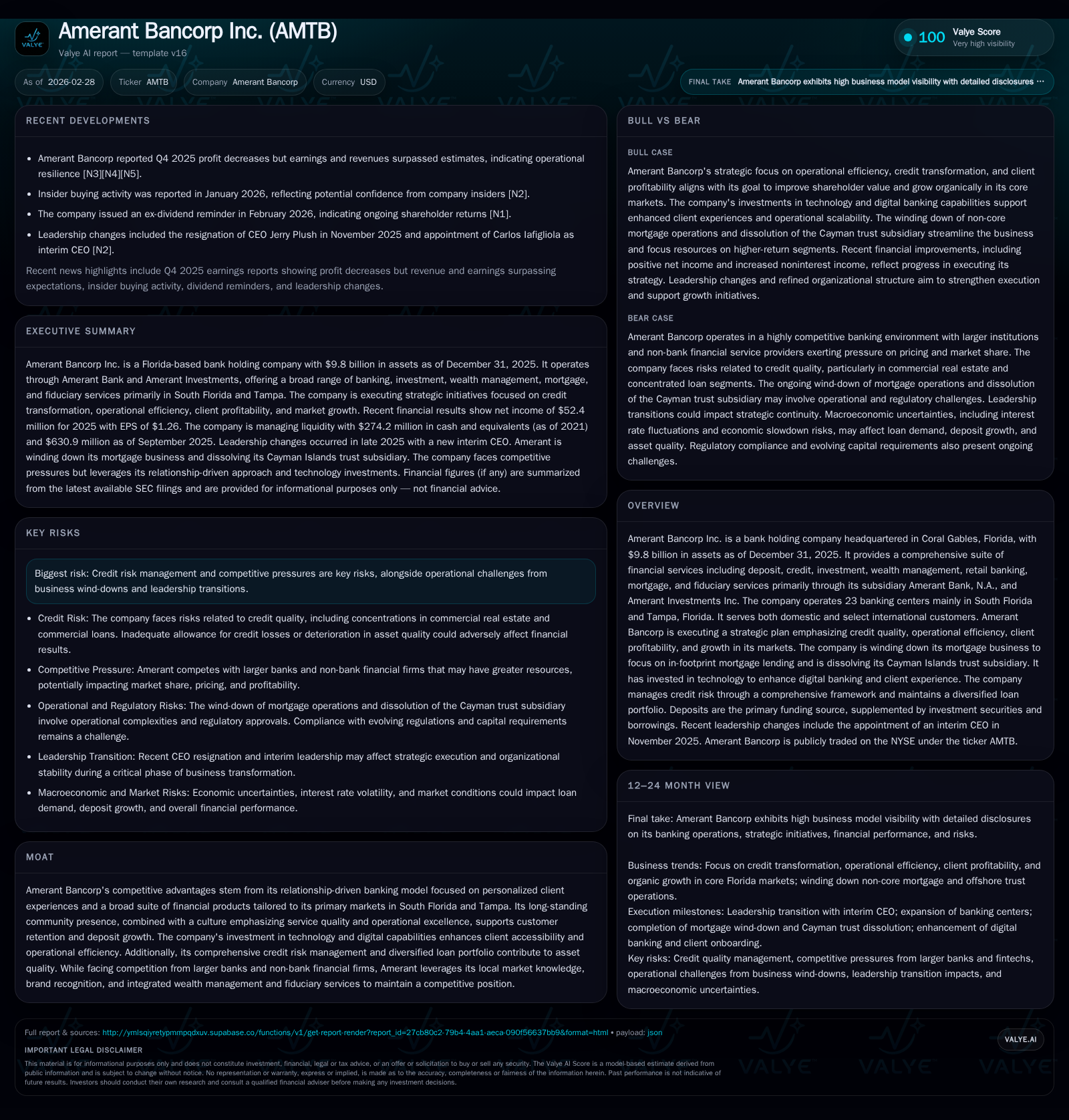
Amerant Bancorp returned to profitability in 2025 through disciplined credit management and strategic local market expansion, reflecting a comprehensive shift in its business model and capital deployment amid operational changes.
Amerant Bancorp reversed losses from 2024 to post a net income of $52.4 million in 2025, driven by improved asset quality, credit risk oversight, and operational efficiencies. The company strategically downsized its broader mortgage operations to concentrate on in-footprint loans while extending its banking presence across South Florida and Tampa. Capital allocation favored shareholder returns including buybacks and dividends alongside investments in digital banking platforms. Key risks remain focused on credit management, competition, and operational challenges tied to business wind-downs.
Financial Performance Evolution: From Losses to Returned Profitability
Amerant Bancorp demonstrated a pronounced financial turnaround between fiscal years 2024 and 2025. The company reported net income of $52.4 million for the year ended December 31, 2025, compared with a net loss of $15.7 million in 2024 [F1]. This reversal was grounded in improved asset quality stemming from enhanced credit risk management practices and a focus on operational efficiency.
Operating cash flow (CFO) more than doubled from $82.2 million in 2024 to nearly $137.0 million in 2025, signaling steady underlying liquidity improvements [F1]. Capital expenditures remained relatively stable at approximately $7.7 million after a slight increase over 2024 outlays, reflecting continued investment in technology platforms rather than expansionary physical assets alone [F1]. Shareholders' equity increased to about $939 million by year-end 2025 from $890 million the prior year, supporting capital resilience.
Historical performance (annual)
| FY | Net ($mm) | CFO ($mm) | Capex ($mm) | Net YoY |
|---|---|---|---|---|
| 2025 | 52 | 137 | 8 | +432.8% |
| 2024 | -16 | 82 | 7 | -148.5% |
| 2023 | 32 | 27 | 11 | -48.7% |
| 2022 | 63 | -49 | 11 |
Source: SEC companyfacts cache [F1].
Capital returns and efficiency (annual)
| FY | Div ($mm) | Buybacks ($mm) | FCF ($mm) |
|---|---|---|---|
| 2025 | 15 | 33 | 129 |
| 2024 | 13 | 8 | 75 |
| 2023 | 12 | 5 | 16 |
| 2022 | 12 | 72 | -60 |
Source: SEC companyfacts cache [F1].
Note: YoY percentages calculated based on sequential fiscal year comparisons; capex values reflect prudent investment post restructuring [F1].
Strategic Business Model Shifts and Market Expansion in Florida
Amerant’s strategy pivot involves tapering its broader mortgage operation to focus exclusively on mortgage lending within its primary geographic markets—South Florida and Tampa—where it operates most of its banking centers [S1][N2]. This deliberate narrowing aligns with the ongoing dissolution of its Cayman Islands trust subsidiary as client relationships transition back under domestic regulatory frameworks.
The firm’s geographic presence has been reinforced by adding five banking centers between April 2025 and January 2026, including new offices in West Palm Beach, Miami Beach, Bay Harbor Islands, and multiple sites across Tampa [S1]. A further center slated for St. Petersburg received regulatory approval mid-2025 with opening anticipated during this year [S1]. These openings intensify the relationship-driven local banking model emphasizing deep community ties against competition from larger regional institutions.
This geographic consolidation paired with product refocus enhances operational streamlining while offering integrated wealth management products tailored for high-net-worth clients concentrated in these regions [S24]. Amerant’s dual domestic-international customer base is chiefly rooted within Florida's communities but retains select international outreach through fiduciary services primarily handled by the bank’s securities affiliate [S24].
Credit Risk Management and Asset Quality Controls
Central to Amerant’s recovery is an entrenched credit risk framework governed through weekly Credit Committee meetings which oversee loan approvals exceeding tiered thresholds ($5 million for general loans; exposures over $20 million warrant committee scrutiny) [S4][S5]. The committee also evaluates non-performing loan trends proactively aiming to reduce criticized asset levels consistently.
Portfolio diversification plays a pivotal role—with concentration limits imposed on commercial real estate (CRE) sub-segments (e.g., office space, multifamily, retail)—and active monitoring ensures risk segmentation both geographically within Florida and across industries [S4][S5][S22]. These policies are buttressed by risk classification models that identify deteriorating credits early at the loan-level granularity.
Relationship managers’ compensation schemes integrate downward adjustments linked directly to portfolio asset quality which incentivizes origination of superior credits consistent with Amerant’s strategic objective of preserving asset integrity [S4]. This culture is vital given reported total non-performing assets rose modestly but remain managed within acceptable bounds given overall loan book size ($6.6 billion loans held for investment) [S20][S23][S1].
Furthermore, allowance for credit losses was increased prudently reflecting conservative coverage aligned with portfolio risks supporting stabilization visible in improved profitability metrics [S20][S1].
Digital Transformation and Operational Efficiency Initiatives
Complementing traditional branch expansion is Amerant’s investment in digital infrastructure enhancing the client experience across channels—mobile apps, online account opening (including for international clientele), real-time payments (RTP), Zelle integration for peer-to-peer transfers, and automated teller machines—heightening accessibility without diluting relationship quality [S24].
These initiatives satisfy growing consumer demand while driving operational efficiencies—a necessity given pressures from larger banks equipped with scalable fintech innovations—and have likely contributed materially to increased operating cash flows witnessed over recent years despite cost discipline on capex [F1]. By integrating local market insights with robust digital engagement tools, Amerant positions itself as a hybrid institution merging boutique service with modern convenience.
Capital Allocation: Dividends, Buybacks, and Return on Equity
Amerant maintained disciplined capital deployment through stable dividend distributions increasing to approximately $15 million paid during fiscal year 2025 up from around $12.8 million the prior year [F1]. Share repurchases accelerated significantly last year reaching an estimated $33 million compared to more modest buyback levels previously—demonstrating confidence post-return-to-profitability [F1].
Equity expanded steadily reaching just under $939 million by end-2025 producing an approximate return on equity near 5.6% derived from annual net income relative to shareholders' equity balances—a moderate but positive return reflective of the recovery phase [F1]. This level affords reasonable capital flexibility while supporting balance sheet strength amidst ongoing strategic transitions.
Liquidity remains healthy supported by growing core deposit acquisitions fueled by relationship bankers focusing on conversion of commercial clients into depositors alongside higher Federal Home Loan Bank (FHLB) advances securing contingent funding capacity ($831 million outstanding by September 30, 2025) [S6][S20]. Regulatory capital ratios comfortably exceed minimum well-capitalized thresholds ensuring robust contingency buffers [S16][S18].
Forecast and Milestones: What to Watch in 2026
Key developments anticipated include finalizing the dissolution of Elant Bank & Trust Ltd., the Cayman trust subsidiary scheduled upon regulatory approval during H1-2026 as relationships transition back under U.S jurisdictions [S1]. Monitoring new branch openings—such as St Petersburg—and their impact on local deposit growth illumination of expansion success remains critical.
Progress continues on winding down Amerant Mortgage focusing strictly within the institutional footprint which will be important considering competitive pressures from specialized mortgage providers [S1][N2]. Analysts will watch trajectory on asset quality metrics closely given incremental rise of non-performing assets reported during last quarters but counterbalanced by rising provisions.
Digital adoption rates tied to RTP payments usage alongside broader retail account enrollment via mobile platform enhancements represent emerging indicators of sustained operational improvements referenced by management presentations earlier this year [N1][N2][S3].
Absent explicit long-term guidance from SEC filings or public disclosures so far necessitates viewing these milestones as directional markers rather than firm forecast commitments.
Risks and Regulatory Considerations Facing Amerant Bancorp
Credit risk remains foremost among vulnerabilities especially relating to CRE portfolios exposed within Florida markets where localized economic shifts could affect borrower performance despite stringent underwriting standards [S13][S20]. Competitive dynamics intensify as large-scale national banks leverage technology investments plus fintech entrants gain share particularly in payments and lending verticals challenging Amerant’s regional model.
Operational risks are highlighted by ongoing challenges related to winding down legacy businesses including mortgage units and offshore trust subsidiaries requiring detailed project management to prevent disruption or reputational impact [S13][S24]. Cybersecurity governance is robustly structured under an experienced Chief Information Security Officer backed by internal audits plus board-level oversight ensuring dynamic threat response albeit these areas carry inherent uncertainty given expanding threat landscapes facing financial firms generally [S1].
Liquidity stresses could emerge if deposit costs accelerate or wholesale funding conditions tighten unexpectedly although current treasury positions appear sufficient per recent disclosures alongside strong contingency funding plans involving FHLB lines at adequate levels [S14][S25].
In summary, while Amerant demonstrates notable strategic clarity accompanied by improving fundamentals during transition periods, prudent monitoring of asset quality trends, competitive responses, regulatory compliance adherence particularly cybersecurity readiness remains imperative going forward.
This report is intended solely for informational purposes without any recommendation regarding buying or selling securities related to Amerant Bancorp Inc., offering analysis that relies exclusively on provided data sources up to February 28, 2026.
Disclaimer: This is research-only, informational analysis and not investment advice. It may include AI-generated interpretation and general industry context. Always verify important details using primary sources.

Comments