
AppFolio Expands Units Under Management and Boosts Profitability Amid Growing SaaS Demand
AppFolio's Q2 2026 results highlight strong subscription and usage growth driven by increased property units under management and enhanced value-added services.
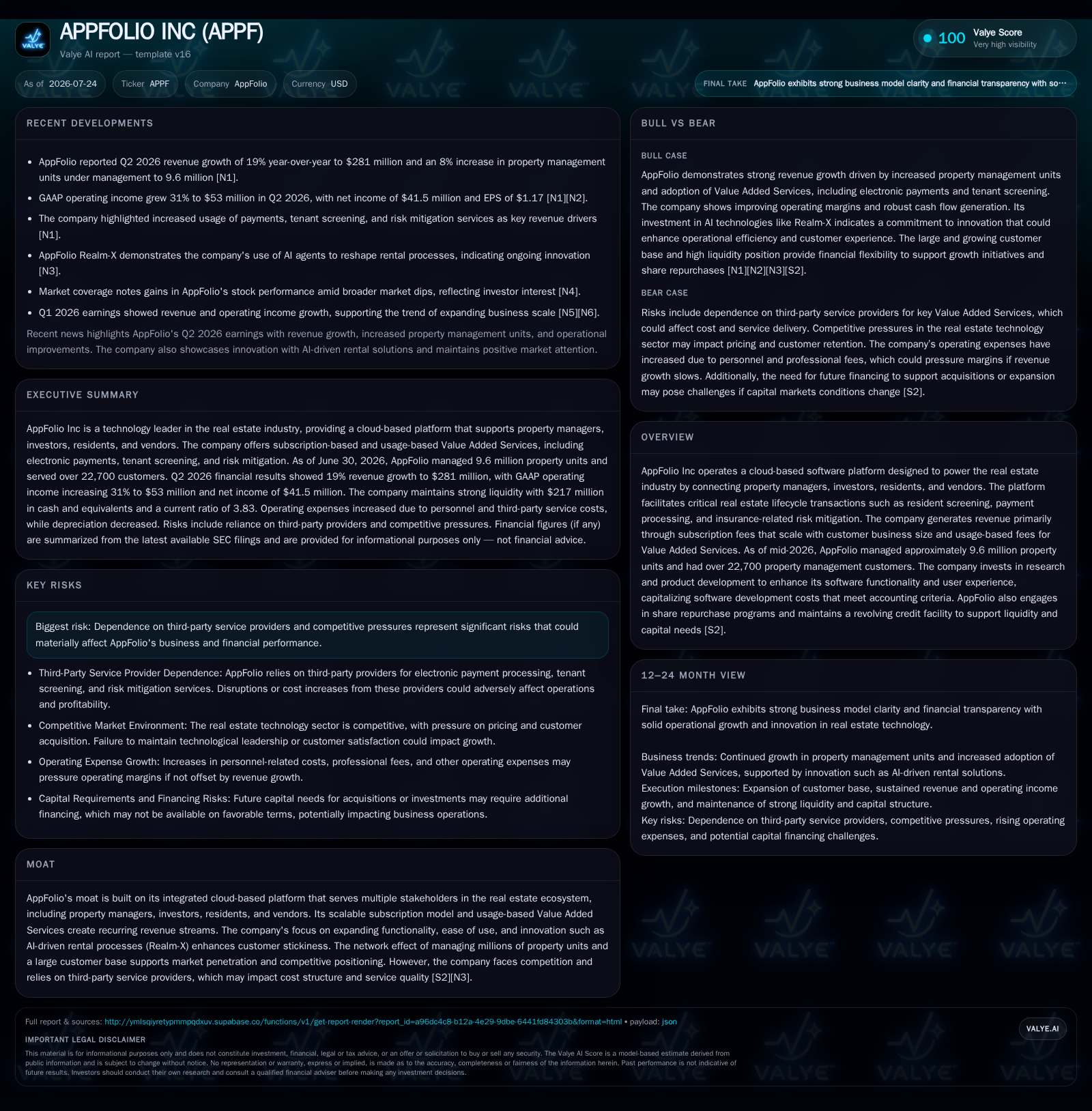
In the second quarter of 2026, AppFolio demonstrated robust operational momentum with revenue rising 19% year-over-year to $281 million and total property units under management increasing 8% to 9.6 million [S2][S15]. The company’s SaaS business model, anchored in scalable subscription fees supplemented by usage-based value-added service charges for payments and screening, underpinned this growth. Profitability improved notably, with GAAP operating income growing 31% and non-GAAP operating margins expanding to 27.1%. AppFolio’s competitive position benefits from its integrated cloud platform connecting multiple real estate stakeholders, although it faces cost pressures from third-party service providers [S2][S24]. Financially, the company maintains strong liquidity with over $217 million in cash and a healthy current ratio of 3.83 [F1][S2]. Going forward, monitoring customer retention, adoption of transaction services, and third-party cost trends will be critical for sustaining growth.
Recent Operating Update
Profitability gains were impressive: GAAP operating income grew by 31% year-over-year to $53 million (18.8% of revenue), while non-GAAP operating income expanded by 24%, representing a non-GAAP operating margin improvement from 26.2% to 27.1% [S2][S8]. The improvement reflects better operational leverage combined with careful expense management during ongoing investments.
Business Model Overview
AppFolio operates a cloud-based software-as-a-service platform that serves as an integrated hub connecting property managers, investors, residents, and vendors within real estate ecosystems. Its revenue model is bifurcated into predictable subscription fees that scale primarily with property type and portfolio size—a direct function of the number of property units managed—and variable usage-based fees linked to transactional volume for value-added services including payments processing and tenant screening [S25]. Subscription revenues are recognized on a straight-line basis over contract terms reflecting recurring nature; usage-based fees are recognized as services render value in the period.
This blended model balances stable recurring revenue streams with the upside from transactional consumption growth. The company's ability to grow its property units under management correlates strongly with subscription scaling but also increases the volume potential for discrete transactional service revenues—a synergistic effect that enhances overall monetization per managed unit.
Customer contracts typically involve monthly or annual prepayment arrangements for subscriptions alongside monthly invoicing or at-time-of-service billing for usage-based offerings. Management highlights that most value-added service revenues derive from electronic payment facilitation (including payment interchange fees borne internally), credit reporting for tenant screening, and risk mitigation insurance partnerships supported through third-party vendor integrations [S25][S24].
Industry Structure & Competitive Positioning
AppFolio competes within the SaaS real estate technology sector alongside peers such as Buildium, RealPage, Yardi, MRI Software, Entrata, and CoStar Group—companies similarly leveraging cloud platforms to digitize property lifecycle management. Key competitive moats center on comprehensive ecosystem integration across multiple stakeholders—not just property managers but also residents (tenants) and investors—and scalability aligned with increasing managed assets.
Its network advantage arises from managing millions of units within an increasingly interconnected user base that benefits from automation in leasing workflows driven by AI enhancements (e.g., proposed Realm-X innovations). This scale also supports premium pricing power relative to smaller or fragmented competitors whose platforms may lack breadth across modules such as payment processing and risk mitigation.
However, a notable competitive constraint lies in the company's reliance on third-party providers for essential backend services including payment processing infrastructure and credit reporting agencies. These dependencies influence cost structure volatility since third-party fees rise proportionally with transaction volume growth—pressuring gross margins if not managed carefully [S24]. Additionally competitive SaaS market pressures demand continual innovation expense commitments.
Growth Drivers
Several structural drivers underpin AppFolio’s growth trajectory:
- Expanding Property Units Under Management: An expanding portfolio directly increases subscription revenue base while enabling upsell opportunities through ancillary transactional services.
- Increasing Usage of Value Added Services: As more properties transact rent payments electronically or use tenant screening/risk solutions digitally adopted post-pandemic behavioral shifts demand grows.
- Innovation & AI Integration: Investments in product development focused on ease-of-use improvements and AI-enabled rental lifecycle automation provide long-term stickiness benefits trying to differentiate versus commoditized SaaS offerings.
- Cross-Selling Capability: Leveraging existing customers for newly developed features or ancillary products within unified contract environments drives improved net retention rates.
- Industry Digitization Trends: Regulatory frameworks favoring digital tenant screening disclosure rules and mainstream acceptance of online rent payments accelerate platform dependency across the ecosystem.
These factors collectively bolster both top-line expansion and deepen platform engagement metrics critical in SaaS retention calculus such as churn reduction and seat/usage expansion.
Risks / Watchpoints / Growth Constraints
Significant risks remain integral to AppFolio’s operating environment:
- Third-Party Service Provider Dependence: Cost volatility tied to vendor interchange/payment processor fees poses margin compression risk amid rising transaction volumes if not offset by pricing adjustments or efficiency gains.
- Competitive Pressure: Rival SaaS providers competing on functionality breadth or price can pressure new customer acquisition costs (CAC) or slow net retention gains.
- Customer Churn & Retention: Sustained demand requires maintaining low churn rates; any weakness here could undermine recurring revenue predictability.
- Integration & Platform Scalability Risks: Rapid feature additions require solid engineering execution; failure could delay rollout schedules affecting competitiveness.
- Real Estate Market Cyclicality: Broader economic downturns could indirectly reduce budgets allocated by property managers for software subscriptions or transactional volumes.
- Accounting Risks Over Capitalized Software Development: Application of capitalization rules affects reported profitability metrics; changes here could alter earnings perceptions.
- Regulatory/Data Privacy Compliance: Maintaining compliance when handling sensitive tenant data is critical; breaches pose reputational risks.
Management notes no material changes recently to pre-existing risk disclosures but these dynamics warrant continuous monitoring given their material impact potential [S17].
What to Watch Next
Investors should focus on several key metrics in upcoming quarters:
- Continued quarterly growth trends in property units under management indicating market capture progress.
- Net retention metrics reflecting both subscription renewals plus incremental transactional spend per customer year-over-year.
- Usage-based revenue acceleration particularly in payments processing volume signaling deeper platform monetization.
- Gross margin progression trends vis-à-vis third-party service costs which may reveal pricing power effectiveness or cost containment success.
- R&D productivity signals including new product feature releases or AI capabilities that could enhance long-term differentiation.
- Sales efficiency metrics such as CAC payback periods amid intensified marketing investment aimed at sustaining top-line growth momentum.
Additionally, any shifts in liquidity status or leverage arising from capital allocation decisions including share repurchases (currently paused Q2 but $125 million authorization remains) will affect financial flexibility assessments [S7][F1]
Financial Profile Discussion
Non-GAAP operating income rose briskly to $76 million driven partially by stock-based compensation adjustments excluded from GAAP figures underlying strong margin expansion despite inflationary pressures on third-party costs [S8]. The company currently carries no borrowings against its revolving credit facility providing runway flexibility through economic cycles while strategically deploying capital toward targeted share repurchase programs preserving shareholder value when opportunity aligns [S7].
Conclusion
AppFolio’s latest quarterly performance underscores solid execution against an interconnected SaaS business model tailored for real estate lifecycle digitization where managing scale via growing property unit count drives subscription stability while expanding fee-based transaction services diversify revenues. Operational leverage combined with prudent cost control yielded higher profitability amid increased competition leveraging technology innovation fueled by steady R&D investment. While reliance on outsourced providers generates some cost variability risk that must be managed carefully alongside retention challenges inherent in competitive cloud marketplaces, the company’s strong liquidity position offers resilience enveloping future growth initiatives amid evolving industry trends fostering digital adoption across multifamily housing segments.
Disclaimer: This is research-only, informational analysis and not investment advice. It may include AI-generated interpretation and general industry context. Always verify important details using primary sources.

Comments