
Ashland Inc. Delivers Volume-Driven Growth While Managing Environmental Liabilities
Q3 2026 results show Ashland’s sales strength led by volume growth across diversified specialty chemical segments, offsetting margin pressures from environmental costs.
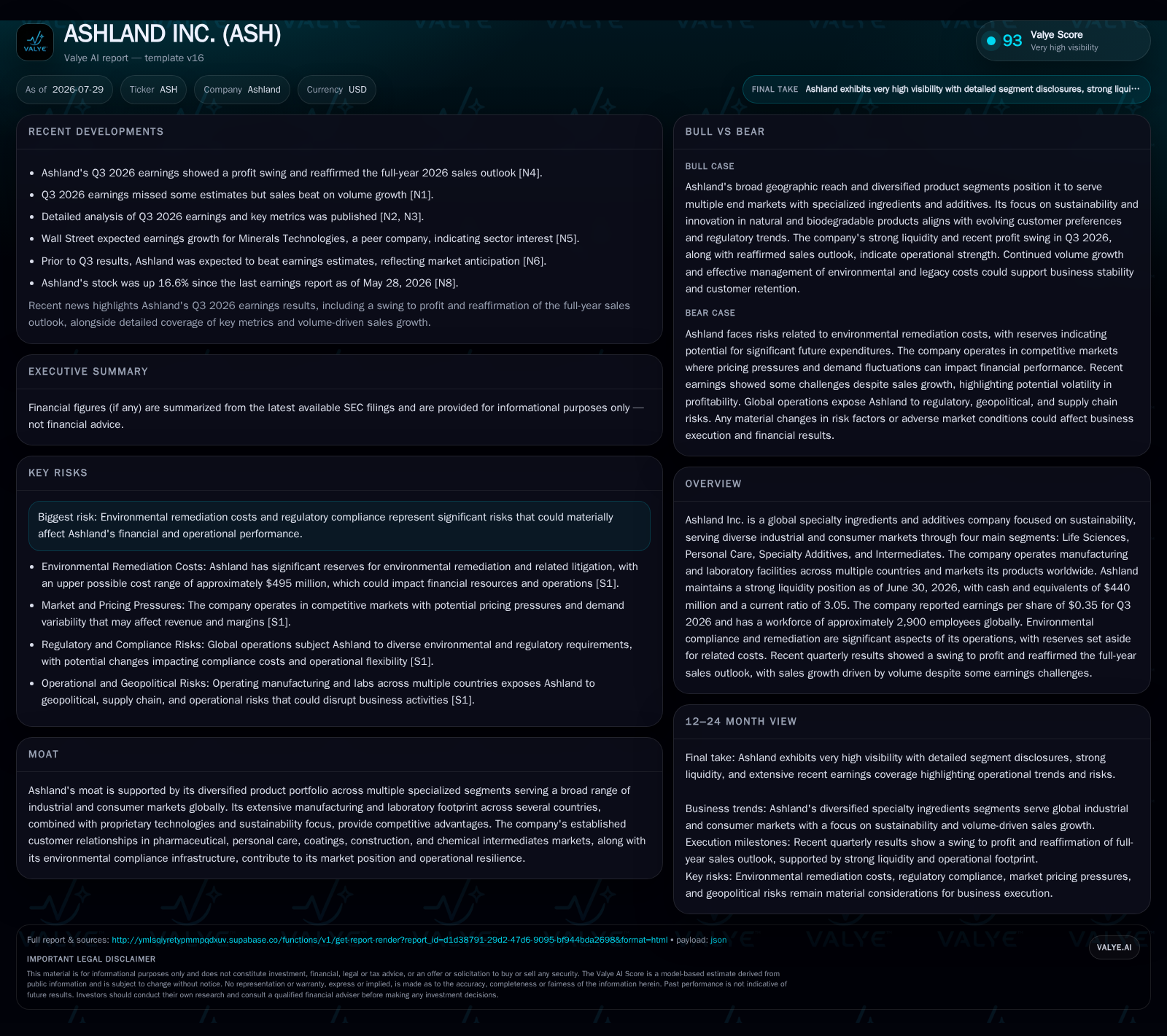
Ashland swung back to profitability in Q3 2026 with earnings per share of $0.35 driven primarily by higher sales volumes despite persistent cost inflation and competitive pricing pressure [S2][N1][N6]. The company reaffirmed full-year sales guidance, reflecting resilience supported by its diversified portfolio spanning Life Sciences, Personal Care, Specialty Additives, and Intermediates [S2][S1]. While volume growth bolsters revenue, Ashland continues to manage significant environmental remediation liabilities estimated at $226 million, representing a material constraint on cash flow and margin expansion [S1][S2]. New board appointments suggest a governance refresh aimed at optimizing asset utilization amid ongoing strategic execution challenges [S3]. Going forward, demand drivers centered on sustainability trends and emerging market expansion present growth opportunities balanced against regulatory risks and supply chain complexities.
Q3 Operating Turnaround Driven by Volume Expansion in Core Segments
onstrain operating leverage.
Integrated Specialty Chemical Model Balances Customer-Centric Innovation with Manufacturing Reach
Ashland operates a diverse specialty chemical model structured around four main segments: Life Sciences, Personal Care, Specialty Additives, and Intermediates — each targeting distinct industrial or consumer applications with tailored formulation expertise [S1]. Life Sciences caters largely to pharmaceutical excipients and nutrition additives requiring stringent quality controls and regulatory compliance. Personal Care focuses heavily on biofunctional and biodegradable ingredients vital amid rising consumer sustainability demands. Specialty Additives serve architectural coatings and construction markets with products like rheology modifiers and foam control agents critical to performance polymers in coatings systems. Intermediates manufacture chemical building blocks such as 1,4-butanediol for use both internally and externally.
This segmentation strategy places Ashland in the midstream value chain where product innovation, multi-site manufacturing footprint, and customer formulation support directly influence pricing power and retention. Extensive global labs enable geographical market customization vital for regulatory nuances while proprietary technologies differentiate offerings versus larger commodity players like BASF’s specialty chemicals segment or Clariant AG’s formulation-focused platforms.
Diverse Portfolio Mitigates End-Market Cyclicality But Raises Mix Complexity Risks
Ashland’s diversified portfolio acts as both a buffer against cyclical volatility—especially by balancing slower consumer-facing Life Sciences products with faster-moving additives—and as a source of margin complexity [S1][N1]. For instance, recent volume gains were primarily driven by healthcare-related pharmaceutical excipients alongside adhesive additives used in specialty coatings — sectors marked by steady demand rather than high-margin nutraceuticals that the company exited in 2024 [S1]. However, inconsistent mix shifts across the four segments pose challenges for gross margin predictability given differing product economics: bulky intermediates rely on scale, whereas specialized personal care chemicals command premium pricing but have longer development cycles.
This mix variability requires agile supply chain management and targeted R&D investment to maintain resilient margins. Ashland’s ongoing innovation efforts underpin its ability to introduce new formulations responding to evolving regulatory trends favoring safer chemistries.
Environmental Remediation Liabilities: A Key Risk Merit Close Monitoring
The sector-wide prevalence of such remediation responsibilities parallels peers like Evonik Industries which also report lengthy environmental liabilities affecting valuation multiples. For Ashland specifically, these remediation costs underscore the importance of conservative reserve setting but also limit operating flexibility amidst other margin pressures.
New Leadership Appointments Signal Strategic Renewal Potential in Governance
A fresh governance signal emerged during July 2026 when Ashland appointed Peter Thomas and Allen Spizzo to its Board — moves framed as strengthening oversight capabilities during an ongoing phase of strategy execution aimed at optimizing asset utilization [S3]. Such board refreshment can be interpreted as deliberate positioning ahead of potential transformative steps including portfolio refinement or capital deployment acceleration given persistent integration risks from prior acquisitions.
While no direct operational changes have yet been attributed to these appointments, their timing close to the quarterly earnings announcement positions them as part of broader strategic renewal efforts.
Growth Opportunities Lie in Sustainability Trends and Emerging Market Expansion
Key secular growth drivers for Ashland center on sustainability-oriented product innovation aligned with increasing demand for biodegradable ingredients especially within its Personal Care segment where nature-derived rheology modifiers are gaining traction [S1][N6]. Regulatory trends globally are tightening volatile organic compound limits and restricting certain chemical classes pushing formulators towards safer alternatives that Ashland is positioned to supply.
Further opportunities lie in expanding geographic exposure particularly in emerging markets where industrialization accelerates infrastructure activity benefiting Specialty Additives tailored towards construction materials. Broadening penetration into Asia-Pacific or Latin America offers incremental volume upside backed by localized manufacturing capabilities enabling cost competitiveness without compromising regulatory compliance.
Key Operational Watchpoints: Pricing Power, Product Launches, and Supply Chain Stability
Despite volume progress supporting top-line growth in Q3 2026, earnings missed some analyst estimates highlighting ongoing margin compression related largely to input cost inflation and competitive price pressures [N2][N3]. Pricing power appears constrained across several end markets given fragmentary competitors often larger in scale offering overlapping solutions which limits upward price adjustments without risking volume loss.
Furthermore, supply chain disruptions continue influencing order backlogs and lead times imposing delivery timing variability that affects customer satisfaction metrics critical in specialty chemical relationships dependent on formulation consistency [S2]. Ashland’s R&D expenditure intensity as a percentage of sales remains a vital KPI signaling pipeline strength — ensuring future product introductions needed to sustain differentiation amid commoditization threats.
Financial Profile Discussion: Strong Liquidity Cushions Debt Amid Margin Variance
As of June 30, 2026, Ashland holds liquidity buffers with cash and equivalents approximating $440 million against total debt nearing $1.38 billion resulting in net debt close to $943 million—a moderate leverage profile supported by a solid current ratio of 3.05 indicating ample short-term asset coverage over liabilities [F1]. This financial posture provides resilience allowing flexibility to manage environmental remediation payments alongside funding working capital needs during periods of margin pressure.
Earnings progress evident from the swing to profitability contrasts with previous years’ net losses recorded at earlier periods highlighting operational improvement though risks remain from fluctuating input prices impacting EBITDA margins.
Ashland Inc.'s latest quarterly results reflect its core strength anchored by volume-driven gains across multiple specialty chemical platforms meeting varied end-market needs globally. While diversification supports revenue resilience amid macroeconomic uncertainty, embedded environmental liabilities pose enduring financial constraints necessitating prudent capital management. Sustained focus on formulation innovation aligned with global sustainability mandates positions Ashland favorably against peers like BASF SE’s specialty segment or Clariant AG, though limited pricing power amid competitive backdrops tempers margin upside prospectively. Governance refresh signals readiness for strategic evolution. Stakeholders should monitor upcoming quarterly volumes alongside expense trajectories related to environmental compliance as key indicators validating this cautious optimism.
Disclaimer: This is research-only, informational analysis and not investment advice. It may include AI-generated interpretation and general industry context. Always verify important details using primary sources.

Comments