
ASML’s Capacity Expansion and AI-Driven Demand Catalyze Margin and Cash Flow Growth
ASML leverages its EUV lithography dominance to capitalize on increasing chip demand fueled by AI and memory sectors, while managing supply chain and regulatory complexities.
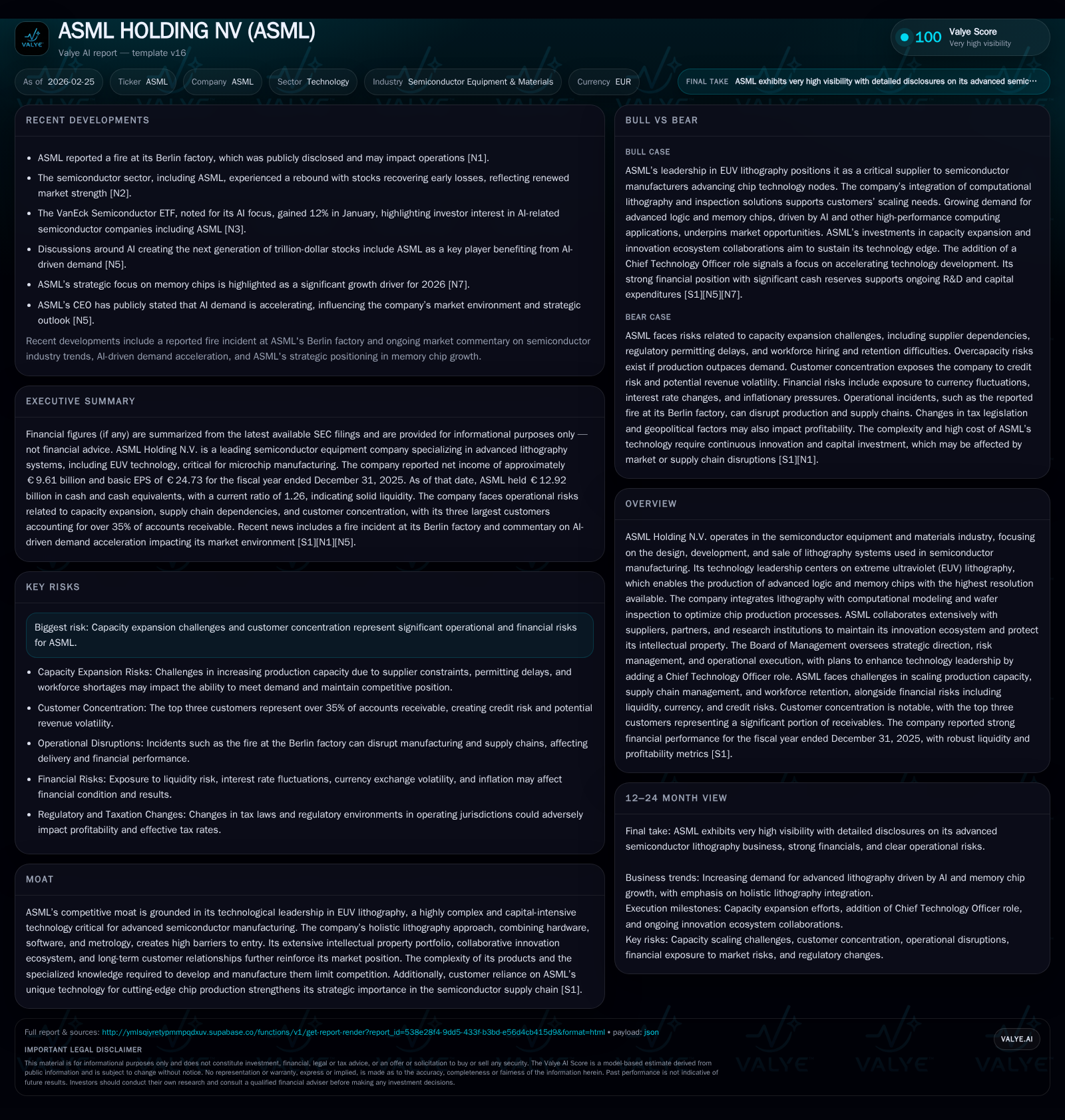
ASML Holding NV demonstrated strong financial growth in 2025 with operating income rising 25% and net income nearly 27%, driven by robust demand for leading-edge lithography systems essential to advanced semiconductor production. The company’s future growth is underpinned by AI-related semiconductor demand and memory chip investments, yet capacity expansion constraints and geopolitical risks pose key challenges. ASML is investing strategically in R&D, expanding capacity despite supply chain bottlenecks, and maintaining disciplined capital allocation with significant buybacks and dividend growth. Observers should monitor capacity ramp-up progress, regulatory developments, and the evolution of product mix toward High NA EUV technology.
Overview of Business Model and Market Position
ASML Holding NV operates exclusively in the semiconductor equipment sector with a specialized focus on lithography systems critical to fabricating advanced microchips. Its leadership position is uniquely fortified by pioneering Extreme Ultraviolet (EUV) lithography technology which enables the precise patterning necessary for leading-edge logic and memory devices [S1]. This technology has no close substitutes at comparable productivity or resolution levels, cementing ASML's pivotal role across global semiconductor foundries.
The company pursues a holistic lithography strategy bridging cutting-edge hardware with sophisticated computational modeling and wafer inspection solutions. This tight integration enhances yield optimization for customers and further deepens ASML’s competitive moat through knowledge accumulation and intellectual property protection [S1].
Historical Financial Performance
Though direct revenue figures are not disclosed in provided tags, ASML’s operating income grew from €6.5 billion in FY2022 to over €11.3 billion in FY2025, a sharp improvement illustrating expanding profitability tied to increased sales volumes and operational leverage [F1]. Net income exhibited similar strength rising from approximately €5.6 billion to €9.6 billion over the same period (Table below).
Operating cash flows climbed significantly as well—from €8.5 billion in FY2022 to nearly €12.7 billion by FY2025—reflecting efficient working capital management alongside strong earnings quality [F1]. Capital expenditure outlays have fluctuated but remained substantial as ASML invests heavily in production capacity expansion and technology development.
Historical performance (annual)
| FY | Net ($bn) | CFO ($bn) | OpInc ($bn) | Capex ($bn) | Net YoY |
|---|---|---|---|---|---|
| 2025 | 9.6 | 12.7 | 11.3 | 1.6 | +26.9% |
| 2024 | 7.6 | 11.2 | 9.0 | 2.1 | -3.4% |
| 2023 | 7.8 | 5.4 | 9.0 | 2.2 | +39.4% |
| 2022 | 5.6 | 8.5 | 6.5 | 1.3 |
Note: Omitted columns lack sufficient annual XBRL coverage in the provided tags (need ≥2 annual points): Rev, Div. Source: SEC companyfacts cache [F1].
Capital returns and efficiency (annual)
| FY | Buybacks ($bn) | FCF ($bn) | ROE% |
|---|---|---|---|
| 2025 | 6.0 | 11.1 | 49.0 |
| 2024 | 0.5 | 9.1 | 41.0 |
| 2023 | 1.0 | 3.3 | 58.3 |
| 2022 | 4.6 | 7.2 | 63.8 |
Source: SEC companyfacts cache [F1].
Table excludes metrics not sufficiently covered in provided data such as revenue.
Drivers Behind Past Growth
Three core drivers explain ASML’s financial trajectory:
- Technology Leadership: Dominance in EUV lithography is essential for chipmakers targeting nodes below ~7nm; this creates a structural advantage that supports premium pricing.
- Customer Demand: Expansion of AI workloads has stimulated demand for high-performance logic chips requiring EUV tools [N7]. Memory market recovery also contributes meaningfully as more advanced DRAM/NAND chips incorporate EUV layers [N6].
- Operational Scaling: Gradual enhancement of production throughput enabled higher shipment volumes from new platform rollouts albeit constrained by supply chain limitations.
Future Growth Prospects
Key growth catalysts include:
- AI-Driven Semiconductor Demand: Rising investments into AI accelerators from cloud providers and chipset OEMs are driving increasing wafer fab upgrades needing advanced lithography [N7].
- Memory Chip Segment Expansion: As memory manufacturers adopt EUV for higher-density nodes, this sector presents significant upside potential for ASML sales beyond logic-driven demand [N6].
- High Numerical Aperture (High NA) EUV Technology: Set for commercialization mid-decade, this next-gen platform promises enhanced resolution enabling further scaling Moore’s Law trends [S1].
Constraints likely capping growth:
- Capacity Expansion Challenges: Building new tool production lines requires extensive capital expenditure with dependence on suppliers scaling their operations on time; labor shortages also pose risks [S10]. Permit acquisition delays for facilities expansions further complicate timing.
- Geopolitical / Regulatory Risks: Increasing export control restrictions affect customer access especially within China; regulatory investigations across jurisdictions add complexity to compliance frameworks [S4][S5][S10].
- Customer Concentration: The top three customers accounted for over one-third of receivables in late-2025 indicating sensitivity to individual client downturns or credit issues [S10].
Guidance & Milestones to Watch
While explicit forward-looking guidance details are limited in the sources provided, management indicated expectations for total net sales between €34 billion and €39 billion in calendar year 2026 with gross margins targeted at roughly 51–53% range [S3]. Illustrative milestones include successful ramp-up of new generation EUV tools including High NA platforms post-launch, backlog conversion rates from orders to shipments, plus mitigation of supply chain bottlenecks hindering output capacity.
Returns & Capital Allocation
ASML exhibits impressive return on equity (ROE), approximated at nearly 49% based on net income relative to shareholders' equity as of FY2025 year-end—underscoring highly profitable capital deployment within a high-barrier industry segment [F1].
The firm generates robust free cash flow (approximately €11 billion) supporting ongoing investments alongside significant shareholder distributions:
- Dividends have been growing steadily over recent years though exact recent dividend payments were not available in data.
- Share repurchases accelerated strongly in FY2025 totaling €5.95 billion compared to prior years’ lower levels reflecting confidence in cash flow strength and capital discipline [F1][S24].
Equity base expansion from sustained profitability supports continued balance sheet strength while funding requisite R&D (€1+ billion annually) focused on extending technological leadership.
Industry Context & Strategic Positioning Analysis
The semiconductor equipment industry is characterized by rapid innovation cycles combined with massive capital intensity—particularly true within lithography segments where wafer throughput efficiency metrics (wph) materially impact fab economics.
EUV technology has historically faced complex challenges around source power scaling, optics precision including mask defect avoidance using multi-layer mirrors, and system throughput improvements needed for fab-level volume fulfillment [S1],[N6]. ASML's broad ecosystem collaboration model involving optics partners like Carl Zeiss SMT enables effective innovation diffusion.
Demand drivers within semiconductors continue evolving rapidly with sustained AI compute power growth fueling investment into sub-3nm node fabrication processes where only EUV-based patterning suffices for volume manufacturing [N7]. Meanwhile memory manufacturers’ adoption curves vary but increasingly incorporate EUV as they target denser devices requiring finer patterning layers.
Nonetheless geopolitical tensions translate into export licensing complications impacting sales channels especially toward Chinese foundries [S4][S10], amplifying supply risk profiles.
Management & Corporate Governance Updates
The Board of Management will expand to add a Chief Technology Officer role starting in the coming year to spearhead the technology roadmap aggressively aligned with advancing product offerings under heavy R&D focus [S20]. This organizational adjustment signals heightened emphasis on maintaining innovation edge amid intensifying competition for talent globally within photonics and materials science domains critical for lithography breakthroughs.
Risk Factors Summary
Primary risks facing ASML encompass:
- Supply chain execution failures resulting from supplier capacity constraints or permit delays create delivery bottlenecks reducing revenue realization timing accuracy.
- Concentrated customer exposure elevates credit risk if major clients encounter financial distress.
- Rising complexity within regulatory frameworks heightens compliance costs while restricting market access.
- Inflationary pressures impacting material costs or labor wages may compress margins if not offset via pricing adjustments effectively.
- Cybersecurity threats owing to sensitive IP importance require vigilant risk monitoring across internal teams plus third-party suppliers [S19][S16].
Conclusion & Monitoring Points
ASML holds an unparalleled position within semiconductor equipment through unmatched EUV capability that is central to next-generation chip manufacturing underpinned by sustained AI/memory demand tailwinds. The ongoing challenge will be scaling production capacity expeditiously while managing operational complexity elevated by geopolitical regulations and supply chain resiliency concerns. Investor attention should focus on execution progress regarding High NA EUV commercialization timelines, order backlog conversion rates into shipments, diversification effects amidst concentrated customer base risks, evolving regulatory impacts particularly concerning China exports, along with continued trends in R&D investment efficiency versus emerging product platform rollouts.
Disclaimer: This analysis is based exclusively on publicly available information as of February 25, 2026, including SEC filings and recent news reports; it does not constitute investment advice or recommendations.
Disclaimer: This is research-only, informational analysis and not investment advice. It may include AI-generated interpretation and general industry context. Always verify important details using primary sources.

Comments