
Coronado Global Resources Confronts Market Headwinds with Cost Efficiency Initiatives
Coronado faces sharply lower metallurgical coal prices and volume headwinds, yet pursues operational improvements and liquidity support to stabilize its capital structure.
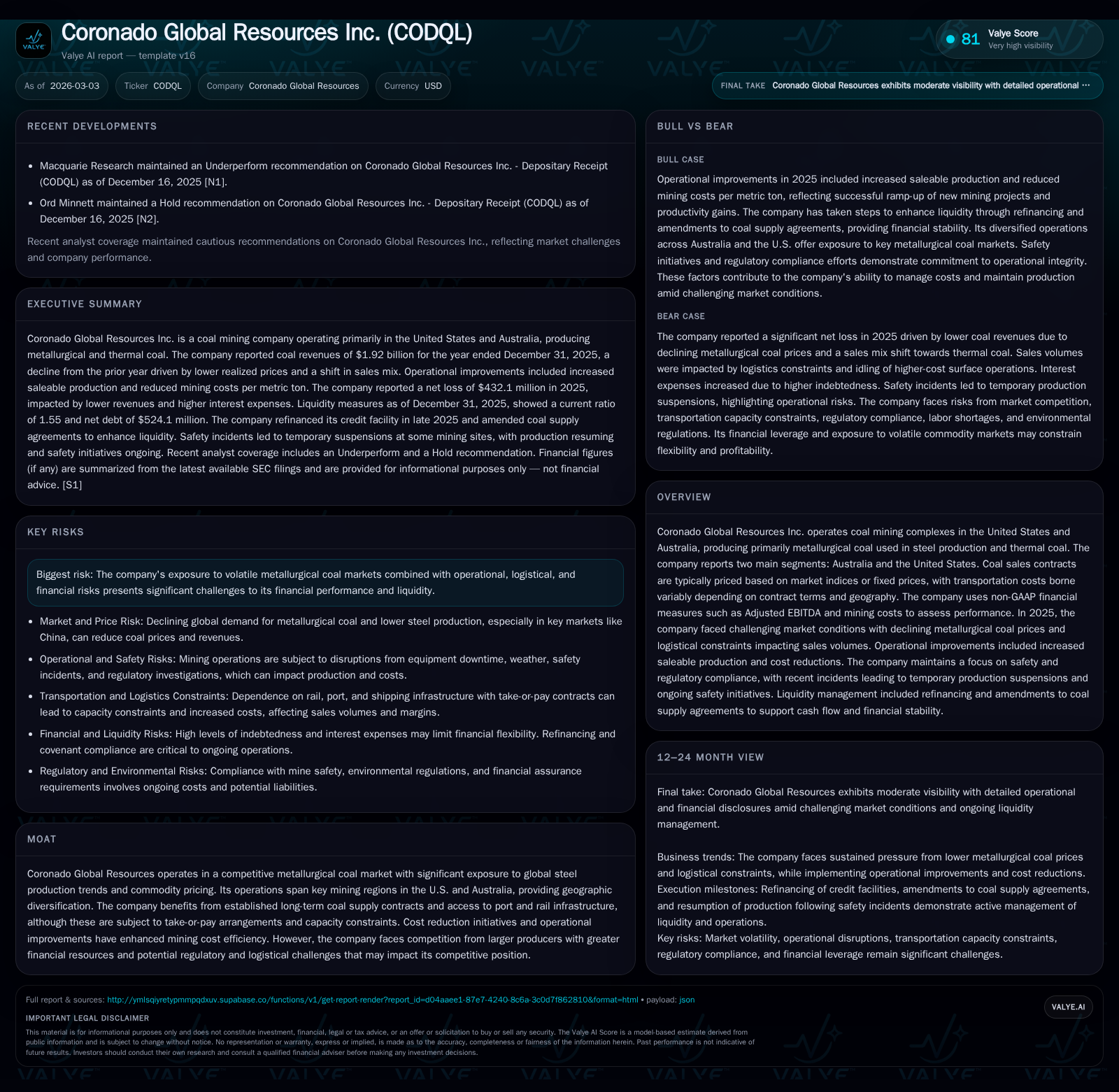
Coronado Global Resources’ financial performance deteriorated significantly through 2025 due to a 22% revenue decline driven by lower metallurgical coal prices and volume constraints. Despite these challenges, the company implemented cost reductions and operational efficiencies that partially mitigated margin compression. Critical liquidity enhancements including a new asset-based lending facility with Stanwell and refinancing measures have reinforced the balance sheet amid volatile market dynamics. The company maintains a disciplined capital allocation approach, focusing on cash conservation and prudent dividend payout relative to available free cash. Safety remains a core priority as regulatory compliance incidents temporarily disrupted production during the year.
Historical Revenue Decline and Operating Shifts
From 2022 through 2025, Coronado Global Resources experienced a marked contraction in revenue from $3.57 billion down to approximately $1.95 billion [F1]. This decline by nearly 45% over three years reflects a combination of falling metallurgical coal prices and volume pressures. Specifically, metallurgical coal sales volume decreased by about 6.3% between 2024 and 2025, while average realized met coal prices per metric ton dropped approximately 19.5%, from $185.3 to $149.3 [S7]. Sales volumes were also disrupted by logistical constraints such as rail bottlenecks that delayed shipments into early 2026 and temporary production idling at surface mines like Logan [S24].
Mining costs improved notably during this period: reductions totaling $43.7 million year-over-year through measures including operational efficiencies and reduced well drilling activity helped partially cushion the impact of lower sales volume [S24]. These cost improvements demonstrate targeted efforts within mining segments to preserve margins in an adverse pricing environment.
Drivers Behind Year-Over-Year Revenue and EBITDA Movement
The deterioration in Coronado's profitability is underscored by adjusted EBITDA shifting from a positive $115 million in 2024 to a negative $144 million in 2025 [S7]. This swing primarily reflects the steep drop in coal revenues due to both price realizations – the ~19.5% decrease in met coal price per metric ton sold being critical – and shipment volumes [S7]. Freight cost variability under different contract terms further affected margins: export contracts for Australian operations typically require Coronado to bear freight costs from mine to port while customers bear ocean freight; in contrast, U.S. export sales often recognize revenue at mine load out with customers responsible for freight beyond [S18]. This structure introduces freight cost exposure inconsistently across geographies.
Corporate expenses increased modestly as cost headwinds required liquidity-seeking initiatives, pushing corporate adjusted EBITDA loss higher by roughly $3.8 million [S24]. Interest expense spiked due to increased borrowings including drawdowns on new facilities (9%-12% interest) alongside higher insurance premium financing costs [S7].
Current Market Pressures and Operational Constraints
Geopolitical tensions such as disruptions stemming from global conflicts have contributed market volatility impacting commodity prices broadly; combined with pandemic-related operational disruptions, these factors have compressed demand fundamentals for metallurgical coal [S1], [S8], [S15]. Regulatory regimes impose evolving constraints—for example, take-or-pay contract arrangements limit flexible profitability management when volumes fall below contracted levels [S13]. Moreover, transportation infrastructure capacity caps export flexibility especially at port facilities vital for seaborne shipments; failure to secure sufficient throughput not only delays delivery but can also impose economically punitive handling fees [S8], [S26].
Such dynamics intensify competition among producers globally that benefit from larger scale or fewer environmental restrictions potentially reducing Coronado’s market share or pricing power [S17]. Tariffs and trade barriers affect market access with examples including recent Chinese tariffs on U.S.-origin coal causing additional uncertainty [S16], [S27].
Metallurgical Coal Demand, Contracting Dynamics, and Pricing Sensitivities
Coronado’s metallurgy-focused coal sales are heavily dependent on steel industry demand which in turn influences global Met coal consumption patterns [S1]. Customer contracts range from long-term fixed-price agreements offering revenue visibility but limited upside to spot-indexed contracts exposing revenues directly to fluctuating benchmark indices updated quarterly or even monthly depending on geography [S26], [S16]. Such contracting contributes both stability risks when indices fall and opportunity risks if prices recover.
Transportation cost responsibilities under these contracts vary: Australian export contracts typically require Coronado to absorb freight from mine-to-port which affects net realized prices; U.S. operations mostly shift trucking/rail freight costs onto customers domestically but bear them fully on export sales recognized at mine load out volumes [S18]. This creates complex margin sensitivity requiring active management of cost inputs.
Liquidity Enhancement and Debt Refinancing Strategies
In response to strained free cash flow generation amid deteriorated operating results, Coronado prudently refinanced its existing revolving credit facility on November 27, 2025, replacing it with a five-year asset-based lending (ABL) Facility backed by Stanwell Corporation Ltd offering up to AUD$406.6 million (approx. USD $265 million) borrowing capacity under secured liens against current assets including accounts receivable and inventory [S11], [S4], [S5], [S7], [S19].
This ABL Facility carries an interest rate band starting at 9%, adjustable up to 12% based on the Borrowing Base Ratio—the ratio of eligible assets supporting outstanding borrowings—embedding direct leverage-sensitive pricing reflective of credit risk exposure [S4], [S11]. The facility includes maintenance covenants such as gearing ratio limits and interest coverage tests beginning December 31, 2027 providing medium-term financial discipline signals while granting flexibility currently amidst cyclical challenges.
Alongside this refinancing, contractual amendments were reached with Stanwell covering rebate waivers and prepayment deferrals that collectively improve near-term operating cash flows by mitigating prior rebate obligations under coal supply agreements (ACSA/NCSA) while providing downside protection triggered when cash balances drop below $250 million thresholds [S4], [S9].
As of year-end 2025, Coronado’s net debt position stood around $524 million after accounting for cash balances near $173 million excluding restrictions reflecting cautious liquidity reserves given prevailing demand uncertainties [F1], [S7].
Capital Allocation Priorities: Dividends, Capex, and Shareholder Returns
The company adopts a prudent dividend policy where payments are discretionary and contingent upon maintaining adequate liquidity post-distribution above prescribed thresholds — particularly targeting minimum cash balances above $250 million following distributions [S6]. Dividend payouts are typically aligned between 60% and 100% of available free cash which is defined as operating cash flows less capex requirements plus/minus adjustments for acquisition spend or debt servicing costs emphasizing a “cash available” framework rather than earnings alone.
Year-over-year dividend payments declined substantially coincident with profit compression—from over $16 million paid in dividends during FY2024 down to roughly $8.3 million in FY2025—as management prioritized balance sheet preservation amid turbulence seen across commodities markets [F1], [S6].
Capex spending held relatively stable near $245 million annually across recent years aimed mainly at sustaining existing mining operations instead of expansionary outlays amidst an uncertain commodity price cycle [F1], supporting operational continuity without incurring excessive leverage-driven growth risk.
Safety Compliance and Regulatory Environment Impact
Safety continues as an unequivocal priority for Coronado manifested through rigorous compliance with U.S Mine Safety Health Administration (MSHA) inspections applicable across multiple U.S mining complexes covering three states alongside parallel state regulatory oversight frameworks enforcing standards under the Mine Act as codified regulations govern operational controls routinely audited by MSHA inspectors issuing citations when warranted under Section 1503(a) Dodd-Frank/Regulation S-K disclosures requirements filed with the SEC annually highlighting transparency protocols surrounding safety metrics reported publicly only for U.S operations given jurisdictional exemptions elsewhere particularly Australia [S1], [S22].
In late December 2025, a fatal injury at Logan mining complex forced temporary suspension followed quickly by production resumption post-investigation demonstrating responsiveness balanced against safety rigor; similarly early January fatality at Mammoth Underground initiated pause until regulatory clearance enabled full resumption anticipated within Q1 calendar year reflecting compliance diligence and targeted safety cultural improvement programs bearing fruit though trailing incident frequency rates remain elevated compared against prior year baselines mandating continued focus on risk mitigation strategies going forward toward reducing workforce injuries further while adhering fully to evolving permit conditions across jurisdictions including Australia’s Financial Provisioning Act transitional risk rating adjustments applying moderate-high risk classification temporarily permitting scaled financial assurance contributions while pending annual review outcome later in Nov-26 elementally shaping fiscal planning around environmental obligations tied closely to ongoing permitting regimes critical for Curragh mine operations stability [S22], [S26], [S29].
Historical Financial Performance Summary
Historical performance (annual)
| FY | Rev ($bn) | Net ($mm) | CFO ($mm) | Capex ($mm) | Rev YoY | Net YoY |
|---|---|---|---|---|---|---|
| 2025 | 1.9 | -80 | 245 | -22.2% | ||
| 2024 | 2.5 | 74 | 248 | -13.2% | ||
| 2023 | 2.9 | 156 | 268 | 237 | -19.1% | -79.8% |
| 2022 | 3.6 | 772 | 927 | 200 | +307.4% |
Source: SEC companyfacts cache [F1].
Capital returns and efficiency (annual)
| FY | Div ($mm) | FCF ($mm) |
|---|---|---|
| 2025 | 8 | -325 |
| 2024 | 17 | -174 |
| 2023 | 17 | 31 |
| 2022 | 700 | 727 |
Source: SEC companyfacts cache [F1]. | *Note: Adjusted EBITDA figures are derived from SEC filings; exact historical data may vary slightly due to adjustments.[S7]
What to Watch: Milestones and Financial Covenant Stability
Although explicit forward guidance remains limited reflecting ongoing market unpredictability, key milestones loom for stakeholder monitoring including the December 31, 2027 covenant testing periods initiating scrutiny on gearing ratios and interest coverage ratios within loan agreements underpinning ABL Facility terms simultaneously approaching scheduled contract tonnage prepayment obligations linked inherently to Stanwell contractual agreements with timing dependent cash flows capable of stressing near-term liquidity comfort windows if metered pricing or volume recoveries lag materially beyond optimistic scenarios outlined historically.
Investors should also track operational recovery from safety-related suspensions completeness expected soon paired responsibly with robust safety cultural embedding ensuring underlying physical risk headwinds do not erode production capacity sustainably necessary for financial resilience.
This report is intended solely for informational purposes reflecting data contained in official SEC filings up through March 3, 2026 alongside summary analysis rooted exclusively in disclosed facts without extrapolation or investment recommendations.
Disclaimer: This is research-only, informational analysis and not investment advice. It may include AI-generated interpretation and general industry context. Always verify important details using primary sources.

Comments