
Actelis Networks Struggles with Nasdaq Delisting Amid Strategic Shift to IoT and Supply Chain Challenges
The latest quarter highlights Actelis Networks’ financial distress and operational risks amid its pivot to IoT verticals while maintaining a telecom customer base.
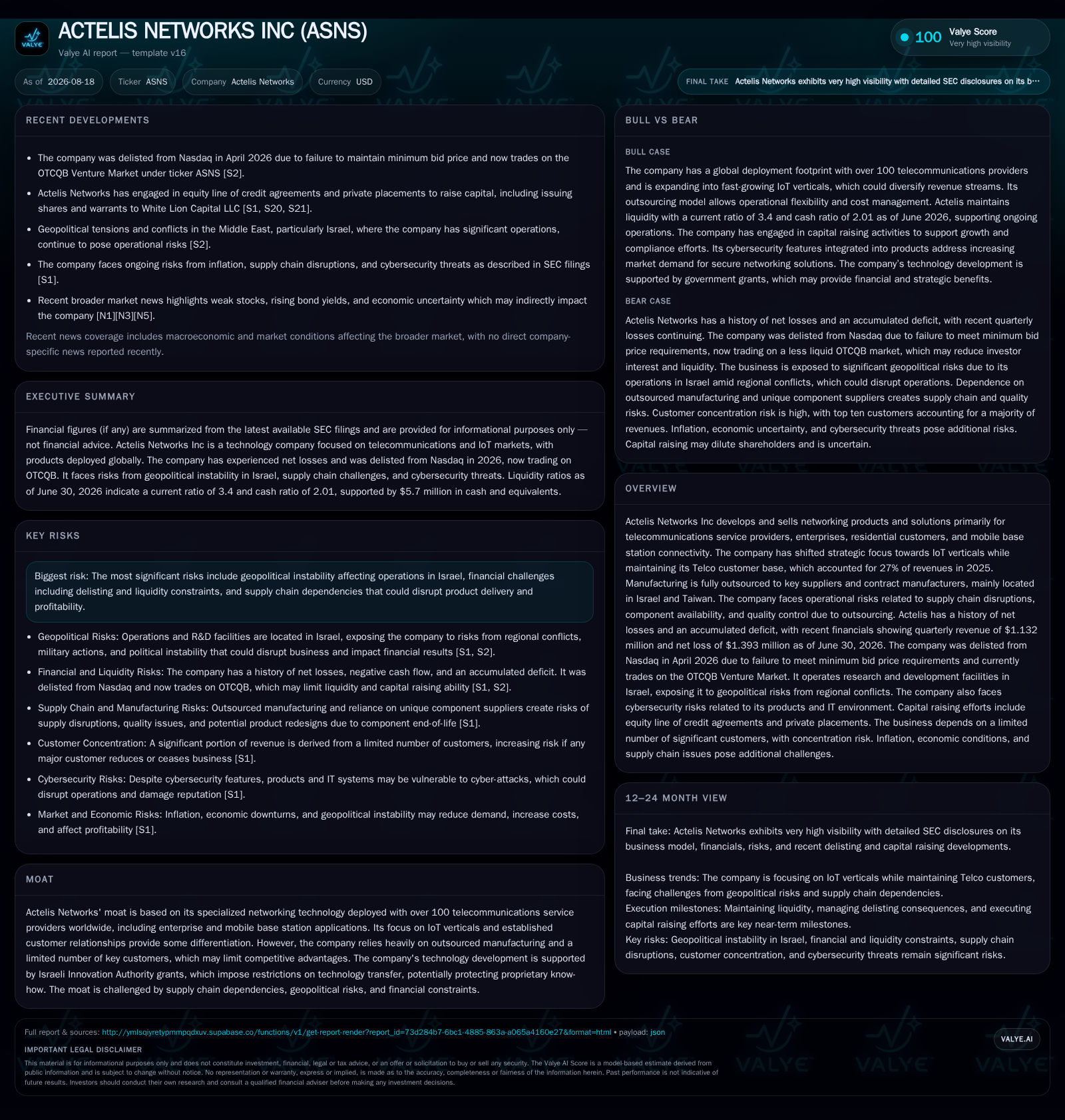
Actelis Networks Inc reported a second-quarter net loss of $1.393 million on revenue of $1.132 million, continuing a trend of significant operating losses as it transitions from traditional telecom networking towards IoT markets. The company was delisted from Nasdaq in April 2026 following a failure to meet minimum bid price rules after a reverse stock split, trading now on OTCQB with limited liquidity. Outsourced manufacturing in Israel and Taiwan exposes the company to supply chain and geopolitical risks, further complicating its path to profitability. Customer concentration remains high, with telecommunications service providers accounting for 27% of revenues in 2025. Financial constraints raise doubts about sustainability despite a current cash position supporting operations for the near term.
Recent Operating Update
Actelis Networks Inc reported Q2 results ending June 30, 2026 showing continued financial strain with revenue at approximately $1.132 million alongside a net loss of about $1.393 million [S2][S3]. This follows earlier disclosures highlighting sustained negative cash flow from operations and substantial accumulated deficits. These quarterly results underscore that revenues have not yet reached levels sufficient to support the company's cost structure or achieve profitability despite ongoing efforts.
A critical near-term event impacting Actelis was its delisting from the Nasdaq Capital Market in April 2026 following failure to meet minimum bid price requirements after conducting a reverse stock split (1-for-10) less than six months prior [S2]. The delisting moved the stock’s trading venue to the OTCQB Venture Market, which typically offers lower liquidity and visibility compared to national exchanges. Management expressed intentions to seek re-listing on Nasdaq but faces hurdles given current valuation and liquidity challenges [S2]. This market status change poses material impacts on investor access and capital raising ability.
Business Model Overview
Actelis develops specialized networking hardware and solutions primarily catering to telecommunications service providers (Telcos), enterprise clients, residential customers, and increasingly Internet-of-Things (IoT) verticals including mobile base station connectivity [S1][S20]. Unlike large diversified peers such as Cisco Systems or Nokia Networks which offer broad product portfolios across multiple network segments, Actelis focuses heavily on niche connectivity solutions tailored for last-mile access and IoT deployment scenarios.
Revenue generation derives chiefly from product sales of networking equipment complemented by integration offerings. Pricing follows deal-based contracts largely dependent on customer size and usage scale rather than standardized subscription models common in software-centric peers. Key drivers include volumes shipped to telecom operators upgrading infrastructure and expanding IoT deployments.
Manufacturing is entirely outsourced to select contract manufacturers predominantly located in Israel and Taiwan — hubs well known for electronics outsourcing but also vulnerable due to regional geopolitical tensions [S1][S20][S23]. This model reduces fixed-capital intensity but exposes Actelis to risks around component availability, quality control issues, lead-time variability, and supplier dependency.
Industry Structure and Competitive Position
The telecommunications equipment sector features intense competition with major global vendors like Cisco Systems, Juniper Networks, Nokia Networks dominating broad infrastructure solutions; smaller specialists such as ADTRAN or Calix provide access-specific hardware; meanwhile niche vendors focus on cutting-edge IoT connectivity solutions akin to Cambium Networks.
Within this landscape, Actelis' moat rests on proprietary networking technology deployed across over 100 service providers worldwide [S20]. The company benefits from Israeli Innovation Authority grants that create some barriers against technology spillover due to restrictive transfer agreements supporting intellectual property security [S1]. Nevertheless, reliance on outsourced manufacturing coupled with high customer concentration—its top ten clients accounted for roughly 62% of revenue in recent years—creates vulnerability not typical of more diversified incumbents [S4][S5].
Operationally, delays or quality lapses from contract manufacturers can ripple into revenue shortfalls or margin compression amid fluctuating semiconductor pricing—a key raw material affected by global supply chain constraints exacerbated by political instability in Taiwan Strait regions where many chip fabs reside [S23]
Growth Drivers
While traditional Telco infrastructure upgrades provide steady albeit modest growth opportunities—with roughly one-quarter of revenues still sourced from telco customers—Actelis has prioritized expansion into IoT verticals promising higher long-term growth potential given rapid proliferation of connected devices globally [S20][S1]. This strategic pivot aligns with broader industry trends emphasizing smart cities automation, industrial IoT applications, and 5G network densification requiring robust last-mile connectivity.
Positive growth outcomes hinge on several factors: successful market penetration beyond existing telecom clientele; accelerating time-to-market for innovative products meeting diverse IoT use cases; establishing robust sales channels through direct engagements or partnerships with system integrators; securing stable supply chains amid global shortages; and improving gross margins through scale efficiency and cost controls.
Industry tailwinds such as government investments in broadband infrastructure expansion especially in emerging markets represent opportunities if execution risks are mitigated.
Risks and Constraints
Actelis faces non-trivial risks threatening growth sustainability:
- Financial Health Risks: Continued losses cast doubt on the company's going concern status. Delisting diminishes capital market access complicating equity or debt fundraising needed for operations expansion or R&D investment [S1][S2].
- Customer Concentration: Revenue dependence on a small group of large telecom customers elevates volatility risk should any key client reduce orders or experience financial distress [S4][S5].
- Supply Chain Vulnerabilities: Outsourcing production primarily to Israel and Taiwan fosters exposure to geopolitical shocks such as regional conflicts or export restrictions affecting component availability or spike costs[S1][S23]. Quality control issues outside direct company management further pressure product reliability metrics.
- Competitive Challenges: Larger incumbents enjoy scale advantages in R&D spending, distribution breadth, and brand reputation complicating expansion into generalized or new IoT segments.
- Market Listing Status: Trading now on OTCQB reduces institutional interest potential due to lower liquidity settings and increased regulatory hurdles linked to ‘penny stock’ classification post-delisting complicate secondary market activity.[S2]
- Sales Execution Risk: Penetration into new vertical markets may require longer development cycles or higher marketing expense than anticipated potentially impairing near-term revenue growth projections.[S20]
What to Watch Next
Key milestones monitoring Actelis' trajectory include:
- Nasdaq Re-listing Efforts: Success will significantly improve liquidity and capital raising capability.
- Quarterly Revenue Trajectory: Any increase beyond current sub-$2 million quarterly run-rate would signal traction especially outside incumbent telco base.
- Gross Margin Trends: Improvement would indicate stabilization of supply chain costs or enhanced pricing power.
- Customer Diversification Progress: Reduction in customer concentration ratios would signal healthier long-term revenue stability.
- Supply Chain Stability: Absence of prolonged lead-time increases or quality issues will confirm operational resilience amid external shocks.
- R&D Investment Intensity: Maintaining competitive technology differentiation is essential amid rapid telecom equipment innovation cycles.
Financial Profile Discussion
As of June 30, 2026, Actelis held approximately $5.75 million in cash and equivalents against current liabilities around $2.96 million resulting in a healthy current ratio near 3.4x that provides short-term liquidity cushion despite operating losses rendering cash burn significant risk without further capital infusion [F1][S2]. Total debt stood minimal at ~$150 thousand as of September 2025 indicating low leverage but also limited capacity for incremental borrowing absent improved cash flows or assets collateralization [F1].
Capital raising efforts are hindered by the delisting-induced liquidity constraints alongside investor wariness stemming from operational uncertainties [S9][S11]. Equity dilution remains a persistent concern given prior funding rounds tied closely to shareholder structure changes noted in past annual filings
Overall financial condition embodies extended transition towards sustainable profitability dependent on top-line growth acceleration coupled with disciplined cost management reducing cash burn rates over coming quarters.
This analysis is based solely on publicly available regulatory filings and company disclosures without offering investment advice or research views concerning Actelis Networks Inc securities.
Disclaimer: This is research-only, informational analysis and not investment advice. It may include AI-generated interpretation and general industry context. Always verify important details using primary sources.

Comments