
Athena Technology Acquisition Corp. II Eyes Business Turnaround with Ace Green Recycling Merger
The SPAC confronts tight deadlines and financial constraints as it seeks to finalize a transformative merger promising operational activation.
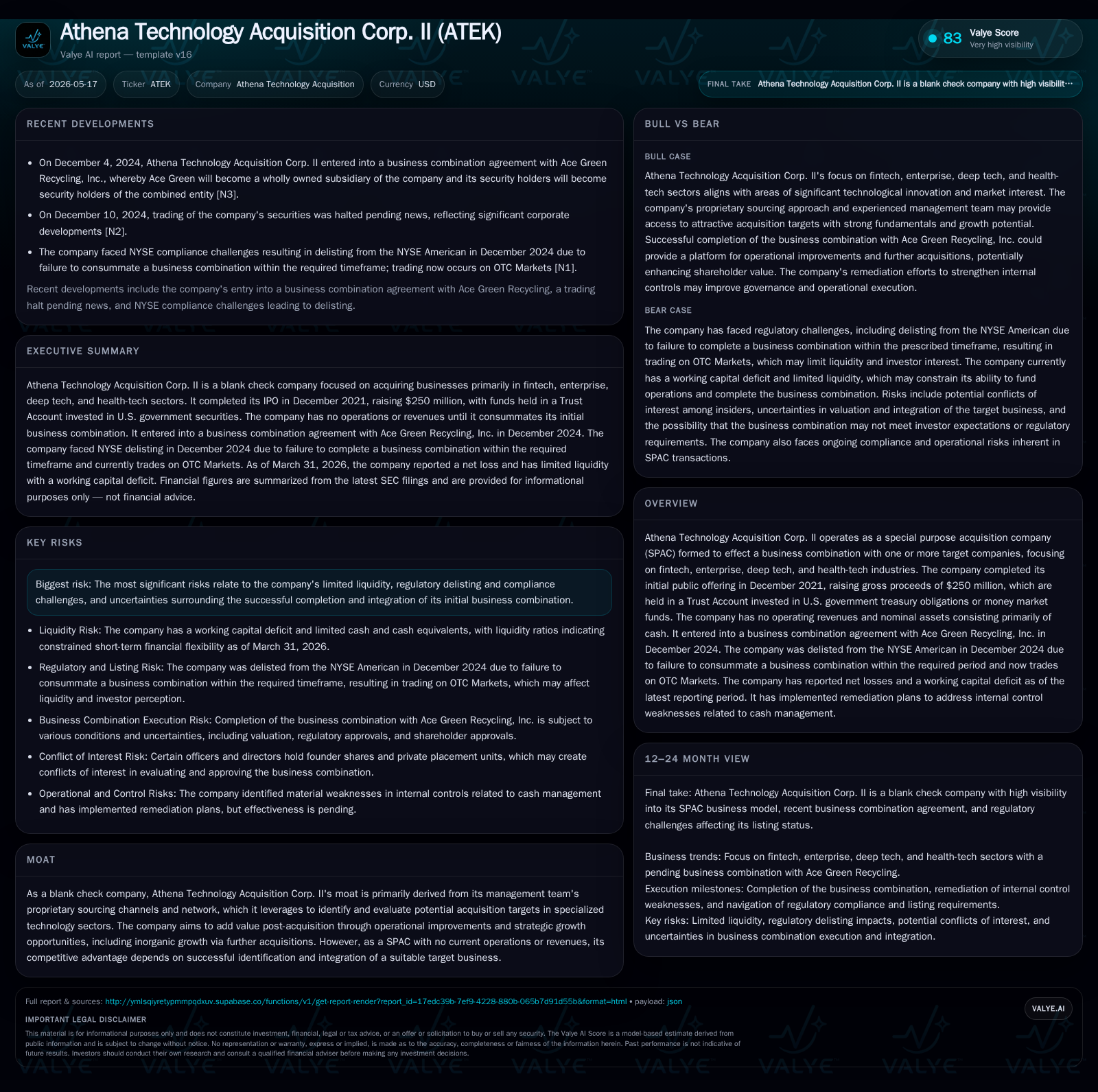
Athena Technology Acquisition Corp. II, a special purpose acquisition company (SPAC) focused on fintech and technology sectors, is nearing a critical deadline to consummate its initial business combination with Ace Green Recycling amid a protracted extension saga and financial pressures. Having been delisted from the NYSE American due to delays, Athena currently operates as a shell company with limited liquidity and mounting working capital deficits. The successful completion of the merger could transform Athena into an operating public entity with growth prospects rooted in inorganic expansion and operational leverage post-acquisition. However, execution risks remain high given weak balance-sheet metrics and ongoing regulatory compliance challenges.
Latest Quarterly Update: Time-Sensitive Extension and Implications
Athena Technology Acquisition Corp. II filed its latest quarterly report on May 15, 2026 [S2], revealing that it obtained its ninth—and final—one-month extension to consummate its initial business combination with Ace Green Recycling. This short extension extends the deadline from May 14 to June 14, 2026. Crucially, this marks the last permissible monthly extension under the company's amended certificate of incorporation [S3]. The company has thus entered a 'use it or lose it' phase where finalizing the merger is imperative to avoid liquidation.
This urgency is compounded by Athena's delisting from the NYSE American in late December 2024 due to failure to complete a qualifying business combination within mandated timelines [S14]. Repeated delay-driven extensions have signaled struggles in securing or closing a combination target in time, heightening operational pressures.
Athena’s latest filings reflect no material change in risk factors but clearly underscore that completing the merger remains existentially vital [S2]. Absent success by mid-June, the company must liquidate assets and dissolve operations per its prospectus terms.
SPAC Business Model and Target Acquisition Structure
Founded in May 2021 as a blank-check company designed specifically to effectuate mergers within fintech, enterprise technology, deep tech, and health-tech sectors [S1], Athena raised gross proceeds of $250 million via its December 2021 IPO. These proceeds are held in a trust account invested conservatively primarily in U.S. Treasuries [S13]. With no revenues or commercial operations so far, Athena operates purely as an acquisition vehicle waiting for a business combination.
Its current transformative opportunity involves Ace Green Recycling—a Delaware corporation focusing on recycling services—which is set to merge into Athena's wholly owned subsidiary Project Atlas Merger Sub Inc., resulting in Ace Green becoming a public entity under Athena’s umbrella [S7]. Under this Business Combination Agreement dated December 4, 2024 [S26], Ace Green shareholders will receive approximately 10.5 million shares plus up to 1.5 million earnout shares contingent on Athena stock price performance over five years post-merger.
Sponsor commitments include voting lockups supporting deal approval along with structured transfer restrictions [S1]. The deal envisages that post-merger Athena will transition from shell SPAC status into an operating public firm.
Athena stresses selective targeting of companies backed by proprietary sourcing channels rather than broad auctions and prioritizes candidates led by committed management aligned with investor interests [S1]. Further value creation is expected through potential bolt-on acquisitions by the merged entity.
Competitive Landscape for SPACs in Specialized Tech Sectors
Athena's focus on fintech, enterprise software, deep tech innovations, and health technologies situates it among several sector-specialist SPACs deployed since the heyday of SPAC popularity before heightened SEC scrutiny post-2023. Regulatory measures increasingly clamp down on delayed deals or poorly vetted targets leading to accelerated delisting risks—an outcome Athena has already faced firsthand [S14].
Competition for suitable fintech or deep tech assets remains intense but also fragmented given underfunding trends in these sectors compared with consumer internet or biotech juggernauts. Athena's pitch centers on its management team's network and ability to source differentiated opportunities off-market alongside promising scale-up potential in target businesses [S1].
Pricing power is limited early-stage but can improve depending on integration success post-merger; however, sector maturity variability introduces complexity around predicting revenue trajectories absent operational data until closing.
Strategic Growth Drivers Post-Acquisition
Upon closing the merger with Ace Green Recycling—the platform entity—the combined firm aims to execute both organic growth initiatives through operational enhancements and inorganic expansion via subsequent acquisitions leveraging public market funding sources enabled by Athena’s listing status [S1].
Operational improvements might involve streamlining costs or expanding service offerings while inorganic growth could accelerate consolidation in recycling or related sectors benefiting from rising sustainability agendas globally.
The business model post-merger presumes enhanced liquidity for capital expenditures and potential debt financing that were inaccessible during SPAC phase. This access could unlock scale advantages but depends critically on swift transaction closure.
The earnout share component creates further alignment incentives for management and shareholders toward achieving positive stock appreciation milestones over five years.
Key Risks and Operational Constraints
Foremost among risks is tight liquidity exacerbated by large current liabilities totaling over $9.3 million against current assets below $850K as of March 31, 2026—a razor-thin current ratio of just about 0.09 signals acute working capital inadequacy [F1]. This severe imbalance constrains operational spending beyond minimal overhead.
The inability to consummate the merger by June 14 will trigger mandatory liquidation erasing shareholder value tied solely to trust account balances net of expenses [S2]. The depletion of restricted funds for tax payments further tightens financial flexibility [S25].
Dilution risks arise from potential issuance of up to 10.5 million shares plus earnouts post-combination affecting existing holders’ equity stakes materially [S1]. Moreover, lingering regulatory delisting history suppresses investor sentiment.
No ongoing litigation mitigates legal risk exposure somewhat; however internal control weaknesses flagged around subscription share liabilities suggest governance challenges needing remediation [S25].
Upcoming Milestones and What to Watch
The looming June 14 extension deadline is pivotal—failure here means unwinding all prior efforts into liquidation procedures as mandated by Athena's charter [S2]. Following this date, indications such as tender offer documents or proxy materials related to shareholder votes approving the merger will provide crucial clarity whether transaction momentum persists.
Watch also for any announcements about further extensions (though unlikely given limit reached), withdrawal notices from key partners like Polar Multi-Strategy Master Fund who recently funded interim extensions via loans convertible into equity post-business combination [S16].
Monitoring secondary market trading patterns may offer insight into market perception of deal likelihood ahead of these events.
Current Financial Position and Balance Sheet Metrics
As of March 31, 2026, Athena exhibits a current ratio of approximately 0.09, reflecting current liabilities of about $9.3 million against current assets near $835,000, indicating significant working capital constraints [F1]. Cash and equivalents stood at approximately $348,000 as of December 31, 2025 [F1]. These figures underscore the company's acute liquidity challenges amid ongoing operational and transactional pressures.
Latest financial snapshot
| Metric | Value | Period |
|---|---|---|
| Cash & equivalents | $348,472 | |
| 2025-12-31 | ||
| Current assets | $835,456 | |
| 2026-03-31 | ||
| Current liabilities | $9,310,065 | |
| 2026-03-31 | ||
| Current ratio | 0.09x | |
| 2026-03-31 |
Source: SEC companyfacts cache [F1].
| Metric | Value (USD) |
|---|---|
| Cash & Equivalents | 348,472 |
| Current Assets | 835,456 |
| Current Liabilities | 9,310,065 |
| Current Ratio | 0.09 |
In fiscal terms ending March 31, 2026 according to company facts data [F1], Athena exhibits deeply negative working capital driven largely by outstanding obligations well beyond available liquid assets. Net loss amounted to $1.27 million for calendar year ended December 31, 2025 reflecting expenses tied mostly to pursuit of transaction closure without offsetting revenues [F1]. Restricted cash formerly earmarked for tax liabilities has been fully utilized previously raising operational strain further [S25].
Loans from sponsors aggregating over $2 million help bridge immediate funding gaps but carry conditional conversion features tied to future equity issuance in case of successful business combination closure [S23]. Management faces pressing financial headwinds necessitating either rapid deal completion or alternative capital solutions.
This analysis draws upon SEC filings through May 17, 2026 ([S1]-[S29]) supplemented by quantitative data from official companyfacts repositories ([F1]). It provides a comprehensive view of Athena Technology Acquisition Corp. II's precarious yet potentially transformative position pivoting on closing its merger with Ace Green Recycling amid formidable liquidity constraints and regulatory challenges.
Disclaimer: This is research-only, informational analysis and not investment advice. It may include AI-generated interpretation and general industry context. Always verify important details using primary sources.

Comments