
Aurora Innovation Advances Driverless Trucking Commercialization with Expanding Partnerships and Scalable Platform
Latest quarterly results highlight Aurora's ongoing transition from pilot to commercial scale deployment in autonomous freight with a capital-light DaaS model supported by leading OEM collaborations.
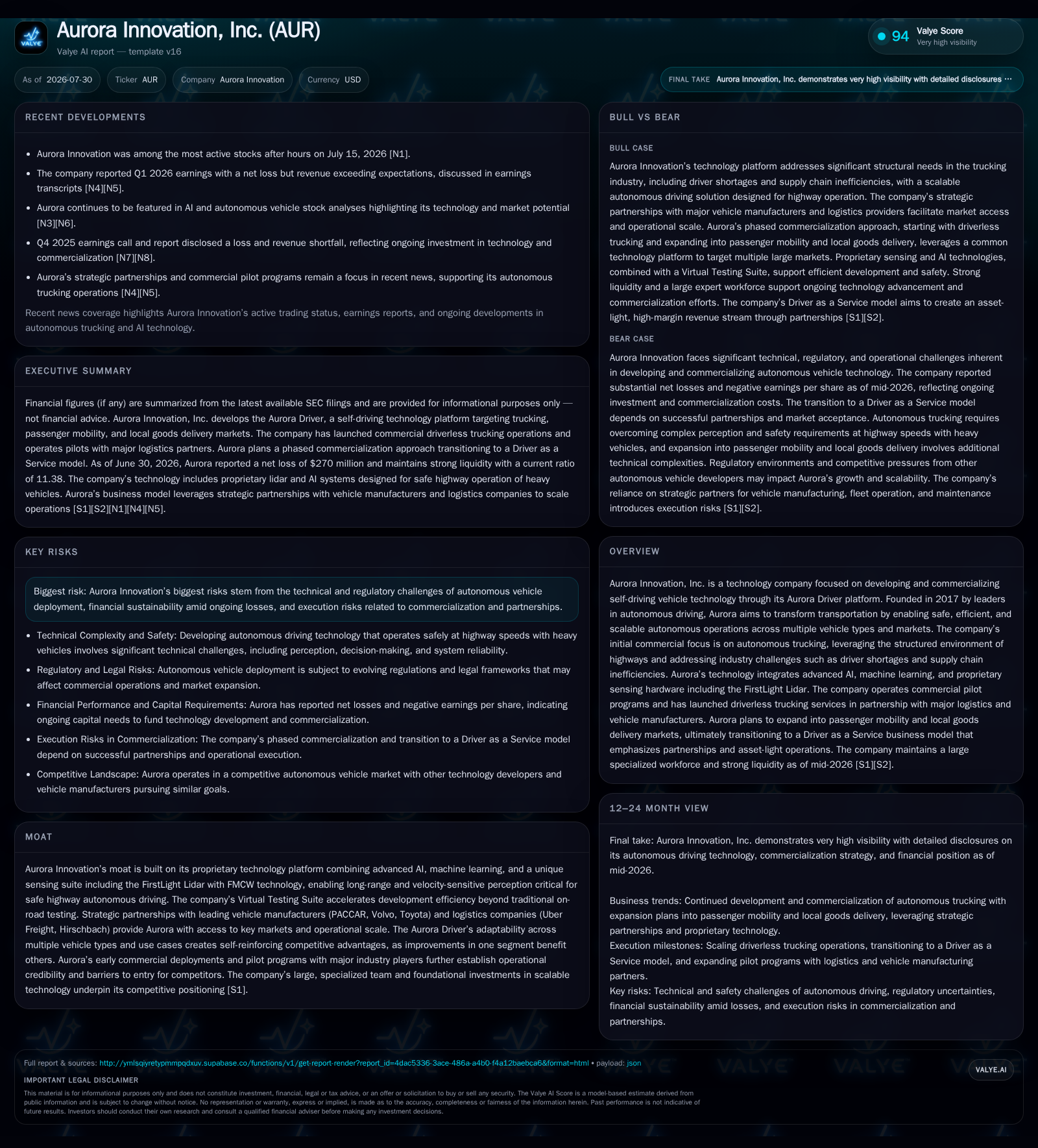
Aurora Innovation, Inc. is progressing its commercialization of autonomous freight trucking through the Aurora Driver platform, leveraging a Driver as a Service (DaaS) model that emphasizes partnerships and scalable technology. The company’s recent quarterly filing reveals early revenue generation from freight operations launched in April 2025, sustained investment in R&D, and strategic alliances that enhance hardware lifecycle management and software development. While operating losses remain significant due to heavy capital deployment, Aurora's strong liquidity and multi-vehicle platform position it to capitalize on structural demand in highway freight and expand into passenger mobility and goods delivery markets.
Recent Operating Update: Scaling Commercial Autonomous Freight
Aurora Innovation’s latest quarterly report filed July 29, 2026 ([S2]) highlights continued progress transitioning from pilot testing to commercial-scale driverless trucking services. Since the launch of Aurora Driver for Freight in April 2025 ([S1]), the company has begun recognizing revenue tied to fee-per-mile subscriptions under its Driver as a Service (DaaS) business model. This early monetization milestone validates years of R&D investment and marks a critical inflection point toward sustainable commercial operations.
The firm continues to operate controlled vehicle fleets directly during this nascent phase to develop operational playbooks instrumental for partners’ future scaling efforts—balancing fleet control with its long-term asset-light strategy ([S1]). No material changes were reported in risk factors related to technical or market execution challenges ([S13]).
Business Model: Asset-Light DaaS Leveraging Multi-Vehicle Autonomous Platform
Aurora’s core product, the Aurora Driver platform, combines advanced AI algorithms, machine learning software stacks, and proprietary sensor technology including FirstLight FMCW lidar hardware ([S1]). Designed for interoperability across vehicle classes—from Class 8 trucks to passenger vehicles—the platform’s extensibility underpins Aurora’s strategy to address multiple transportation markets.
Revenue is primarily derived through a per-mile subscription fee charged to fleet operators or third-party customers who own or lease vehicles integrated with Aurora Driver technology ([S1], [S25]). This DaaS approach reduces capital intensity for Aurora by outsourcing vehicle ownership and operation to partners such as OEMs (e.g., PACCAR) and logistics firms (e.g., Uber Freight), who bring existing manufacturing and fleet management expertise.
Partnerships with hardware lifecycle specialists like AUMOVIO (formerly Continental) support a hardware-as-a-service model paid on a per-mile basis ([S23]). This arrangement aligns costs with usage patterns while enabling scalable supply chain management, contributing positively to gross margins.
During initial commercialization stages, Aurora retains some direct operational control—leasing or owning vehicles equipped with its software—to refine processes critical for partner enablement at scale ([S1]). This phased approach balances internal control with external scaling ambitions.
Industry Context and Competitive Positioning
Operating at the technology development and integration layer of autonomous vehicle value chains, Aurora focuses on delivering comprehensive self-driving software and sensor fusion platforms rather than manufacturing vehicles or managing fleets long-term. Its competitive set includes companies like Waymo (Alphabet), specializing in passenger ride-hailing; TuSimple and Embark focusing on autonomous trucking; and Mobileye (Intel), known for sensor technologies.
Aurora differentiates itself through a versatile platform applicable across diverse vehicle types—a strategic advantage allowing knowledge transfer between freight trucking and passenger mobility use cases where highway autonomy is critical. This contrasts with peers more narrowly focused on single-market verticals.
Strategic OEM partnerships facilitate industrial-scale vehicle integration while logistics collaborations enhance market reach. Additionally, Aurora’s virtual testing capabilities accelerate validation cycles beyond traditional physical road tests—important given regulatory scrutiny over safety performance ([S1]).
Regulatory engagement remains proactive as evolving frameworks increasingly support safe deployment of autonomous systems on highways—a key enabler of commercial growth ([S23]).
Growth Drivers: Structural Freight Demand & Platform Scalability
Near-term growth is driven by addressing chronic driver shortages and efficiency challenges plaguing long-haul trucking networks. Autonomous highway driving offers safety improvements alongside operating cost reductions attractive to logistics operators.
Aurora leverages extensive real-world testing across varied geographies including Arizona, Texas, and Pennsylvania to ensure robustness against environmental variability—a prerequisite for scaling commercially ([S1]). Highway routes provide relatively structured environments conducive to safer autonomy compared with complex urban settings.
The extensible Aurora Driver platform allows lessons learned from Class 8 truck deployments to be applied directly toward passenger ride-hailing services targeting highway-heavy trips ([S1]). Longer-term plans include expansion into local goods delivery markets.
Continuous data collection from deployed fleets supports iterative improvements in disengagement rates—a critical safety KPI influencing regulatory acceptance—and frequent over-the-air software updates enhance capabilities without costly hardware replacements.
Risks & Execution Considerations
Achieving reliable Level 4/5 autonomy remains technically challenging given diverse driving conditions; system disengagement rates serve as key indicators of readiness. Regulatory approvals are uncertain despite active government relations efforts; delays could impede rollout timelines ([S13]).
Financially, Aurora operates at substantial losses typical for deep-tech startups transitioning toward commercialization. Operating loss exceeded $900 million at year-end 2025 driven by R&D spending exceeding $700 million annually focused on software refinement, sensor production scale-up including FirstLight lidar manufacturing capacity, simulation infrastructure investments, and early fleet operations ([F1], [S22]).
Strong liquidity entering mid-2026—with $136 million cash plus $1.25 billion current assets versus modest current liabilities—provides runway supporting near-term development without immediate capital raises ([F1]).
Execution risks center on integrating Aurora Driver into partners’ vehicle platforms reliably while aligning multiple stakeholders including OEMs, leasing firms, and fleet operators ([S23]). Competition remains intense from both well-funded incumbents and startups emphasizing differentiated technology or go-to-market strategies.
What To Watch Next
Key milestones include growth in commercially operated autonomous miles signaling market traction and revenue expansion under the pay-per-mile DaaS model. Monitoring system disengagement trends will reveal technological progress toward fully driverless operations.
Announcements regarding passenger mobility pilots leveraging shared hardware/software architectures will indicate successful platform extension beyond trucking ([S1]). Regulatory developments clarifying liability frameworks or expanding permissions will materially influence deployment velocity.
Financially, tracking cash burn relative to operational cash flow from ongoing services will inform sustainability ahead of further fundraising needs ([F1]).
Financial Profile Discussion
Aurora’s financials reflect an advanced-stage tech startup investing heavily in innovation amid early commercial revenues beginning mid-2025 linked to driverless freight services ([S1]). Operating losses totaled approximately $901 million at year-end 2025 fueled primarily by over $700 million annual R&D expenses aimed at advancing software algorithms, proprietary sensor hardware production including FirstLight lidar scaling, simulation capabilities expansion, and initial fleet operating costs ([F1], [S22]).
Liquidity as of June 30, 2026 stood robust at $136 million cash supported by $1.25 billion current assets against $110 million current liabilities yielding a strong current ratio above 11x—indicating low short-term financial stress risk ([F1]). Management expects this liquidity suffices for working capital needs for at least twelve months post-reporting period without immediate recapitalization requirements ([S16], [F1]).
Capital allocation prioritizes R&D over SG&A reflecting focus on maintaining technological leadership during commercialization ramp—paralleling peers like Waymo or TuSimple during similar stages.
Long-term viability depends on scaling autonomous miles commercially under DaaS contracts incorporating hardware-as-a-service elements via partnerships such as with AUMOVIO that convert fixed costs into variable expenses aligned with usage ([S23]). Economies of scale driven by platform commonality across segments will be essential to compress unit costs.
Disclaimer: This is research-only, informational analysis and not investment advice. It may include AI-generated interpretation and general industry context. Always verify important details using primary sources.

Comments