
Alibaba’s Fiscal 2026 Results Highlight Strategic Balance of Innovation and Market Challenges
Alibaba's latest quarterly and fiscal year results reveal strengthened revenue amid tech investment and regulatory scrutiny shaping its near-term outlook.
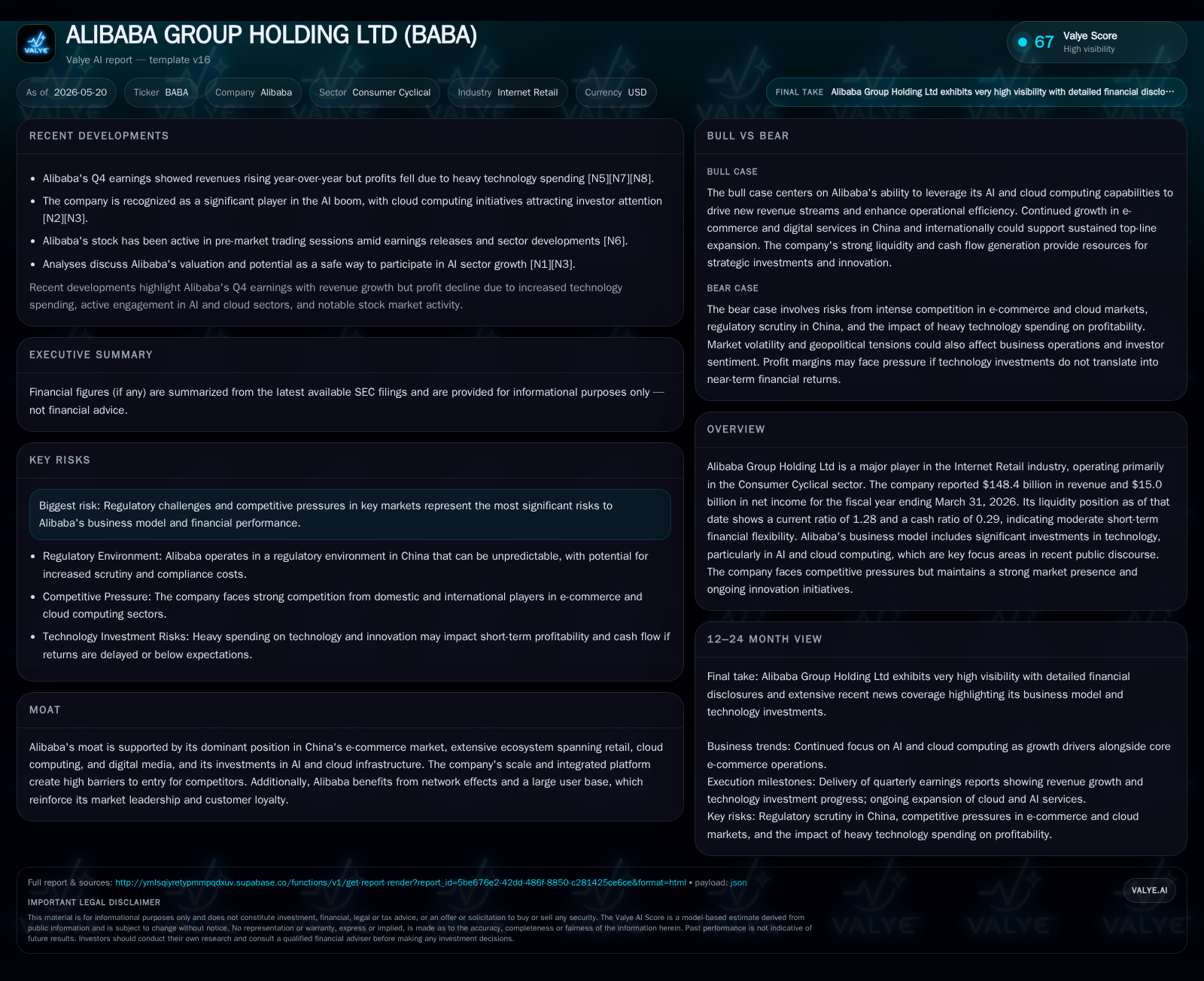
In its May 2026 quarterly filings, Alibaba reported continued revenue growth for fiscal 2026 tempered by margin pressures from elevated technology spending, particularly in AI and cloud capabilities. The company moderated its dividend payout compared to prior years, signaling a shift in capital allocation balance amidst an intensifying regulatory environment and robust competitive dynamics at home and abroad. Alibaba's integrated e-commerce platform, coupled with expanding cloud services, sustains its market leadership, while evolving legal frameworks and activist litigation remain notable risk factors. Tracking upcoming platform monetization milestones and regulatory developments will be critical for assessing Alibaba’s growth trajectory.
Recent Quarterly Update: Fiscal Q4 and Year-End Results
Alibaba Group’s fiscal fourth quarter ending March 31, 2026, as reported on May 13 ([S2], [S3]), highlights a continued trajectory of rising revenues juxtaposed with margin compression largely attributed to heavy technology spending. The company reported total fiscal year revenue of $148.4 billion with net income around $15 billion [F1]. Despite top-line growth exceeding expectations ([N2]), profits fell short due to amplified investments in AI capabilities and cloud infrastructure crucial for maintaining competitive differentiation ([N3], [N10]). Notably, Alibaba declared a regular cash dividend of $1.05 per ADS for fiscal year 2026 totaling approximately $2.5 billion—a significant contraction relative to the more generous dividends distributed in fiscal years 2024 and 2025 which included one-time extraordinary payouts totaling upward of $4 billion ([S2], [S1]). This signals a recalibrated capital return approach aligning with reinvestment priorities amid mounting external pressures.
Core Business Model and Product Ecosystem Overview
Alibaba is fundamentally an integrated internet retail powerhouse anchored by its vast e-commerce platforms—primarily Taobao and Tmall—which serve as critical conduits connecting merchants to China's extensive consumer base. Revenue chiefly derives from transaction fees, advertising solutions, and value-added merchant services embedded within this ecosystem ([S1]). The platform's sheer scale fosters formidable network effects: an expansive merchant pool attracts increasing consumers while high traffic volumes incentivize sellers to deepen engagement.
Complementing this retail backbone is Alibaba Cloud (Aliyun), a strategic bet underpinning future growth through cutting-edge cloud infrastructure integrated with AI technologies. Revenue recognition follows rigorous contract-performance analysis due to complex multi-element arrangements that bundle hardware, software licenses, installation, development, and ongoing maintenance ([S1]). This integrated model lends sticky, recurring revenue streams buffered by customer switching costs related to technology stack migration complexities. Moreover, Alibaba leverages digital media assets facilitating cross-promotional marketing enriching user engagement.
Industry Structure: Competitive Dynamics and Regulatory Environment
Alibaba operates within a tightly contested landscape dominated domestically by competitors such as JD.com and Pinduoduo who emphasize distinct value propositions around logistics efficiency or social commerce innovation respectively. On the international front, Alibaba extends through AliExpress and Alibaba.com targeting cross-border trade amid escalating geopolitical sensitivities ([S1]).
The regulatory climate represents a critical constraining factor: China’s intensified oversight aiming at antitrust enforcement and data security compliance has led to enhanced operational scrutiny ([S1]). Parallel regulatory regimes in Europe impose stringent data privacy requirements under GDPR alongside obligations under the Digital Markets Act impacting transparency, content moderation, and data sharing protocols especially pertinent for AliExpress operations. Such jurisdictions also potentially threaten increased penalty exposure for non-compliance forming a complex web of legal responsibilities expanding operational costs.
Growth Drivers: AI, Cloud Computing Investments, and Market Penetration
Recent disclosures emphatically spotlight Alibaba’s prioritization of artificial intelligence augmentation across cloud services as a cornerstone of sustainable competitive advantage ([N5], [N6]). By embedding proprietary AI algorithms within aliCloud offerings, the company aims to capture expanding enterprise SaaS demand spanning industries transitioning towards digital workflows.
Investments focus on scaling data center capacity while advancing algorithmic capabilities that optimize user experience on e-commerce platforms enhancing targeted advertising effectiveness and conversion rates. Additionally, digitization trends across China’s economy support cloud adoption gradually accelerating revenue diversification beyond commission-based models into higher-margin service contracts.
Strategically, Alibaba is also capitalizing on growing global market opportunities despite geopolitical headwinds by refining localized offerings compliant with domestic data sovereignty requirements—aiming to expand footprint particularly across Southeast Asia.
Risks and Constraints: Regulatory Scrutiny, Litigation, and Competitive Pressures
As detailed in the latest Form 20-F ([S1]), Alibaba faces several layered risk exposures:
- Regulatory Risk: Multijurisdictional regulatory landscape demands costly compliance adaptations; risks include fines or sanctions impacting operations materially.
- Activist Litigation: Increasingly prevalent lawsuits invoking consumer protection laws in China pose reputational hazards alongside potential financial liabilities.
- Competitive Intensity: Aggressive pricing strategies from peers undermine pricing power predominantly in commoditized e-commerce segments; sustained investment is necessary to maintain ecosystem relevance.
- Cost Pressures: While inflation has not heavily impacted results historically, future macroeconomic shifts could strain margins given reliance on labor-intensive logistics networks.
Near-Term Milestones and What To Watch Next
Looking forward, key monitoring points include quarterly earnings for Q1 FY2027 revealing progress on monetizing AI-powered cloud offerings alongside updates on regulatory compliance initiatives ([S2], [S3]). Interpretation of management commentary around capital allocation—especially any adjustments to dividend policies or share repurchase programs—and responses to activist claims will provide critical insight into strategic priorities.
Moreover, KPIs such as cloud service ARR growth rates, active merchant numbers on main platforms, user engagement depth measured via GMV (Gross Merchandise Volume), or retention ratios will offer tangible metrics signaling operational momentum.
Brief Financial Summary: Liquidity, Income Statement Highlights, and Capital Returns
The fiscal year ended March 31, 2026 closed with robust financial performance: revenues totaled approximately $148.4 billion supporting net income near $15 billion consistent with a sizable yet cautious profit base amid reinvestment ([F1]). Alibaba’s current ratio stood at a healthy 1.28 reflective of adequate short-term liquidity while cash reserves topped $19 billion bolstering financial flexibility for capex or opportunistic acquisitions ([F1]). The recalibrated dividend payout amounting to $2.5 billion contrasts prior multi-billion one-off distributions underscoring an intentional pivot to preserve cash amid ongoing sector uncertainties ([S2], [S1]).
Disclaimer: This analysis is provided solely for informational purposes without constituting investment advice or research views. It synthesizes publicly available SEC disclosures complemented by factual news reports as of May 2026. Readers should conduct their own due diligence when evaluating Alibaba Group Holding Limited or related securities.
Disclaimer: This is research-only, informational analysis and not investment advice. It may include AI-generated interpretation and general industry context. Always verify important details using primary sources.

Comments