
Bank of America Elevates Returns as Top-Line and Shareholder Payout Expand
Bank of America’s recent surge in revenue and disciplined capital returns underpin a fortified competitive position amid complex regulatory and market environments.
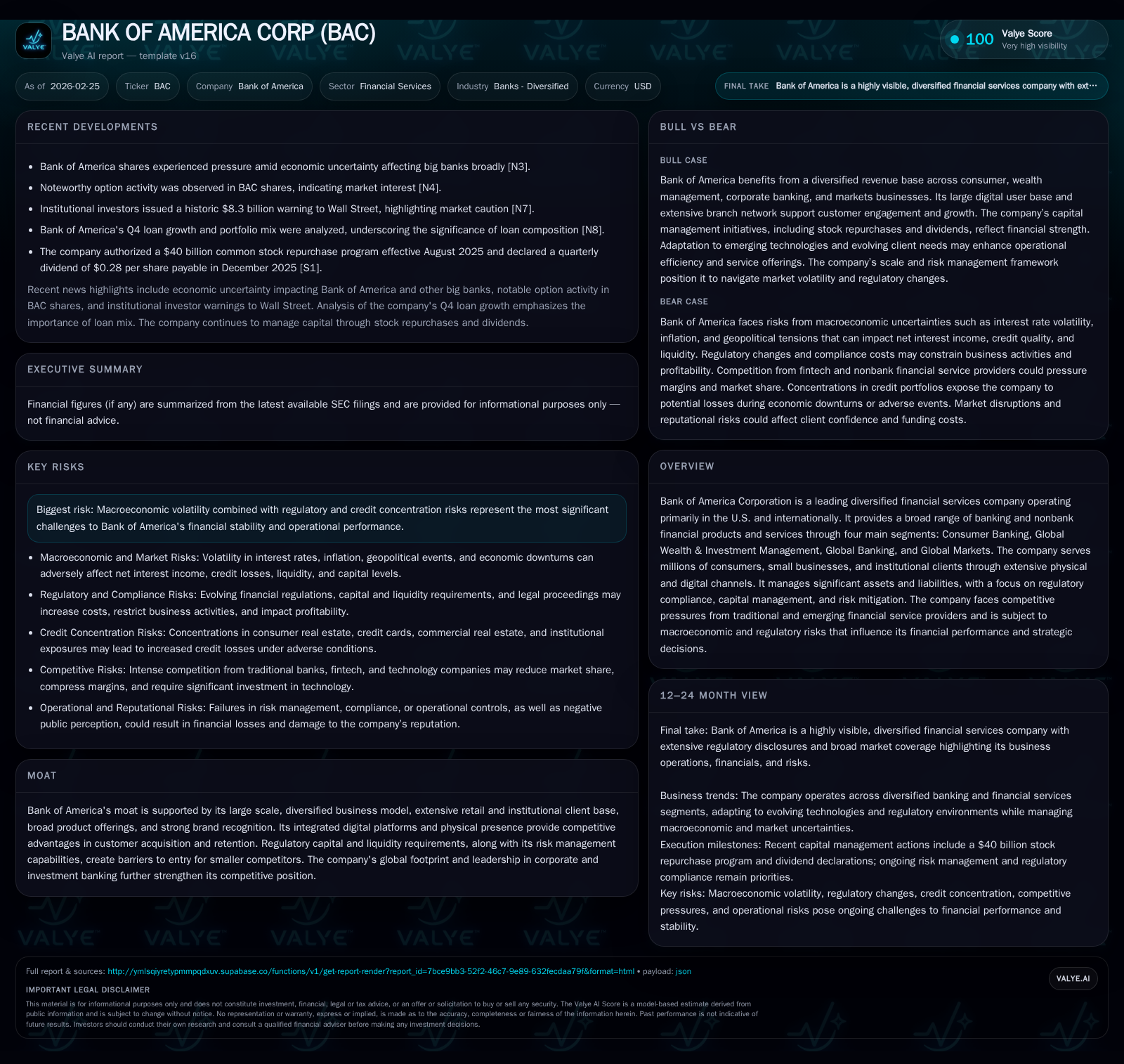
Bank of America reported an impressive 11% revenue growth in fiscal 2025, supported by diversified business segments and digital platform enhancements. Net income rose 12.4% over the prior year, while operating cash flow turned positive after two years of weakness, reflecting effective risk management amid challenging macroeconomic conditions. The bank’s capital allocation strategy intensified with substantial share repurchases totaling $21.4 billion, complementing stable dividend payments and driving a robust return on equity near 10.1%. Regulatory headwinds and credit concentration risks remain key challenges, but BofA's scale, integrated business model, and risk controls support resilient future earnings potential.
Revenue Growth Trajectory and Key Drivers Over Recent Years
Historical performance (annual)
| FY | Rev ($bn) | Net ($bn) | CFO ($bn) | Rev YoY | Net YoY |
|---|---|---|---|---|---|
| 2025 | 113.1 | 30.5 | 12.6 | +11.0% | +12.4% |
| 2024 | 101.9 | 27.1 | -8.8 | +3.4% | +2.3% |
| 2023 | 98.6 | 26.5 | 45.0 | +3.8% | -3.7% |
| 2022 | 95.0 | 27.5 | -6.3 |
Source: SEC companyfacts cache [F1].
Note: Some line items are omitted where multi-year comparability is limited in the structured SEC XBRL dataset; trend columns are shown only when comparable history exists.
Capital returns and efficiency (annual)
| FY | Buybacks ($bn) | ROE% |
|---|---|---|
| 2025 | 21.4 | 10.1 |
| 2024 | 13.1 | 9.2 |
| 2023 | 4.6 | 9.1 |
| 2022 | 5.1 | 10.1 |
Source: SEC companyfacts cache [F1].
Bank of America Corporation has demonstrated notable top-line expansion through fiscal year 2025, reporting revenues of $113.1 billion — an increase of roughly 11% compared to $101.9 billion recorded in FY2024 [F1]. This upward trajectory is anchored by the bank's diversified four-segment business model: Consumer Banking, Global Wealth & Investment Management (GWIM), Global Banking, and Global Markets [S1]. Within Consumer Banking, demand remained elevated for mortgage refinancing and home equity products despite interest rate volatility. GWIM benefited from higher assets under management driven by market appreciation and net new client inflows, while Global Markets capitalized on heightened trading activity amid macro uncertainty.
Digital platforms played a pivotal role by enhancing acquisition efficiency and customer engagement amidst evolving client preferences favoring omnichannel access [S1]. The integration of advanced digital tools complements the extensive physical branch network — collectively fortifying BAC’s moat against smaller fintech entrants that often lack scale or physical presence.
Macroeconomic factors influencing revenue stability include elevated inflation rates that pressured loan demand but aided net interest income growth due to higher short-term rates; however, increased economic uncertainty weighed on investment banking fees [S1][N3]. The bank's mixed exposure to consumer credit portfolios alongside corporate loans positions it well for moderate GDP growth scenarios but remains vulnerable should economic headwinds intensify.
Profitability and Cash Flow Trends: Navigating Market Challenges
Net income improved markedly to $30.5 billion for FY2025 from $27.1 billion the prior year — representing a 12.4% increase [F1]. This gain reflects disciplined expense management combined with stable credit quality that kept loan loss provisions within anticipated ranges despite broader market volatility [S1]. Net interest income (NII) experienced beneficial expansions given prevailing rate environments; however, fluctuations remain significant as deposit costs adjust upward amidst competitive pressures for liquidity.
Operating cash flow exhibited a pronounced turnaround to positive $12.6 billion in FY2025 after enduring negative cash flows in FY2024 (-$8.8 billion) and FY2022 (-$6.3 billion) [F1]. This recovery underscores improved collections efficacy coupled with tighter working capital controls within trading-related businesses where mark-to-market volatility had previously compressed cash flows.
Sector insights suggest credit quality resilience is partly attributable to proactive risk management frameworks emphasizing granular exposure limits particularly in consumer real estate lending and card portfolios—traditional areas susceptible to cyclical stress [S8][S20]. Loan loss reserves remained adequate amidst inflation-driven cost pressures affecting consumer repayment capacity.
Capital Allocation: Buybacks, Dividends, and Return on Equity Dynamics
Bank of America significantly expanded capital returned to shareholders in FY2025 with share repurchases soaring to $21.4 billion—more than doubling the roughly $13 billion spent in FY2024—and exceeding earlier years’ totals by a wide margin [F1]. Dividend payouts remained consistent with the company’s long-standing policy aimed at stable distributions reflecting earnings sustainability rather than aggressive hikes.
Despite rising regulatory buffers expected from increased Global Systemically Important Bank (G-SIB) surcharges—set to escalate from 3.0% to approximately 3.5% in 2027—BAC maintained an approximate return on equity near 10.1%, signaling effective capital deployment under Basel III-like frameworks [F1][S7]. This equilibrium between regulatory compliance and shareholder value creation exemplifies prudent capital stewardship.
Capital optimization also aligns with the firm’s liquidity coverage ratio obligations and stress testing mandates that constrain excess leverage yet permit opportunistic buybacks when prudential metrics are met [S7][S10]. The absence of substantial capex disclosure suggests reinvestments are largely channeled into technology upgrades supporting digital capabilities rather than traditional asset-intensive expansions.
Regulatory Framework Impact and Risk Management Commentary
The regulatory landscape continues to exert profound influence over operational flexibility and financial parameters for Bank of America. As detailed extensively in the annual SEC filings, the corporation confronts escalating complexity stemming from heightened scrutiny around anti-money laundering (AML), fair lending practices, privacy laws such as GDPR/CCPA compliance obligations, as well as emergent risks related to artificial intelligence governance [S5][S14][S18].
Capital adequacy rules impose incremental buffer requirements including Supplemental Capital Buffer (SCB) recalibrations which may compress distributable earnings if breached [S7]. Simultaneously, liquidity mandates like the Liquidity Coverage Ratio (LCR) constrain short-term funding strategies, mandating balance sheet adjustments responsive to market turmoil or geopolitical events potentially disrupting funding markets [S4][S6][S22].
Credit concentration remains a material area of vulnerability due to significant exposure within consumer real estate loans, card debt portfolios, commercial real estate segments, as well as financial institution counterparty clusters—all intensifying potential risk clusters during economic downturns or market stress episodes [S8][S20]. Effective collateral valuation practices alongside margin call mechanisms mitigate some counterparty credit risk embedded within derivative portfolios.
Future Earnings Outlook and Strategic Growth Constraints
Looking ahead, Bank of America's growth prospects hinge on successfully navigating a delicate balance: leveraging digital innovation and expanding high-margin wealth management while managing compression risks associated with shifting interest-rate cycles impacting net interest margins (NIM) [N14][S1]. Digital platform investments promise scalable impacts on customer acquisition costs but require sustained operational discipline.
Conversely, macroeconomic uncertainties—evidenced by recent dips in market sentiment towards BAC shares due to economic concerns—cast shadows over loan demand vigor as consumers react cautiously amid inflationary pressures [N3]. Competitive dynamics intensify notably within payment services and fintech-led lending where agility trumps legacy scale advantages absent thoughtful innovation.
Regulatory changes slated for coming cycles may tighten capital return levers if higher buffer thresholds or additional compliance costs materialize; hence monitoring updates regarding Basel framework evolutions will be essential for forecasting distributable income capacity beyond current levels [S7][N7]. Adjustments in loan portfolio mix toward secured assets could provide some NIM support but must be balanced against credit loss expectations inherent in evolving economic scenarios.
Analysis: Market watchers should stay attuned to quarterly disclosures emphasizing loan loss provisions trends alongside noninterest income fluctuations particularly from trading desks integrating complex derivatives—a barometer for risk appetite shifts across institutional clients.
Important Milestones to Monitor in 2026 and Beyond
Several critical inflection points will shape Bank of America's valuation narrative moving forward. Regulatory developments around G-SIB surcharge recalibration scheduled for late-2026 warrant close observation given their potential impact on capital allocation policies including dividends and buybacks [S7][S3].
Technical chart patterns recently highlighted indicate share price testing key moving averages—a signal often preceding volatility phases influenced by macroeconomic news flow or earnings surprises [N7].
Institutional investor activity typified by recent historic $8.3 billion warnings underscores increasing scrutiny on Wall Street constituents including major banks; shifts here often presage repositioning linked to broader sector rotations or thematic risks such as credit tightening [N12].
Earnings reports remain pivotal milestones providing updated guidance on NII trajectories amid Fed rate forecasts alongside commentary on expense management efficacy and impairment charge outlooks—all crucial for assessing sustainably elevated ROE levels under pressure scenarios.
In summary, while Bank of America benefits from substantial scale advantages reinforced by robust digital infrastructure and diversified revenue streams, continual vigilance toward emerging regulatory burdens and macroeconomic developments is indispensable for understanding its capacity to maintain its elevated profit momentum.
Disclaimer: This is research-only, informational analysis and not investment advice. It may include AI-generated interpretation and general industry context. Always verify important details using primary sources.

Comments