
Atlanta Braves Holdings Navigates Debt Burdens and Broadcasting Shifts Amid Operational Improvements
The holding company’s financial performance reflects ongoing challenges from substantial indebtedness, broadcasting transitions, and real estate development risks balanced against operational progress and stable stadium agreements.
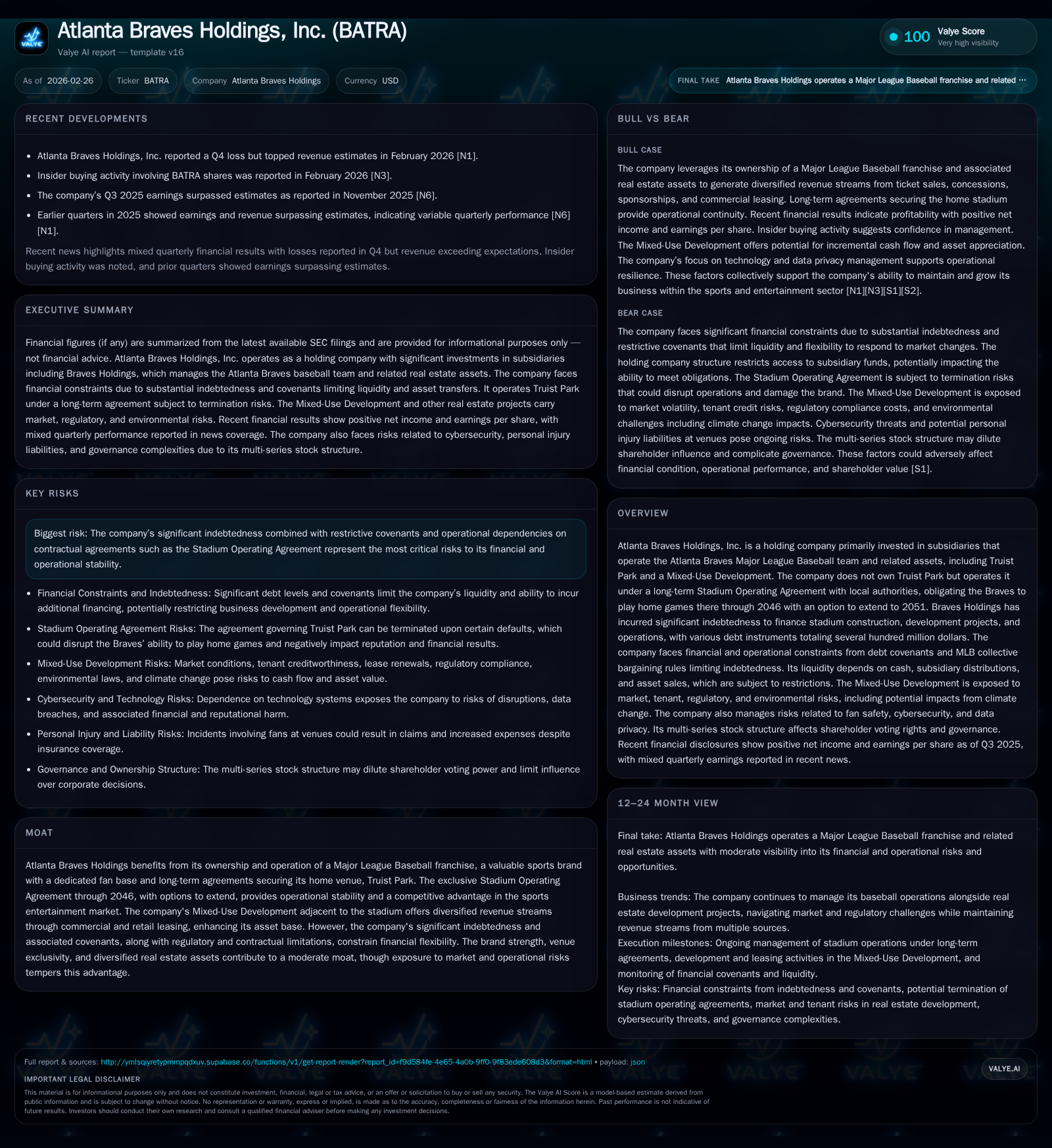
Atlanta Braves Holdings, Inc., owner of the Atlanta Braves franchise and related assets, generates revenue primarily from baseball operations and a Mixed-Use Development near Truist Park. The company benefits from long-term stadium agreements securing venue stability through 2046 but carries heavy debt incurred for stadium construction and development projects, imposing financial constraints. Recent filings show reduced operating losses and improved net income alongside growing cash flow despite continued high capital expenditures. Transitioning local broadcasts from third-party regional sports networks to the proprietary BravesVision platform introduces revenue uncertainty. While liquidity remains solid with nearly $100 million in cash, current liabilities surpass current assets, reflecting short-term pressures. Debt covenants, MLB regulations, and macroeconomic factors affecting tenant demand remain key risks.
Company Overview and Historical Performance
Atlanta Braves Holdings, Inc. operates as a holding company invested primarily in subsidiaries managing the Atlanta Braves Major League Baseball team along with associated properties including Truist Park and an adjacent Mixed-Use Development [S1]. While the company does not own Truist Park outright, it operates under a binding Stadium Operating Agreement (SOA) with Cobb County that mandates all home games be played at the venue through the 2046 season with a five-year extension option through 2051 [S8]. This agreement provides operational stability for the franchise.
Financially, Braves Holdings has confronted significant operating losses largely driven by investments into stadium infrastructure and real estate development costs, compounded by cyclical factors inherent in sports entertainment [F1]. Operating losses improved markedly from -$46.4 million in FY2023 to -$13.5 million in FY2025—a nearly 66% reduction—while net losses narrowed from -$125.3 million to -$23.4 million over the same period [F1].
Operating cash flow rose significantly from $1.6 million in FY2023 to $25.2 million in FY2025 (+51.7% YoY), though elevated capital expenditures of $93.7 million in FY2025 continue to produce negative free cash flow [F1]. These capital expenses largely fund ongoing developments related to the Mixed-Use project and stadium maintenance.
Historical performance (annual)
| FY | Net ($mm) | CFO ($mm) | OpInc ($mm) | Capex ($mm) | Net YoY |
|---|---|---|---|---|---|
| 2025 | -23 | 25 | -14 | 94 | +25.3% |
| 2024 | -31 | 17 | -40 | 86 | +75.0% |
| 2023 | -125 | 2 | -46 | 69 |
Source: SEC companyfacts cache [F1].
Capital returns and efficiency (annual)
| FY | FCF ($mm) | ROE% |
|---|---|---|
| 2025 | -68 | -4.4 |
| 2024 | -69 | -6.0 |
| 2023 | -67 | -23.7 |
Source: SEC companyfacts cache [F1].
(Revenue figures are not disclosed explicitly; analysis focuses on earnings metrics per available data.)
Revenue Drivers and Business Segments
Revenue generation is anchored predominantly in baseball-related streams including ticket sales—spanning premium seating suites—concessions, merchandise sales, national and local broadcasting rights arrangements, sponsorships, and postseason event proceeds [S1]. The Mixed-Use Development adjacent to Truist Park contributes diversified rental income via commercial leases [S14][S19].
Broadcast revenues are split between nationally negotiated contracts managed collectively through MLB—which allocates proceeds among member teams—and locally negotiated agreements for regional broadcast rights handled directly by Braves Holdings [S1]. A recent major disruption occurred when Diamond Sports Group filed bankruptcy and restructured as Main Street Sports Group but subsequently failed to meet contractual payments during late 2025/early 2026. This led Braves Holdings to terminate its regional broadcasting agreement [S1]. To address this gap starting in the 2026 season, the company launched BravesVision—a proprietary multimedia platform for local broadcasts [N1][S1].
This transition entails financial risk given uncertainty about BravesVision’s ability to replicate prior local broadcast revenues amid evolving viewer consumption patterns [S1]. On-field performance also remains a critical factor underpinning fan engagement levels that drive ticketing and merchandise sales; however recent postseason appearances have been limited which could impact ancillary revenues [S1].
Debt Profile and Financial Flexibility
Braves Holdings carries substantial indebtedness related to stadium construction ($223.8 million outstanding), Mixed-Use Development financing ($487.3 million outstanding), and other facilities including spring training assets ($30 million) as of December 31, 2025 [S14]. These obligations restrict refinancing capacity due to restrictive covenants embedded within debt instruments as well as limitations imposed by MLB's collective bargaining agreement Debt Service Rule [S4][S6][S8][S14][S20]. Covenants additionally constrain flexibility by limiting asset transfers or changes of control.
The holding company structure further complicates liquidity because distributions from subsidiaries depend on their individual operating results plus regulatory or contractual restrictions that may limit dividends or intercompany transfers [S4][S8]. As of fiscal year-end 2025 the company held approximately $99.9 million in cash equivalents but current liabilities exceeded current assets by a wide margin resulting in a current ratio near 0.42—indicating short-term liquidity pressures [F1].
Noncompliance with SOA terms risks termination of stadium operating rights which would disrupt home game scheduling and potentially damage brand reputation [S8][S15]. The SOA includes rights of first refusal and purchase options for Truist Park sales events providing some protection over venue control.
Growth Outlook
Future growth prospects depend on:
- Sustained or improved on-field success driving increased ticket sales (including premium seating), postseason participation revenue uplift, merchandise sales growth and higher broadcast viewership engagement [S1].
- Effective monetization of BravesVision restoring lost local broadcast income previously generated under third-party distribution agreements amid evolving streaming landscapes.
- Successful leasing activity within the Mixed-Use Development supporting commercial rental income diversification alongside baseball operations while enhancing asset values; this remains sensitive to broader economic conditions impacting tenant solvency [S9][S14][S23].
- Continued capital investments advancing development projects with potential for long-term returns if managed prudently within budget.
Constraints include:
- Debt service rules restricting incremental leverage needed for large expansions or acquisitions absent equity issuance subject to dilution risks [S4][S6].
- Economic headwinds potentially depressing attendance or increasing tenant defaults adversely impacting revenues [S9][S23].
- Risks of diminished fan interest or media fragmentation weakening traditional revenue bases.
Capital Allocation and Ownership Structure
Braves Holdings currently does not pay dividends nor conduct share repurchases; its capital allocation prioritizes reinvestment into operations and development projects aligned with strategic priorities [S5][S7][F1]. Ownership is concentrated with John C. Malone controlling over half of aggregate voting power influencing corporate governance significantly—a factor that could deter takeover attempts or governance changes given Nasdaq controlled company status implications [S16][S22][S25][S27]. The company’s multi-class share structure limits voting rights among common stock classes adding complexity for minority shareholders [S7][S16].
Regulatory Environment and Risks
The regulatory framework encompasses MLB collective bargaining constraints limiting indebtedness capacity; privacy/security compliance obligations related to digital platforms; director/officer liability protections under Nevada law potentially complicating shareholder litigation; plus anti-takeover provisions embedded within governance documents restricting certain transactions that might unlock shareholder value [S10][S11][S21][S26][S27].
Key Considerations Going Forward
- Monitoring BravesVision adoption metrics relative to legacy broadcast contracts will be crucial for near-term revenue outlooks.
- On-field team performance remains vital for sustaining fan engagement-dependent revenue streams.
- Navigating capital markets constraints while funding ongoing developments without excessive leverage will test management agility.
- Lease renewal rates within the Mixed-Use Development alongside broader commercial real estate trends will influence future cash flow stability.
- Compliance with debt covenants especially Debt Service Rule limits will be important indicators of default risk.
Summary
Atlanta Braves Holdings balances strong brand equity rooted in its MLB franchise status with operational complexities stemming from substantial indebtedness linked closely to large-scale stadium construction and real estate developments. Improvements in operating efficiency have moderated historic losses while rising cash flows provide some cushion against funding needs; however high capital spending sustains free cash flow deficits. Transitioning away from third-party regional sports networks toward an owned multimedia platform introduces fresh revenue uncertainties amid contractual stadium rights ensuring venue continuity through mid-century.
This positions the company with moderate competitive advantages derived from venue exclusivity and diversified assets but circumscribed by leverage constraints plus shifting media consumption dynamics requiring vigilant execution.
This analysis is based solely on publicly available information as of February 26, 2026,and does not constitute investment advice or recommendations. It synthesizes known financial data points and documented business factors pertaining to Atlanta Braves Holdings, Inc.
Disclaimer: This is research-only, informational analysis and not investment advice. It may include AI-generated interpretation and general industry context. Always verify important details using primary sources.

Comments