
Bayview Acquisition Corp Navigates Nasdaq Compliance Amid Oabay Merger Extension
Bayview Acquisition Corp extends its merger deadline with Oabay Inc. to December 19, 2026, while maintaining Nasdaq Capital Market listing, reflecting ongoing SPAC execution challenges in the Asian market.
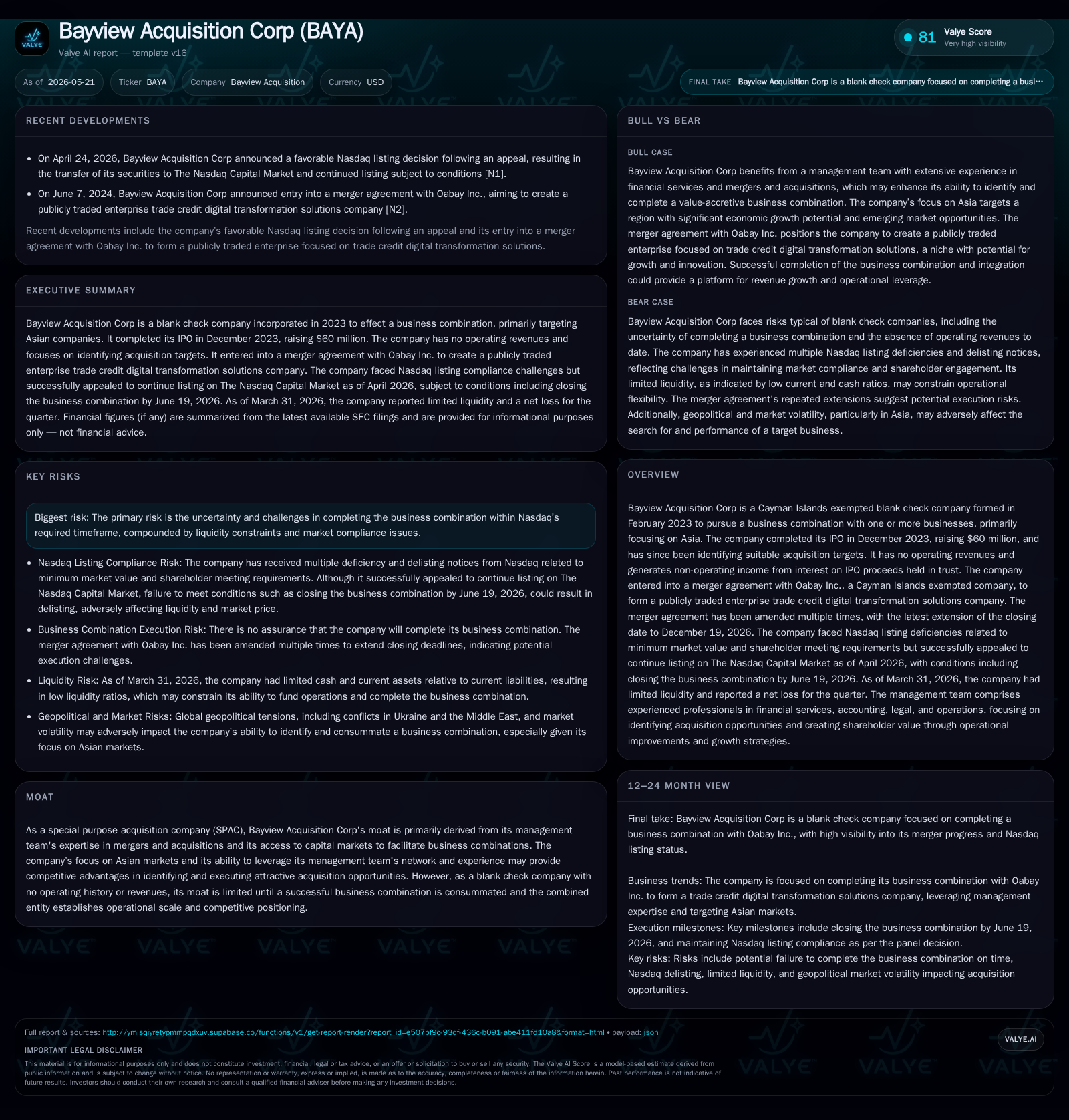
Bayview Acquisition Corp’s latest 10-Q filing details an extended merger closing deadline with Oabay Inc. to December 19, 2026, following a successful appeal against Nasdaq delisting threats tied to minimum market value and shareholder requirements. As a blank check company focused on Asian acquisitions, Bayview currently generates only interest income from IPO proceeds. The firm targets growth opportunities in Asia’s expanding digital trade credit sector through the Oabay merger. Key risks include regulatory uncertainties, timing pressures, and constrained liquidity ahead of deal closure.
Recent Operating Update Highlights Merger Timing and Nasdaq Listing
Bayview Acquisition Corp’s May 20, 2026 10-Q filing confirms ongoing efforts to finalize its business combination with Oabay Inc. The company received multiple Nasdaq deficiency notices between August 2025 and March 2026 concerning minimum market value ($50 million), publicly held shares (over 1.1 million), and shareholder meeting requirements [S2]. Following an appeal, the Nasdaq Hearing Panel granted continued listing conditional on transferring Bayview’s securities to the Nasdaq Capital Market by April 24, 2026, and completing the business combination by June 19, 2026 [S2].
Subsequently, Bayview amended its merger agreement with Oabay Inc., extending the outside closing date to December 19, 2026 [S3]. This extension reflects pragmatic timing adjustments during market challenges and followed prior amendments that realigned earnout milestones and transaction sequencing [S3].
Operationally, Bayview continues as a blank check vehicle generating non-operating income from interest on IPO funds held in trust; it has yet to commence revenue-generating operations [S1], [S2].
Business Model: Targeting Asian Private Companies via SPAC Structure
Incorporated in February 2023 as a Cayman Islands exempted company, Bayview completed a $60 million IPO in December 2023 alongside private placement units [S1]. The company’s business model centers on acquiring one or more Asian private companies with strong management teams, scalable operations, predictable cash flows, and clear pathways to profitability [S1].
Asia’s sustained economic expansion—driven by private sector growth, technological innovation, rising middle-class consumption, and structural reforms—forms the strategic backdrop for Bayview’s acquisition focus [S1]. Notably, Bayview excludes targets reliant on China-based Variable Interest Entity (VIE) structures due to regulatory complexities [S1], underscoring cautious geographic risk management.
Until consummation of its business combination, Bayview incurs expenses primarily related to public company compliance rather than commercial activities [S1].
Industry Context: SPACs Targeting Asia Face Regulatory and Valuation Challenges
Bayview is part of a competitive group of SPACs seeking access to high-growth Asian businesses for U.S. public market entry. This sector faces valuation pressures from intensified regulatory scrutiny—particularly affecting China-linked entities—and fluctuating investor appetite for speculative PIPE transactions.
Documentary requirements including audited financial statements compliant with PCAOB standards further constrain potential acquisition candidates able to meet disclosure timelines [S1]. Regulatory uncertainties around offshore listings of China-influenced companies introduce additional risk premiums and structural complexity.
Bayview’s recent Nasdaq compliance challenges mirror broader sector risks where delayed mergers threaten listing status. Its transfer from Nasdaq Global Market to Nasdaq Capital Market aligns with peer strategies seeking more accommodating listing standards [S2], [N1].
Growth Drivers Centered on Oabay Merger and Asian Market Dynamics
The pending merger with Oabay Inc., a digital transformation solutions provider specializing in trade credit markets, is key for Bayview unlocking operational revenues beyond interest income [S3], [S1].
Asia’s macroeconomic trends support this opportunity: expanding middle-class consumption drives B2B trade finance demand; rapid digital adoption fuels integrated credit risk platforms; and policy frameworks favor fintech innovation enhancing ecosystem modernization.
Amendments revising earnout milestones based on consolidated revenue metrics indicate management expects accelerated top-line growth post-merger [S3], aligning incentives toward operational scale rather than financial engineering alone.
If successfully executed, Bayview-Oabay could capitalize on structural shifts toward enterprise trade credit digitization—a niche characterized by customer stickiness due to integration complexity and data-driven risk insights.
Risks: Regulatory Uncertainty, Execution Timeline Pressure, Liquidity Constraints
Key risks involve execution under compressed timelines—the original June 19, 2026 deadline has been extended but still imposes short-term pressure to close the merger [S2], [S3]. Failure risks delisting and significant shareholder value erosion.
Regulatory risk remains notable despite avoidance of VIE structures. Chinese regulatory influence over overseas listings continues to create uncertainty ranging from intervention potential to capital flow restrictions that could limit target availability or increase compliance costs [S4].
Liquidity constraints are evident: as of March 31, 2026 quarter-end data shows current assets of approximately $126k against current liabilities exceeding $4 million (current ratio 0.03), reflecting tight short-term working capital largely driven by public company expenses without operating revenues [F1]. Cash balances outside trust accounts are minimal ($38k as of September 30, 2025), while total debt stands near $1.5 million net of cash—typical for pre-combination SPACs reliant on trust funds for deal financing [F1].
Extended transaction durations expose Bayview to capital markets volatility where shifts in investor sentiment or geopolitical developments could adversely affect valuations or deal appetite.
Upcoming Milestones: Merger Closure and Listing Compliance
Critical upcoming milestones include fulfilling all Nasdaq conditions by the December 19, 2026 extended closing date per Amendment No.4 [S3], securing financing commitments such as PIPE investments supporting transaction completion, and communicating integration plans post-close demonstrating operational viability.
Shareholder votes on proxy materials will also be pivotal alongside any further amendments adjusting earnout terms or transaction sequencing that may signal renegotiations.
Investors should focus on tangible evidence of deal progression over pre-closure valuation speculation given protracted timelines so far.
Financial Snapshot: Typical Pre-Combination SPAC Profile With Limited Liquidity
Bayview’s financial profile reflects standard SPAC characteristics before business combination: minimal operating expenses mainly from legal and reporting compliance offset by nominal interest income earned on IPO proceeds invested conservatively in government securities or money market funds [S1], [F1].
As of March quarter-end (March 31, 2026), current assets stood at about $126k versus current liabilities exceeding $4 million yielding a critically low current ratio (~0.03), evidencing tight working capital constrained primarily by deferred public company costs payable without operating revenue inflows [F1]. Cash outside trust accounts was roughly $38k at last measured date (September 30, 2025) with total debt near $1.5 million net of cash—a liquidity profile underscoring dependence on successful merger closure for expanded capital access post-combination [F1].
This analysis is based exclusively on official SEC filings as of May 21, 2026 ([S1]-[S26]) supplemented by validated financial snapshots ([F1]) without speculative assumptions or forward-looking research views.
Disclaimer: This is research-only, informational analysis and not investment advice. It may include AI-generated interpretation and general industry context. Always verify important details using primary sources.

Comments