
Barclays PLC Navigates Strategic Liquidity and Geographic Shifts Amid Sector Pressures
Robust 2025 earnings and unmatched liquidity empower Barclays’ adaptive repositioning in a complex banking landscape.
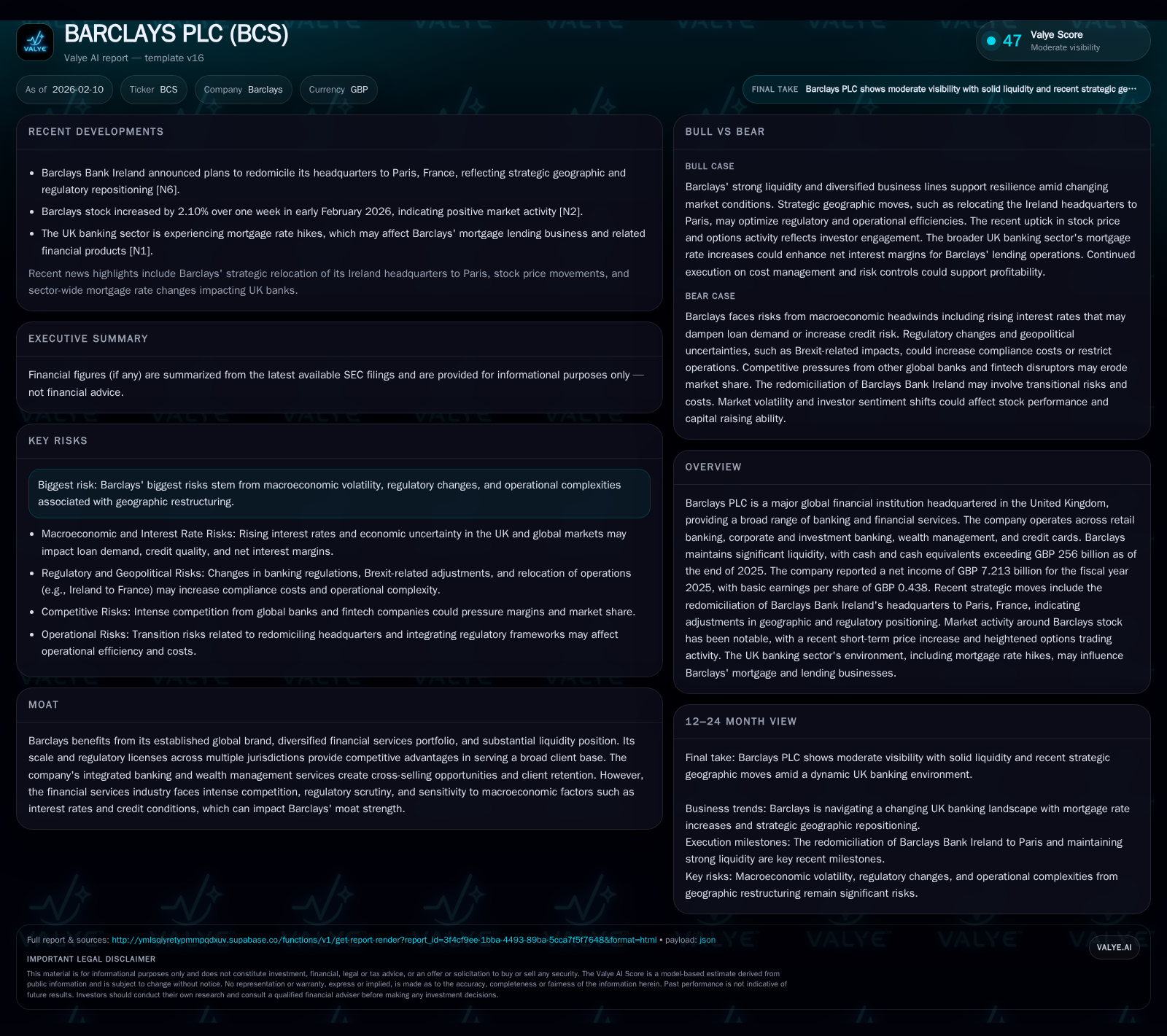
Barclays PLC posted a strong net income of GBP 7.213 billion for fiscal 2025, supported by a substantial cash and equivalents buffer exceeding GBP 256 billion. The company’s recent decision to redomicile Barclays Bank Ireland’s headquarters to Paris signals strategic regulatory repositioning within the shifting EU framework post-Brexit. Market sentiment has shown increased optimism reflected in notable short-term stock gains and heightened options activity. However, sectoral headwinds such as UK mortgage rate hikes and regulatory intricacies continue to shape Barclays’ operational environment.
Setting the Stage: Barclays at a Financial Crossroads
Barclays PLC enters 2026 fortified by strong fiscal results from the previous year and a commanding liquidity position. The company’s reported net income of GBP 7.213 billion for 2025 confirms its capacity to generate sustainable profitability despite sector-wide headwinds [F1][N1]. This milestone unfolds within an evolving global banking landscape marked by regulatory realignments, rising interest rates, and shifting geopolitical contours. Adding nuance, recent market activity reflects growing investor attention, with Barclays stock appreciating over two percent in a single week, accompanied by sharp rises in options volumes and volatility measures [N9][N11]. Together these data threads sketch a narrative of a legacy financial institution caught between preserving stability and adapting to change.
Deep Dive into 2025: Earnings, Liquidity, and Profitability Insights
Delving deeper into Barclays’ financials for 2025 highlights multiple pillars undergirding its strength. Cash and cash equivalents topped GBP 256 billion at year-end — an uncommon liquidity cushion that provides the company with exceptional strategic flexibility [F1]. This buffer acts as both a defensive moat during market turbulence and as ammunition for potential opportunistic investments or capital maneuvers.
The GBP 7.213 billion net income was buoyed by declining credit impairment charges, signaling improved risk management and lending quality under tighter macroeconomic conditions [N1][S2]. This decline not only lifted profitability but also implies discipline in underwriting standards amid challenges like rising UK mortgage rates. Such financial health suggests Barclays is managing credit risk prudently relative to some peers who face more volatile provisioning demands.
Strategic Geography: The Paris Move and Regulatory Reconfigurations
A defining strategic development for Barclays came with the redomiciliation of its Irish subsidiary’s headquarters from Dublin to Paris [N10]. This move reveals multi-dimensional objectives broadly reflecting adaptive responses to post-Brexit regulatory fragmentation.
Paris offers the bank access to EU regulatory frameworks less encumbered by political uncertainty compared with Ireland’s position outside the UK-EU settlement area. It aligns Barclay’s operational footprint closer with continental European markets while potentially streamlining compliance hurdles related to EU financial services passporting rules. Such geographic recalibrations carry operational complexities but underscore Barclays’ proactive stance to optimize regulatory exposure, reduce legal risks, and reinforce business continuity.
Navigating Market Sentiment: Stock Momentum and Volatility Analysis
Investor sentiment around Barclays recently crystallized in measurable terms — the stock advanced +2.10% over one week coupled with surging implied volatility across option strikes [N9][N11]. Heightened options trading volume focused on near-term expirations signals sophisticated hedging or speculative positioning anticipating material news or earnings momentum.
This dynamic can be interpreted as market recognition of Barclays' strong earnings performance blended with optimism about successful geographic restructuring. Alternatively, it also indicates underlying uncertainty where investors seek protection against downside shocks given sector pressures such as fluctuating interest rates or geopolitical events affecting cross-border banking flows.
Competitive Benchmarking: Barclays versus Major European Peers
Relative to fellow European banks Deutsche Bank and UBS—both reporting improved Q4 earnings with cost containment gains—Barclays demonstrates comparable strengths while benefitting from its robust liquidity stance [N2][N3]. Deutsche Bank reported advances partly driven by reduced provisions; UBS emphasized wealth management resilience. Barclays combines these traits while leveraging a more diversified service portfolio ranging from retail deposits through corporate advisory.
This diversification helps smooth revenue variability and potentially shields it from localized economic disruptions experienced by competitors more concentrated in specific segments or geographies. Nonetheless, Barclays must continuously balance investment in digital transformation and risk oversight to keep pace within this competitive tapestry.
Sector Winds: Mortgages, Macroeconomics, and Regulatory Headwinds
The backdrop for Barclays’ retail franchise includes UK mortgage rate increases that ripple through funding costs, borrower affordability, and ultimately lending volumes [N8]. While these shifts can compress net interest margins in the short run, they may bolster fee income via refinancing activities or encourage growth in alternative credit products if managed adeptly.
Regulatory pressures persist robustly across jurisdictions where Barclays operates—requiring ongoing adjustments in capital allocation, stress testing protocols, and consumer protection compliance. These macro-financial currents necessitate a nimble balance between growth ambitions and rigorous risk governance frameworks deeply embedded within the firm’s culture.
Unpacking Risks: Operational Complexity Meets Global Challenges
Barclays’ expansive footprint across multiple countries brings inherent operational complexity amplified by landmark geographic restructurings such as the Irish-to-French headquarter relocation [valye_report_excerpt]. Such transformations challenge IT infrastructure alignment, staff redeployment, license revalidations, and legal entity management.
Macro-level exposures further complicate this picture—fluctuating interest rate regimes can alter credit losses abruptly; inflationary pressures may increase operational costs; geopolitical tensions could constrain capital movements across borders. Recognizing these vectors is crucial for understanding vulnerabilities embedded in Barclays' forward-looking risk profile.
The Moat in Focus: Brand Strength and Diversification Benefits
Beyond numbers lies Barclays' enduring competitive advantage embodied by its global brand recognition cultivated over decades [valye_report_excerpt]. This reputation supports client acquisition across wholesale banking sectors requiring trust-backed advisory capabilities.
Its integrated services—from wealth management catering to high-net-worth individuals through corporate lending—create natural cross-selling synergies bolstering client stickiness. Such an ecosystem reduces reliance on any single revenue stream while enabling scale economies in technology investments designed to enhance customer experience.
Investment Outlook: Weighing Opportunity Against Exposure
Synthesizing these insights presents a well-capitalized institution positioned to leverage its liquidity strength while steering through regulatory complexities highlighted by its proactive geographic maneuvers [F1][N9]. While short-term market enthusiasm demonstrates confidence in this trajectory, incumbent risks related to economic cycles and operational transformation must not be underestimated.
For stakeholders tasked with assessing Barclays within broader portfolios, appreciating this duality—the blend of stability rooted in balance sheet solidity alongside strategic change—offers clarity around potential axes of opportunity balanced against exposure points.
Conclusion: Barclays’ Balancing Act Between Stability and Change
Barclays PLC stands at a pivotal juncture characterized by substantial earnings momentum coupled with calculated geographic repositioning amidst increasingly intricate banking dynamics. Its formidable liquidity cushion acts as both shield against shocks and springboard for future initiatives serving a diverse client base under evolving regulatory regimes.
Simultaneously navigating competitive pressures from peers entrenched in similar transition phases underscores the necessity for sustained operational agility paired with brand-driven client engagement strategies. Ultimately, Barclays exemplifies how an established global lender can maintain equilibrium—preserving foundational strengths while embracing targeted adaptation—in pursuit of durable resilience within a complex financial ecosystem.
This analysis synthesizes public domain information without providing investment recommendations.
Disclaimer: This is research-only, informational analysis and not investment advice. It may include AI-generated interpretation and general industry context. Always verify important details using primary sources.

Comments