
Baird Medical’s Market Challenges Intensify amid Revenue Declines and Control Weaknesses
Despite leadership in thyroid microwave ablation devices, Baird Medical faces declining sales, significant net losses, and audit control issues.
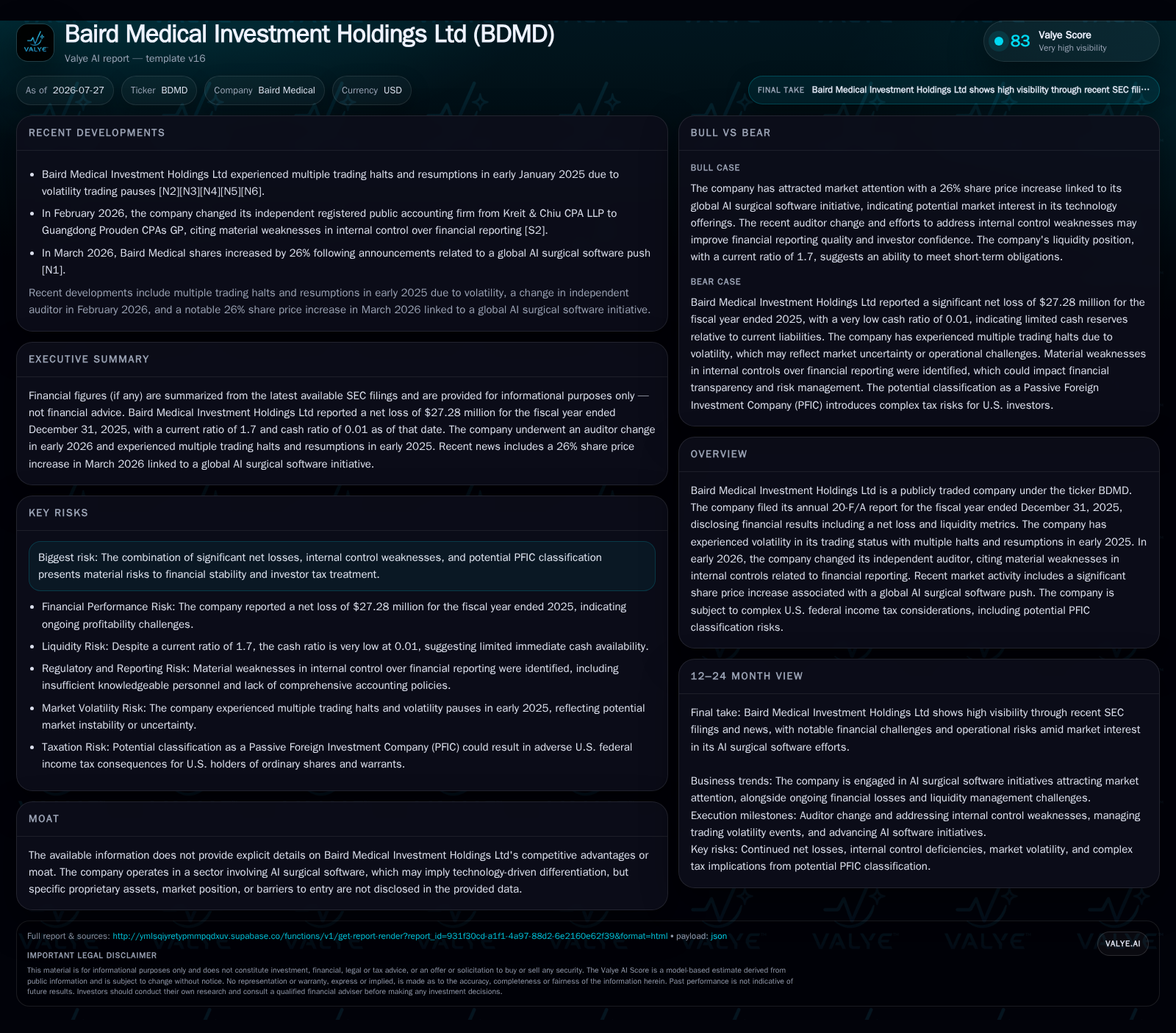
Baird Medical Investment Holdings Ltd, a leading provider of microwave ablation devices focused on thyroid treatment in China, reported a sharp 39% revenue decline in 2025, driven by falling direct sales and pricing pressures amid expanding distributor reliance. The company faces heightened regulatory risks due to China’s evolving medical device procurement and reimbursement environment. Internal control weaknesses prompted an auditor switch in early 2026, impacting investor confidence. Heavy operating losses and negative cash flow reflect costly R&D investment in AI-integrated robotic systems but raise sustainability questions absent capital raises or improved commercial execution.
Recent Operating Update
Financially, the company posted a harsh reversal in performance for the year ended December 31, 2025 compared to prior years. Revenue plunged by approximately 39%, falling from around $37 million in 2024 to just over $22.5 million in 2025 [S14][F1]. This was largely caused by an acute drop in direct customer sales volume and average selling prices for their proprietary microwave ablation (MWA) medical devices targeted at thyroid disease treatment — their core product category that had previously driven growth.
Despite revenue pressure, distributor channel sales surprisingly grew slightly by roughly $1.2 million or about 7%, now accounting for over four-fifths of total revenues at about $18.4 million [S1][S5]. The company's multi-channel approach encompasses direct sales teams focusing on high-tier hospitals (Grade III) while leveraging deliverers and distributors with deeper reach into smaller hospitals or regional markets — a strategy that helped expand hospital penetration from approximately 505 hospitals purchasing products in 2023 to about 614 by end-2025 including an increase in Grade III hospitals from around 310 to nearly 330 during the same period [S1]. This indicates solid underlying demand but also reflects heightened reliance on third-party channels for reaching more price-sensitive or decentralized buyers.
Business Model Overview
Baird Medical operates primarily as a medical device manufacturer specializing in microwave ablation systems designed for minimally invasive treatment of thyroid nodules and breast lumps. Their product suite includes hardware such as proprietary MWA needles and therapeutic apparatuses that incorporate AI-driven surgical assistance technologies—a nascent but strategically important category aimed at enhancing precision care.
Revenue streams fall principally into two segments: proprietary MWA devices sold directly or through distributor networks primarily targeting Chinese hospitals; plus sales of ancillary or traded medical consumables such as catheters and ventilators which remain insignificant but add breadth [S1]. Sales contracts follow three distinct channels: direct hospital contracts facilitating tighter margin capture but higher selling expense; deliverers who aggregate orders across multiple institutions reducing cost-to-serve; and traditional distributors leveraging established logistics infrastructure.
Margins are influenced by product mix — higher-margin proprietary hardware vs lower-margin traded consumables — pricing strategies affected by emerging centralized procurement pricing caps set provincially across China since pilot programs launched around 2021, alongside reimbursement policy shifts impacting hospital willingness and capacity to spend on innovative technologies [S1]. The industry environment requires constant R&D investments both for compliance with fast-evolving regulatory approvals under NMPA guidelines and to enhance AI integration for competitive differentiation.
Industry Structure and Competitive Position
Operating within the medical devices sector focused on minimally invasive therapies, Baird Medical holds prominent position according to Frost & Sullivan positioning it as the leading microwave ablation device provider by sales volume and revenue for targeted indications within mainland China as of the last published data point (2022) and ranking third overall by revenue nationally among microwave ablation providers [S1]. This niche focus affords technical leadership but also subjects them heavily to China’s complex regulatory landscape which continues tightening with expanded post-approval constraints coupled with government efforts toward centralized procurement aimed at lowering device costs.
Competitors include global medical device giants such as Medtronic or Johnson & Johnson who operate broader minimally invasive surgical portfolio ranges alongside emerging local Chinese specialists progressing rapidly on AI surgical software integration platforms. Market access dynamics hinge critically on securing expansion within Grade III hospitals—the highest tier institutions known both for volumes of relevant procedures done annually and their role as influencers for broader market uptake.
Growth Drivers
Several structural long-term growth drivers support Baird Medical's strategic positioning:
- Continued rising diagnosis rates for thyroid diseases fueled by enhancing screening programs across China.
- Increasing preference within healthcare providers toward minimally invasive interventions that reduce patient risk compared to open surgeries.
- Expansion of AI-assisted robotic systems promising improved surgical precision that aligns well with global trends toward smart healthcare technology adoption.
- Gradual increase in number of hospitals adopting Baird’s solutions especially among tertiary care centers (Grade III).
- Pipeline development collaboration with research institutions aims to broaden application beyond thyroid-focused devices into adjacent oncology segments potentially expanding addressable market size [S1][S18].
However, these drivers must be balanced against near-term commercial execution hurdles particularly amid intensifying governmental pricing scrutiny which compresses average selling prices observed during fiscal year 2025 causing downward revenue pressure despite relatively stable hospital counts.
Risks and Constraints
Material risks clouding Baird Medical’s prospects include:
- Regulatory uncertainty: Ongoing legislative initiatives could impose stricter approval procedures or promotional conduct restrictions negatively affecting speed-to-market or marketing freedom for new medical devices [S1].
- Pricing pressure: Centralized procurement policies targeting provincial level purchase price controls risk eroding margins making profitability elusive unless offset by scale or cost reduction.
- Financial reporting quality: Auditor dismissal citing internal control deficits hints at governance gaps that could delay reporting accuracy or hamper investor trust impacting capital raising ability.
- Liquidity concerns: Cash reserves are near depletion ($178K at end-2025) while debt remains at approximately $1.7M implying limited cushion without fresh financing options given historical operating losses exceeding $25M recently realized [F1][S6].
- Operational cost escalation: Surging R&D spends focused on AI robotic pipelines inflate SG&A line items with selling expenses rising sharply on increased share-based comp compounding cash burn risks until product commercialization matures [S14][S19].
- Customer concentration: Heavy dependence on Chinese hospital adoption cycles subject company to geopolitical sensitivities involving export efforts or currency exposure impacting topline stability.
What To Watch Next
Key milestones shaping near-term trajectories include:
- Efficacy of new auditor’s guidance toward resolving previous internal control shortcomings responsible for past qualified audit concerns—investors should monitor upcoming quarterly filings for clean audit opinions evidencing improvements.
- Revenue recovery signals linked to stabilization or rebounding volumes/selling prices through distributor channel expansion or renewed direct contract wins particularly within high-revenue tertiary care hospitals.
- Progression updates from R&D pipeline especially concerning clinical trial advancements or regulatory approvals enabling launch of next-generation AI-integrated devices broadening product portfolio scope beyond microwave ablation legacy offerings.
- Ongoing impact assessment relating to provincial centralized procurement expansions such as Heilongjiang Province’s August 2025 inclusion notification affecting ablation electrodes pricing frameworks potentially spilling into national policies going forward.
- Capital raises or alternative financing arrangements given current low cash balances combined with negative free cash flow continuing systemically due to elevated operating expenses outpacing revenues thereby ensuring survival liquidity.
Financial Profile Discussion
Cash consumption also intensified though less severely than net losses indicate due principally to non-cash share-based compensation expense accounting for large portion ($17.5M) reducing immediate liquidity hit although total cash declined precipitously ending fiscal year at only $178 thousand down from nearly ~$3 million previously indicating urgency toward replenishing working capital soon lest operational continuity be threatened [F1][S9][S6]
Borrowings stand moderate around approximately $1.7 million based on latest available data [F1]. Overall balance sheet liquidity appears sufficient short term with current ratio around healthy level (~1.7x) supported by strong current assets versus liabilities aiding flexibility though continued material operating losses place emphasis on successful commercialization execution combined with financing options availability as critical metrics determining business viability going forward
Disclaimer: This is research-only, informational analysis and not investment advice. It may include AI-generated interpretation and general industry context. Always verify important details using primary sources.

Comments