
World Kinect Q2 2026 Highlights Operational Stability Amid Modest Margins and Working Capital Challenges
Solid revenue and net income results in Q2 confirm operational resilience, with liquidity management remaining critical in capital-intensive energy supply.
World Kinect Corporation (WKC) reported its second-quarter 2026 financial results with stable revenue performance and positive net income, reflecting consistent demand across aviation, marine, and land transportation energy segments. The company operates as a midstream energy management firm, providing fuel, natural gas, and power supply alongside specialized sustainability services across the US and Europe. Despite the recurring pressures of modest profitability margins and sizable working capital requirements driven by energy commodity price volatility, WKC maintains a current ratio just above 1, underscoring ongoing liquidity discipline. Key risks include exposure to commodity price fluctuations and industry regulation. Monitoring volume supplied, hedging efficiency, and contract renewals will be critical indicators for future trajectory.
Recent Operating Update: Q2 2026 Results Reinforce Operational Stability
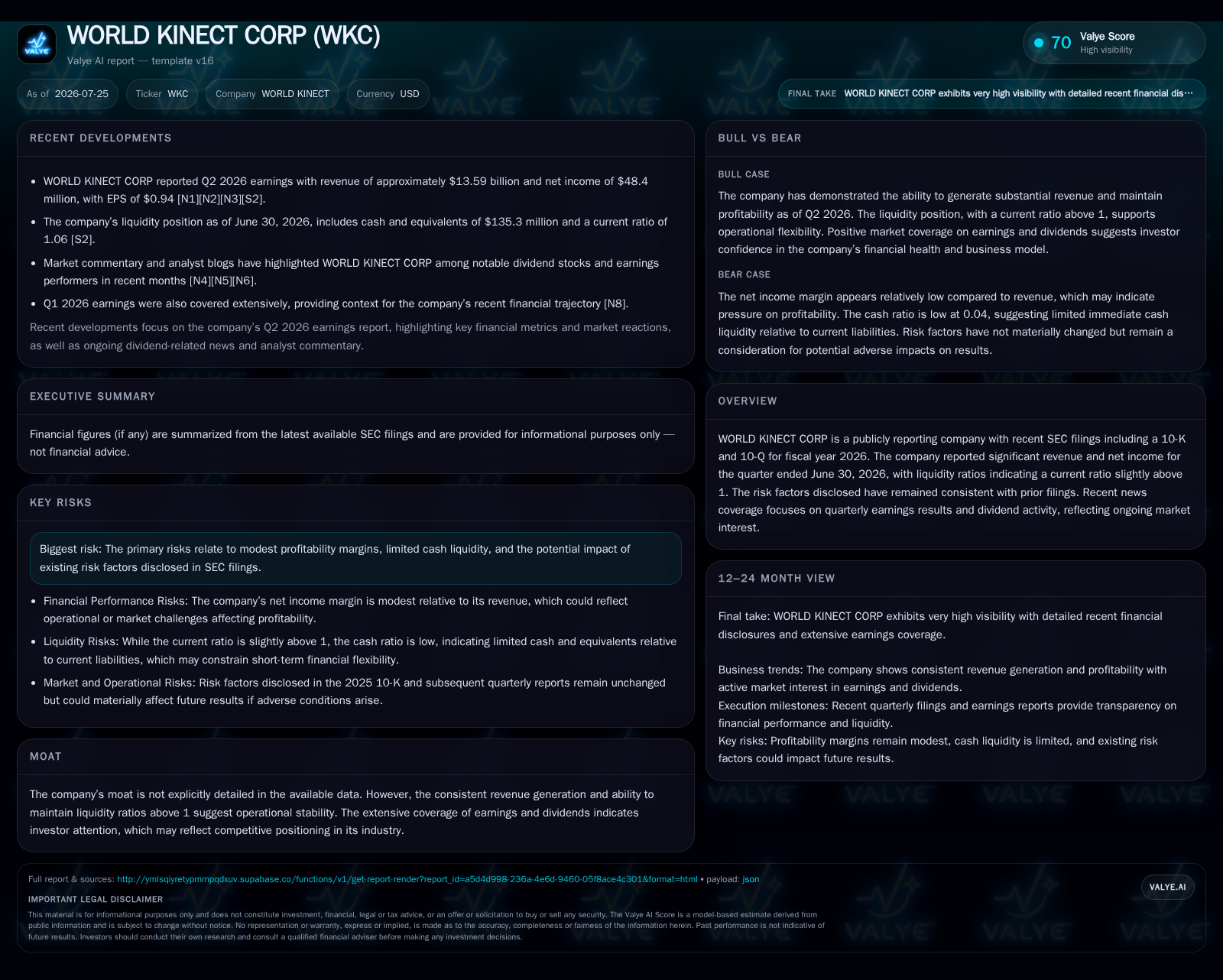
World Kinect Corporation reported a net income of approximately $28 million for the second quarter ending June 30, 2026, reflecting stable operational execution amid typical sector volatility [S3], [N2]. This positive earnings outcome underscores consistent demand across its core energy procurement and supply services in aviation, marine, and land transportation sectors. The company’s ability to maintain steady revenue streams during fluctuating commodity price environments highlights disciplined execution in energy portfolio management and risk mitigation.
Liquidity remains a critical focus for World Kinect given the capital-intensive nature of energy supply logistics. As of June 30, 2026, the company’s current ratio stood at 1.06, supported by cash and equivalents of approximately $135 million against total debt near $737 million [F1], [S2]. This tight liquidity position reflects the working capital demands inherent in managing large volumes of fuel, natural gas, and power transactions, where receivables and payables cycle rapidly with commodity price movements. Maintaining this balance is essential to support ongoing fuel supply reliability and contract fulfillment.
The company affirmed no material changes to its risk factors in the latest quarterly filing, maintaining exposure to commodity price volatility, credit risk, and regulatory developments across its US and European operations [S2]. These risks necessitate ongoing vigilance in hedging strategies and customer contract management to preserve margin stability.
Business Model: Midstream Energy Management with Integrated Fulfillment and Sustainability Services
World Kinect operates as a midstream energy management firm specializing in procurement, logistics, and supply of aviation fuel, marine fuel, land transportation energy, natural gas, and power across North America and Europe [S1], [S8]. Its revenue model centers on contracted sales of energy commodities, where pricing is influenced by underlying market rates but stabilized through commodity price risk management and hedging strategies.
The company differentiates itself by bundling physical fuel supply with value-added services including energy portfolio management, supply chain optimization, and sustainability consulting aimed at reducing customers’ carbon footprints. This integrated approach addresses the complex energy procurement needs of transportation operators who require reliable fuel delivery combined with advisory services to meet evolving environmental regulations.
Customers, primarily in aviation, marine shipping, and land transport sectors, pay for both the physical energy commodities and the associated risk management and sustainability solutions. Contract renewal rates and fuel supply reliability are key operating KPIs that directly impact revenue stability and margin performance. The business model’s capital intensity arises from managing large working capital balances due to the volume of commodity transactions and the timing of cash flows.
Industry Structure and Competitive Position
World Kinect competes within a midstream/downstream energy value chain alongside integrated service providers such as World Fuel Services Corporation and Shell Energy North America. These peers similarly combine commodity sales with logistics, energy trading, and risk management services, facing comparable margin pressures and working capital demands. Other competitors include firms focused on energy portfolio management and sustainability services, reflecting the sector’s increasing emphasis on carbon reduction solutions.
WKC’s geographic footprint spanning US and European markets and its multi-segment focus across aviation, marine, and land transportation energy supply provide diversified revenue streams. However, operating margins remain modest industry-wide due to thin spreads on commoditized fuel sales and the necessity of sustaining infrastructure and technology platforms.
Customer retention is influenced by contract renewal rates, which depend on fuel supply reliability and the ability to meet growing sustainability requirements. Providers that can effectively integrate carbon reduction services alongside traditional fuel supply are positioned to strengthen competitive differentiation.
Growth Drivers
Several industry trends underpin World Kinect’s growth prospects:
- Transport Sector Demand Growth: Post-pandemic recovery in global aviation and steady expansion in maritime trade support volume increases in aviation and marine fuel supply.
- Sustainability and Carbon Reduction Services: Increasing regulatory and customer focus on environmental compliance drives demand for bundled sustainability offerings integrated with core energy procurement.
- Natural Gas and Power Supply Expansion: Growth in natural gas and renewable power markets, particularly in Europe, offers additional revenue opportunities beyond liquid fuels.
- Complexity in Energy Procurement: Rising complexity and volatility in energy markets incentivize transport operators to outsource procurement and risk management to integrated suppliers like WKC.
Monitoring volume metrics such as gallons of fuel supplied, MMBtu of natural gas, and MWh of power delivered will provide insight into demand trends. Additionally, disclosures on hedging effectiveness and customer contract renewal rates will be critical indicators of operational resilience and margin sustainability.
What To Watch Next
Key operational markers to monitor include quarterly volume disclosures across aviation, marine, and land transportation fuels, as well as natural gas and power supply. These volumes directly correlate with revenue generation and reflect end-market demand health. Hedging strategy disclosures within management’s discussion and analysis will reveal adjustments to commodity price risk management amid market fluctuations.
Customer contract renewal rates and fuel supply reliability metrics will indicate the company’s success in maintaining stable revenue streams and competitive positioning. Dividend activity, as noted in recent market reports, may also reflect management’s assessment of free cash flow availability after working capital requirements [N6], [N7].
Capital expenditure plans and infrastructure investments will be important to track, given the need to comply with evolving regulatory standards for cleaner fuel distribution and to support operational scalability.
Financial Profile Discussion
As of June 30, 2026, World Kinect held cash and cash equivalents of approximately $135 million against total debt of about $737 million, resulting in net debt near $601 million [F1]. The current ratio of 1.06 reflects a liquidity position that is tight but consistent with industry norms for capital-intensive energy supply businesses managing large working capital cycles.
Profitability margins remain modest, typical of midstream energy management firms operating with thin spreads on commodity sales [S2]. Efficient working capital management and prudent financing structures are essential to sustain positive operating cash flow and avoid liquidity stress during commodity price downturns. The latest filings show no indication of covenant breaches or refinancing challenges, supporting a stable financial footing
Summary
World Kinect Corporation’s Q2 2026 results demonstrate operational stability supported by steady demand across its diversified energy supply portfolio. The company’s midstream business model integrates commodity procurement, logistics, risk management, and sustainability services tailored to transportation sectors in the US and Europe. While liquidity remains tight due to working capital intensity, disciplined financial management and hedging strategies help mitigate commodity price volatility risks.
Growth opportunities lie in expanding sustainability offerings, capitalizing on natural gas and power markets, and leveraging increasing complexity in energy procurement. Key performance indicators such as volume supplied, hedging effectiveness, contract renewals, and fuel supply reliability will be critical to monitor for assessing future operational and financial trajectories.
Disclaimer: This analysis is based exclusively on publicly disclosed information from SEC filings and reputable news sources without any investment research view or forecast speculation.
Disclaimer: This is research-only, informational analysis and not investment advice. It may include AI-generated interpretation and general industry context. Always verify important details using primary sources.

Comments