
AMREP CORP. Leverages Land Portfolio Amid Concentrated Market and Operational Challenges
AMREP's substantial land holdings in New Mexico underpin its land development and homebuilding operations, with recent earnings reflecting strategic sales amid rising costs and regulatory delays.
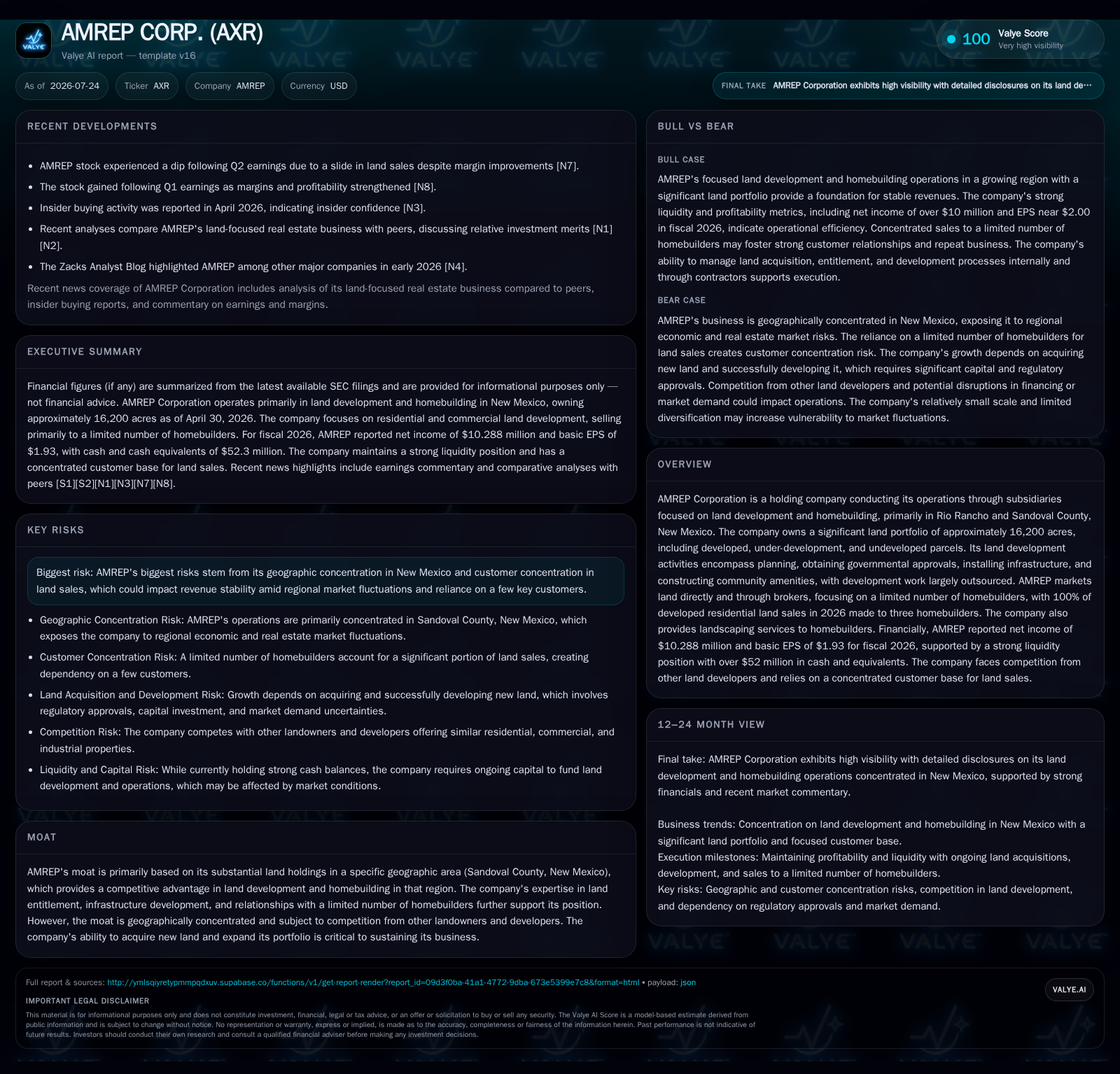
In Q3 FY2026, AMREP CORP. delivered significantly improved net income driven by increased home sales volume despite ongoing challenges including municipal entitlement delays and elevated construction costs. The company’s operational focus remains on its 16,200-acre land portfolio concentrated in Sandoval County, New Mexico, with revenue heavily reliant on a few key homebuilder customers. While construction and development costs pressure margins, AMREP offsets this through price increases. The company maintains a strong liquidity position with minimal debt. Risks include geographic and customer concentration alongside regulatory uncertainties affecting development timelines.
Recent Operating Update
In the third quarter of fiscal year 2026, AMREP Corporation reported a significant improvement in net income, reaching $3.147 million or $0.58 per diluted share, compared to $0.717 million or $0.13 per diluted share in the same period of the prior year [S2]. This increase was primarily driven by a higher volume of homes sold, reflecting stronger operational execution despite ongoing challenges. For the nine months ended January 31, 2026, net income was $9.039 million or $1.68 per diluted share, slightly above the $8.823 million or $1.64 per diluted share recorded in the prior year period [S2].
For the full fiscal year ended April 30, 2026, AMREP reported net income of $10.288 million or $1.91 per diluted share, down from $12.716 million or $2.37 per diluted share in fiscal 2025 [S1], [S3]. The year-over-year decline reflects elevated costs associated with construction inputs and delays in municipal entitlements, which extended development timelines and increased cost of revenues. Management cited persistent delays in zoning approvals, utility infrastructure responses, contractor scheduling, and inspection backlogs that affected both the land development and homebuilding segments [S1]. These factors contributed to timing shifts in revenue recognition and margin pressure.
Despite these headwinds, AMREP was able to partially offset cost inflation through price increases on both developed land parcels and finished homes. Variability in revenue per acre was influenced by the mix and location of land sold, a common dynamic in land development where parcel desirability and entitlement status vary across the portfolio [S2]
Business Model Overview
AMREP operates primarily through subsidiaries focused on land development and homebuilding within Rio Rancho and Sandoval County, New Mexico, where it holds approximately 16,200 acres of land at various stages of entitlement and development [S1], [N1]. This concentrated land portfolio forms the foundation of the company’s strategy, providing a competitive moat based on scale and local market knowledge in a region where large contiguous land holdings are scarce.
The company’s business model involves acquiring raw land, securing zoning approvals and municipal entitlements, developing infrastructure and community amenities, and converting land into residential lots. These lots are then sold primarily to a concentrated group of three regional homebuilders, which accounted for all developed residential lot sales in fiscal 2026, underscoring significant customer concentration risk [S2]
AMREP’s homebuilding segment complements land sales by constructing single-family detached and attached homes, offering a variety of floor plans and elevations tailored to local buyer preferences [S1]. Sales are conducted through a combination of internal sales teams and external brokers
Operationally, AMREP outsources most infrastructure installation and construction work, which helps manage capital intensity and operational scale typical of regional developers. However, the company retains control over entitlement processes and sales management, balancing operational oversight with cost efficiency [S1]. Landscaping services are provided internally, offering ancillary revenue diversification
Revenue generation depends on several key factors:
- The number of acres developed and converted into residential lots,
- Pricing power for land parcels and finished homes, which varies by location and market conditions,
- The pace of municipal entitlements and zoning approvals,
- The purchasing cycles and demand patterns of its limited homebuilder customer base.
Margins are sensitive to construction input costs, including labor and materials inflation, as well as regulatory delays that can extend holding periods and increase infrastructure expenses.
Industry Environment and Competitive Positioning
AMREP operates within the real estate land development and homebuilding sector, which is heavily influenced by local regulatory environments, housing demand cycles, and cost inflation. The company’s geographic concentration in Sandoval County exposes it to regulatory complexities such as entitlement delays and municipal approval backlogs, which are common challenges in regional land development markets.
The competitive landscape includes regional land developers and homebuilders who similarly rely on relationships with a limited number of homebuilder customers and face constraints related to land availability and entitlement timelines. Publicly traded peers such as MLP and FPH operate in comparable regional markets with sizable but geographically constrained land portfolios, providing a qualitative benchmark for AMREP’s scale and market focus.
AMREP’s extensive land ownership in a limited-growth geography creates entry barriers for new competitors seeking large contiguous acreage. Its established relationships with local homebuilders facilitate steady sales channels, which can provide some insulation against market volatility.
However, the company’s concentrated customer base and geographic focus also present risks. Local economic downturns, regulatory changes, or shifts in homebuilder demand could materially impact revenue stability. Additionally, reliance on third-party contractors for infrastructure and construction introduces execution risk related to scheduling and cost control.
Growth Drivers
Several structural factors underpin AMREP’s growth potential:
- Population growth and housing demand in the Albuquerque metropolitan area, including Rio Rancho, support sustained absorption of residential lots.
- The company’s ability to progress land parcels through entitlement pipelines unlocks new developable lots, maintaining production cadence.
- Infrastructure and community amenity development enhance the attractiveness and value of residential communities, enabling premium pricing.
- Strategic land acquisitions could expand the existing 16,200-acre portfolio, subject to financing availability and market conditions.
- Evolution of homebuilding product offerings to align with changing buyer preferences may increase average home sale prices.
Operational indicators such as backlog conversion rates—the transition of homes under contract to closed sales—will be critical to assessing AMREP’s effectiveness in capitalizing on these growth drivers.
Risks and Constraints
AMREP faces several notable risks:
- Geographic Concentration: The company’s focus on Sandoval County exposes it to localized economic and regulatory risks, including prolonged municipal entitlement delays that can disrupt cash flow timing and project economics [S1].
- Customer Concentration: With all developed residential lot sales in fiscal 2026 made to three homebuilders, revenue is highly dependent on a limited customer base, increasing credit and demand risk [S2].
- Regulatory Delays: Ongoing entitlement and inspection backlogs extend project durations, increasing exposure to cost inflation in labor and materials.
- Construction Cost Inflation: Elevated input costs compress gross margins despite price increases, while sustained high mortgage rates may constrain homebuyer affordability and demand.
- Outsourcing Dependencies: Reliance on third-party contractors introduces risks related to availability and schedule adherence.
- Liquidity Considerations: Although AMREP maintains a strong liquidity position with approximately $52.3 million in cash and equivalents and minimal debt of about $1.7 million as of January 31, 2026, capital-intensive land development requires ongoing access to funding to support growth [F1], [S2].
What To Watch Next
Key operational and financial indicators to monitor include:
- Quarterly changes in acres entitled and acres sold, which reflect pipeline velocity and development progress.
- Updates on municipal entitlement processes and any improvements or further delays impacting project timelines.
- Trends in home sales volume and average sale prices, providing insight into market demand and pricing power.
- Shifts in customer concentration or diversification efforts that could mitigate revenue risk.
- Capital deployment activity, including land acquisitions or investments in infrastructure, signaling growth strategy execution.
- Liquidity metrics, particularly cash flow from operations and capital expenditure requirements, given the capital-intensive nature of land development.
Tracking these variables will help assess AMREP’s ability to sustain operational momentum while managing risks inherent in its concentrated geographic and customer base.
Financial Profile Discussion
AMREP’s fiscal 2026 revenues remain modest relative to larger national peers, with total revenues just over $12 million reflecting its regional scale [S1]. Despite cost pressures, the company has maintained resilient margins through price pass-throughs on land and home sales. The balance sheet remains strong, supported by approximately $52.3 million in cash and equivalents and minimal total debt of roughly $1.7 million as of January 31, 2026, resulting in a net cash position that provides financial flexibility for ongoing development activities [F1], [S2].
Overall, AMREP’s financial results and operational updates illustrate a company navigating the cyclical and regulatory challenges typical of regional land development and homebuilding, leveraging its substantial land portfolio and local market expertise to sustain growth and profitability.
This analysis is based on information available as of July 24, 2026, including AMREP’s quarterly (Form 10-Q), annual (Form 10-K), and event filings (Form 8-K), supplemented by current balance-sheet data from SEC companyfacts and relevant industry context. It is intended for informational purposes and does not constitute investment advice.
Disclaimer: This is research-only, informational analysis and not investment advice. It may include AI-generated interpretation and general industry context. Always verify important details using primary sources.

Comments