
Teledyne Technologies Leverages Defense Contract Growth and Strategic Acquisitions in Q2 2026
Q2 results show solid revenue and net income gains supported by defense spending and technological innovation.
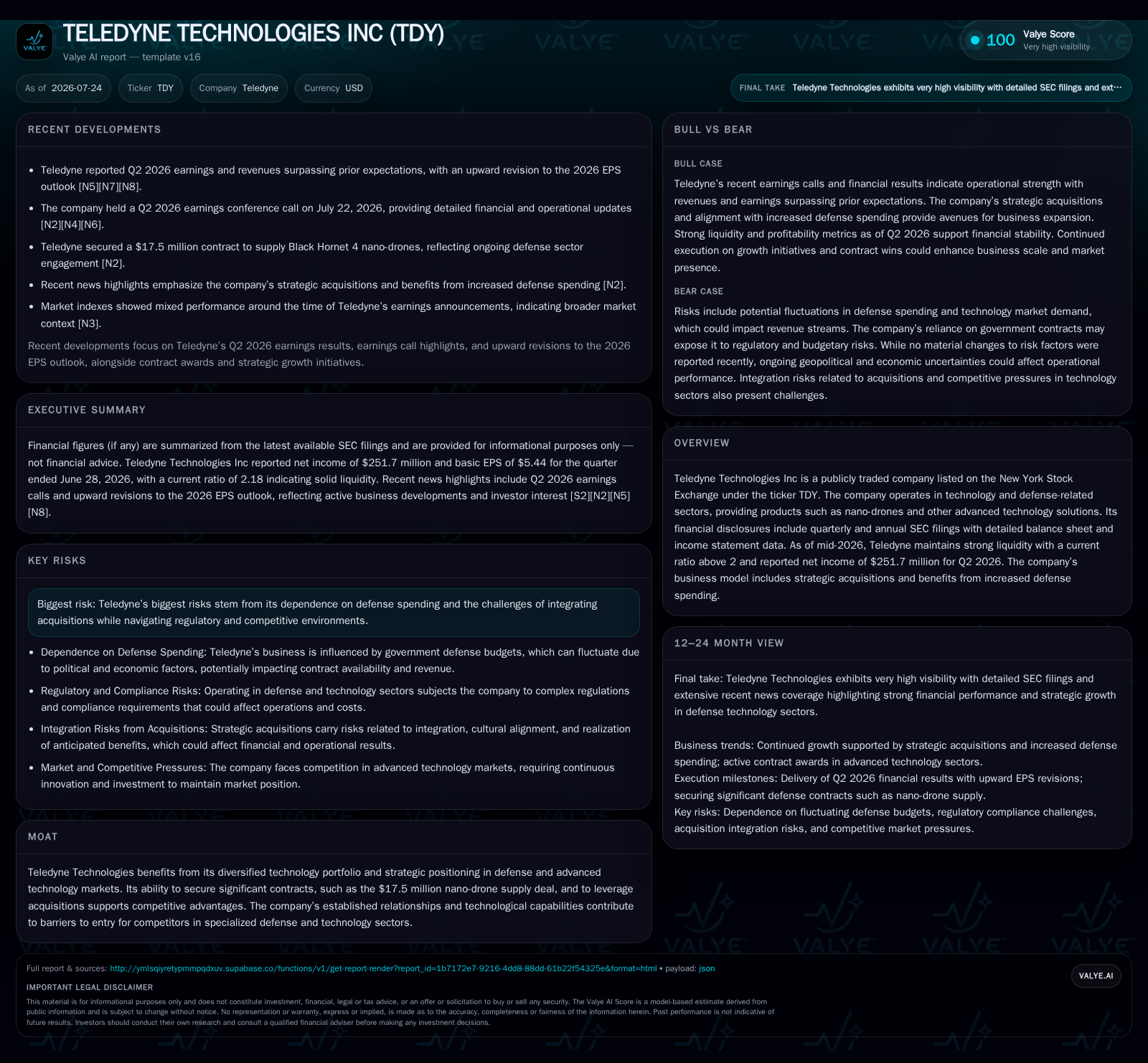
Teledyne Technologies Inc delivered a strong second-quarter performance in mid-2026, with revenues reflecting increased demand for advanced technology solutions including nano-drones underpinned by defense spending growth. The company’s strategy emphasizes strategic acquisitions and R&D investment that sustain its competitive positioning in aerospace and defense technology markets. Robust liquidity and a healthy current ratio support the firm's ability to manage capital-intensive contracts amid cyclical defense procurement dynamics. Key risks remain linked to government spending variability and acquisition integration complexities.
Recent Operating Update and Its Strategic Implications
Teledyne Technologies Incorporated reported strong operational results for the second quarter ended June 28, 2026, with revenues surpassing $1.02 billion, driven primarily by expanded defense contracts including significant orders for unmanned aerial vehicles (UAVs) such as nano-drones [S2][N4]. Net income for the quarter rose to approximately $251.7 million, reflecting improved operational leverage and disciplined margin management amid increased production volumes and contract execution [S3][N5]. The company confirmed no material changes to previously disclosed risk factors, indicating a stable regulatory and market environment as of mid-2026 [S19].
Liquidity remains a key strength, with a current ratio of 2.18 as of June 30, 2026, supported by $340 million in cash and equivalents against current liabilities of $1.47 billion [F1]. This robust liquidity position is critical for funding the working capital demands inherent in long-term government contracts, supporting ongoing research and development (R&D) investments, and enabling strategic acquisitions that expand Teledyne’s technological capabilities and market reach.
Business Model: Integrated Aerospace & Defense Technology Provider
Teledyne operates as a diversified aerospace and defense technology manufacturer, specializing in the design, production, and integration of advanced systems including UAVs, nano-drones, aerospace components, and sophisticated sensor technologies [S1]. Its primary customers are government defense agencies and aerospace original equipment manufacturers (OEMs), with revenue generated through competitively awarded, multi-year contracts characterized by milestone-based revenue recognition tied to production and delivery volumes
The company’s business model emphasizes system integration, combining hardware and software components into complex subsystems tailored to evolving defense and aerospace requirements. This integration capability enhances customer value beyond standalone component sales and supports long program lifecycles.
Aftermarket services, including maintenance, upgrades, and lifecycle support, represent a growing recurring revenue stream that helps stabilize cash flow beyond initial contract deliveries [S1]. Strategic acquisitions play a pivotal role in broadening Teledyne’s product portfolio and engineering expertise, particularly in unmanned systems and advanced sensor technologies, facilitating cross-selling opportunities and access to new commercial aerospace and industrial markets
Industry Structure and Competitive Positioning
The aerospace and defense technology sector is marked by high barriers to entry, including intensive R&D requirements, stringent regulatory and export compliance, and the necessity of established government procurement relationships. Teledyne competes primarily as a specialized technology integrator, differentiating itself through innovation in nano-technology and UAV platforms rather than scale alone.
While large defense contractors such as Lockheed Martin and Raytheon Technologies dominate the broader market, Teledyne’s focus on niche advanced sensors, nano-drones, and integrated electronic systems positions it competitively within specialized segments. Recent contract wins, including multi-million dollar nano-drone supply agreements, underscore the company’s ability to secure and execute technically sophisticated government procurement contracts [N4].
Key operational KPIs include contract backlog value and order intake, which provide visibility into future revenue streams. Maintaining a book-to-bill ratio above one is critical to ensuring sustainable growth. Manufacturing efficiency metrics such as production volume and on-time delivery rates are essential for meeting the stringent timelines and quality standards demanded by defense customers.
Growth Drivers
Teledyne’s growth is underpinned by increasing global defense expenditures driven by geopolitical tensions and modernization initiatives. Demand for autonomous and unmanned systems, including nano-drones, is rising, requiring continuous innovation in miniaturization and sensor integration—areas where Teledyne invests heavily through R&D.
Strategic acquisitions accelerate growth by expanding technological breadth and opening new commercial aerospace and industrial market opportunities. The company’s vertical integration and intellectual property ownership enhance supply chain resilience, a growing priority in government procurement strategies.
Aftermarket services offer a pathway to recurring revenue, mitigating the cyclicality of new contract awards. Expansion into commercial aerospace applications further diversifies revenue sources, reducing dependence on government defense budgets.
Risks and Growth Constraints
Teledyne’s reliance on government defense budgets exposes it to risks from budgetary fluctuations and procurement cycle variability, which can impact order intake and backlog growth. Regulatory compliance across multiple jurisdictions, including export controls on sensitive technologies, imposes operational complexity and potential delays.
The rapid pace of technological change necessitates sustained R&D investment to avoid obsolescence and maintain competitive advantage. Supply chain disruptions, particularly for specialized electronic components, pose risks to production schedules and contract fulfillment.
Cybersecurity threats represent an increasing concern, as product integrity and contract eligibility depend on meeting stringent security standards mandated by government customers.
What to Watch Next
Upcoming quarterly disclosures will be critical to monitor contract backlog growth and order intake trends, which serve as leading indicators of revenue visibility given the deferred revenue recognition typical in defense contracting. The book-to-bill ratio will be a key metric to assess whether new orders continue to outpace recognized revenue.
Progress on strategic acquisitions, including integration success and contribution to revenue growth, will influence near-term performance. Management’s capital expenditure levels and R&D spending rates will provide insight into the company’s commitment to innovation and capacity expansion.
Earnings call commentary may reveal shifts in segment performance, particularly any increase in higher-margin aftermarket services or commercial aerospace exposure, which could help offset defense budget cyclicality [N2]
Financial Profile Discussion
As of June 28, 2026, Teledyne reported cash and equivalents of approximately $340 million and current assets totaling $3.2 billion against current liabilities of $1.47 billion, resulting in a current ratio of 2.18, indicative of strong short-term liquidity [F1]. This liquidity supports the capital-intensive nature of aerospace manufacturing and the working capital requirements of long-term government contracts.
Total debt stood near $2.49 billion as of December 28, 2025, with net debt of approximately $2.15 billion after accounting for cash balances, reflecting moderate leverage consistent with industry peers managing capital cycles linked to contract execution [F1]
The reported net income improvement to $251.7 million in Q2 2026 demonstrates operational efficiency gains and scalable margin expansion amid increased production volumes and contract fulfillment [S3]. Capital allocation remains balanced between funding organic R&D to sustain technological leadership and pursuing strategic acquisitions that complement the core portfolio.
This analysis is based exclusively on publicly available filings including Teledyne Technologies’ latest quarterly report (10-Q) dated July 24, 2026 [S2], recent event disclosures (8-K) through July 22, 2026 [S3], annual filings (10-K) from February 20, 2026 [S1], supplemented by company facts data snapshots as of mid-2026 [F1], and relevant industry context within aerospace defense technology manufacturing sectors. It is intended to provide an informed understanding of Teledyne’s operating performance and strategic positioning without constituting investment advice.
Disclaimer: This is research-only, informational analysis and not investment advice. It may include AI-generated interpretation and general industry context. Always verify important details using primary sources.

Comments