
Next Technology Holding Advances AI-Driven SaaS Expansion Amid Cryptocurrency Strategy
Q2 2026 updates underscore Next Technology's focus on AI-powered SaaS growth across Asia coupled with active Bitcoin asset management.
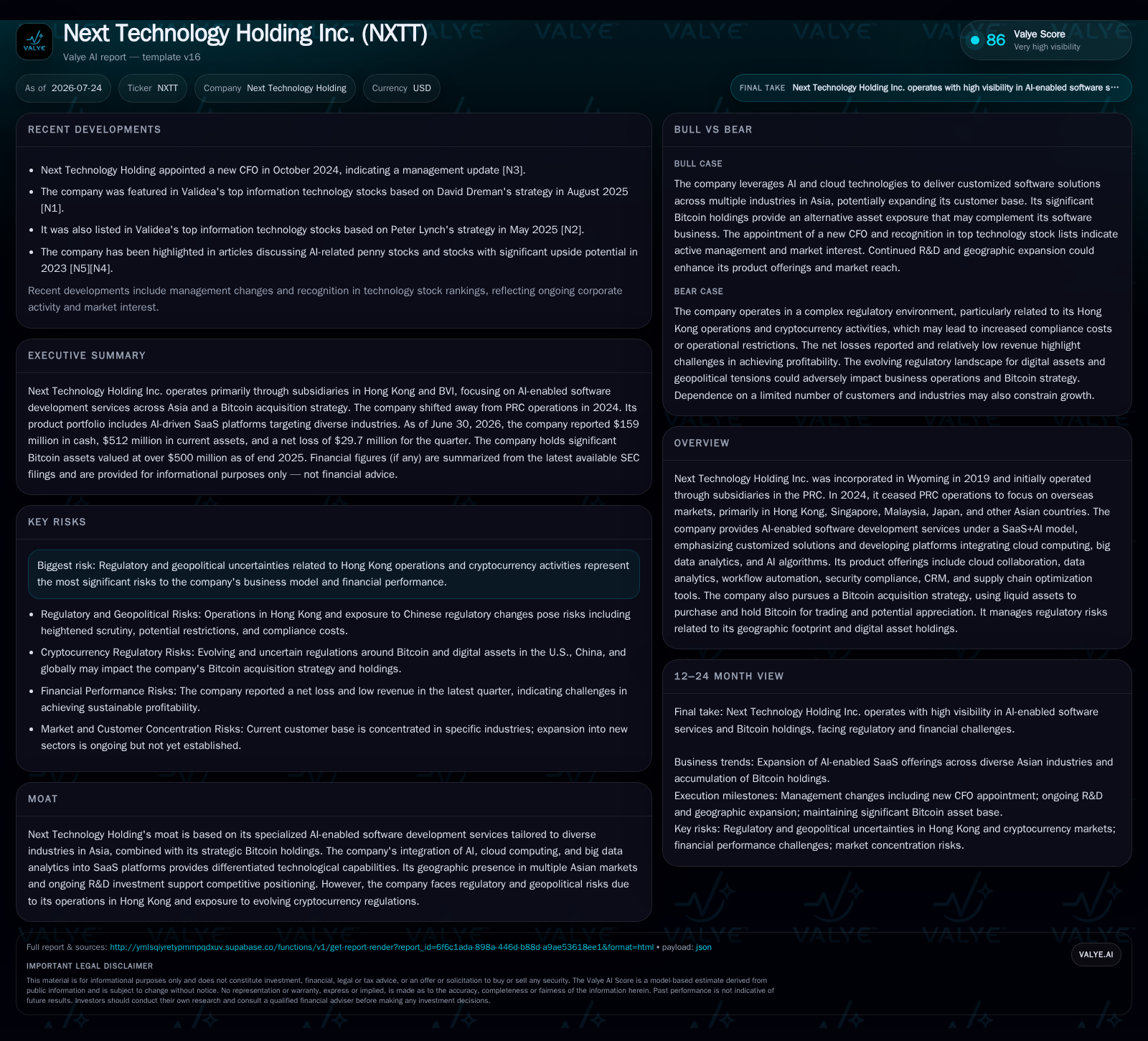
Next Technology Holding Inc. reported a strategic pivot away from PRC operations in Q2 2026, concentrating its AI-enabled SaaS offerings in multiple Asian markets including Hong Kong, Singapore, and Japan, while maintaining a sizeable Bitcoin holding strategy. The company’s business model blends subscription-based and customized software development revenue streams enhanced by cloud computing and AI integration. Despite operational agility and strong liquidity enabling continued R&D and digital asset acquisitions, Next Technology faces risks from regulatory uncertainties around cryptocurrency and geopolitical complexities linked to its Asian footprint. Monitoring ARR trends, platform uptime, and regulatory developments will be crucial to assess the sustainability of growth and risk mitigation efforts.
Q2 2026 Operating Update: Strategic Shift to AI-Enabled SaaS and Digital Asset Expansion
Next Technology Holding Inc. reported in its Q2 2026 10-Q filing a decisive strategic realignment, exiting its PRC operations to concentrate on AI-driven SaaS offerings across key Asia-Pacific markets including Hong Kong, Singapore, Malaysia, and Japan [S2]. This repositioning supports the company’s hybrid SaaS+AI business model, which integrates subscription-based revenue with customized software development contracts tailored to diverse industry verticals. Concurrently, the company maintains an active Bitcoin acquisition strategy funded by substantial cash reserves, reflecting a dual approach to growth and asset diversification [F1]. As of June 30, 2026, Next Technology held approximately $159 million in cash and equivalents against minimal debt of $580,000, yielding a current ratio exceeding 175x, underscoring a strong liquidity position that supports ongoing R&D investments and digital asset purchases [F1]. This combination of scalable software platform development and digital asset management differentiates Next Technology within its competitive landscape.
AI-Enabled SaaS Platform Suite and Multi-Industry Penetration
Next Technology’s revenue generation centers on its AI-enabled software development services delivered through a SaaS+AI model that blends recurring subscription fees with bespoke development projects [S1]. Its core product portfolio includes a Smart Cloud Collaboration Platform built on Model-View-Controller (MVC) architecture with integrated continuous integration/continuous deployment (CI/CD) pipelines. This platform facilitates real-time collaboration across geographies and incorporates AI-driven analytics to recommend resources and optimize workflows. Complementary offerings encompass fully automated workflow tools designed to streamline repetitive tasks such as data entry and report generation, AI-powered data analytics and decision support systems providing real-time insights into customer behavior and operational trends, as well as customer relationship management (CRM) and supply chain optimization modules tailored to client needs [S1].
The company’s customer base currently spans property management chains, cryptocurrency mining investment operators, and energy and resource sectors, with ongoing discussions to expand into financial services, media, transportation, education, and healthcare industries. This diversification strategy aims to mitigate concentration risks and stabilize Annual Recurring Revenue (ARR), a key SaaS KPI, although specific ARR, Customer Acquisition Cost (CAC), and churn rate figures remain undisclosed [S1]. Monitoring these KPIs will be essential to assess the sustainability of revenue growth and customer retention.
Competitive Landscape and Differentiation
Operating within the AI-augmented SaaS sector, Next Technology’s competitive set includes enterprise SaaS providers with AI capabilities, cloud platform developers, and regional software firms serving Asia-Pacific markets. While not explicitly named in filings, companies such as Salesforce, Palantir Technologies, and ServiceNow exemplify the broader competitive environment characterized by integrated CRM, workflow automation, and big data analytics platforms. Next Technology differentiates itself through its regional focus on Asia-Pacific markets, leveraging geographic diversification to access emerging digital transformation demand while navigating complex regulatory environments, particularly in Hong Kong [S1]. Its platform architecture employing MVC and CI/CD pipelines aligns with industry best practices, enabling rapid feature deployment and platform reliability critical for enterprise adoption.
However, this regional focus introduces geopolitical risks and competitive pressures from both global SaaS leaders and local technology consultancies. The company’s integration of AI algorithms throughout its platform suite aims to enhance differentiation by delivering intelligent automation and real-time data analysis capabilities that address vertical-specific operational challenges.
Growth Drivers and Operational Metrics
Key growth drivers include accelerating enterprise adoption of AI-enabled SaaS solutions in underpenetrated Asian markets, rising demand for workflow automation, and increasing utilization of big data analytics for business intelligence [S1]. Vertical expansion into finance, healthcare, media, transportation, and education sectors presents opportunities for customized platform deployments. Sustained R&D investment, evidenced by continuous platform enhancements and AI integration, supports competitive positioning amid rapid technological evolution.
Critical operating metrics to monitor include ARR growth rates, platform uptime and availability reflecting operational resilience, CAC and churn rates indicating customer acquisition efficiency and retention, and sales pipeline strength and conversion rates providing visibility into future revenue streams. Monthly Active Users (MAU) and Average Revenue Per User (ARPU) are additional KPIs relevant to subscription revenue stability and monetization effectiveness.
Cryptocurrency Strategy and Associated Risks
Next Technology’s Bitcoin acquisition strategy, funded by its strong liquidity, introduces financial volatility distinct from its software business [F1]. The company’s digital asset holdings expose it to risks stemming from the unregulated nature of many Bitcoin trading venues, including potential fraud, security breaches, and operational failures that could adversely affect asset values [S1]. Regulatory uncertainty remains a significant risk factor, with evolving governmental policies and executive orders in the U.S. and other jurisdictions influencing compliance requirements and market sentiment toward cryptocurrencies.
Geopolitical complexities, particularly related to Hong Kong operations, add layers of operational risk amid shifting political and regulatory landscapes. Additionally, the company has experienced governance challenges, including prior shareholder disputes and unauthorized filings between 2023 and 2025 [S1]. These issues have been addressed through board restructuring, resulting in a leadership team composed of independent directors overseeing audit, compensation, and nominating committees, which may enhance governance stability going forward
Key Monitoring Points and Potential Catalysts
Investors and analysts should focus on several near-term indicators to evaluate Next Technology’s operational trajectory and risk profile. These include:
- ARR growth and stability as a measure of recurring revenue strength.
- Platform uptime and reliability metrics reflecting service quality and customer satisfaction.
- Customer acquisition costs and churn rates to assess sales efficiency and retention.
- Sales pipeline development and contract conversion rates indicating market demand and execution capability.
- Regulatory developments impacting cryptocurrency holdings and compliance obligations.
- Management commentary on balancing software business cash flow needs with digital asset investment volatility.
- Board effectiveness and governance quality post-restructuring influencing strategic decision-making and capital allocation.
These variables collectively shape the company’s ability to sustain growth, manage risk, and capitalize on emerging market opportunities.
Financial Position and Capital Allocation Flexibility
As of June 30, 2026, Next Technology Holding reported cash and cash equivalents of approximately $159 million with total debt of $580,000, resulting in a net cash position near $158 million and a current ratio of approximately 175.57x [F1]. This robust liquidity base provides significant financial flexibility to fund ongoing R&D essential for maintaining competitive advantage in AI-driven SaaS markets and to support incremental Bitcoin acquisitions aligned with its digital asset strategy.
Despite these strengths, the company reported operating losses reflecting substantial investments in technology development, market expansion, and potential impairments related to cryptocurrency holdings [F1]. Monitoring cash burn relative to revenue growth and the trajectory toward operating profitability will be important for assessing longer-term financial sustainability.
Disclaimer: This analysis is based solely on publicly available information as of the dates cited and does not constitute investment advice or research views.
Disclaimer: This is research-only, informational analysis and not investment advice. It may include AI-generated interpretation and general industry context. Always verify important details using primary sources.

Comments