
Phillips Edison & Company Strengthens Retail Portfolio with High Occupancy and Rent Growth
Q2 2026 results reveal sustained portfolio resilience backed by necessity-focused tenants and strategic geographic diversification.
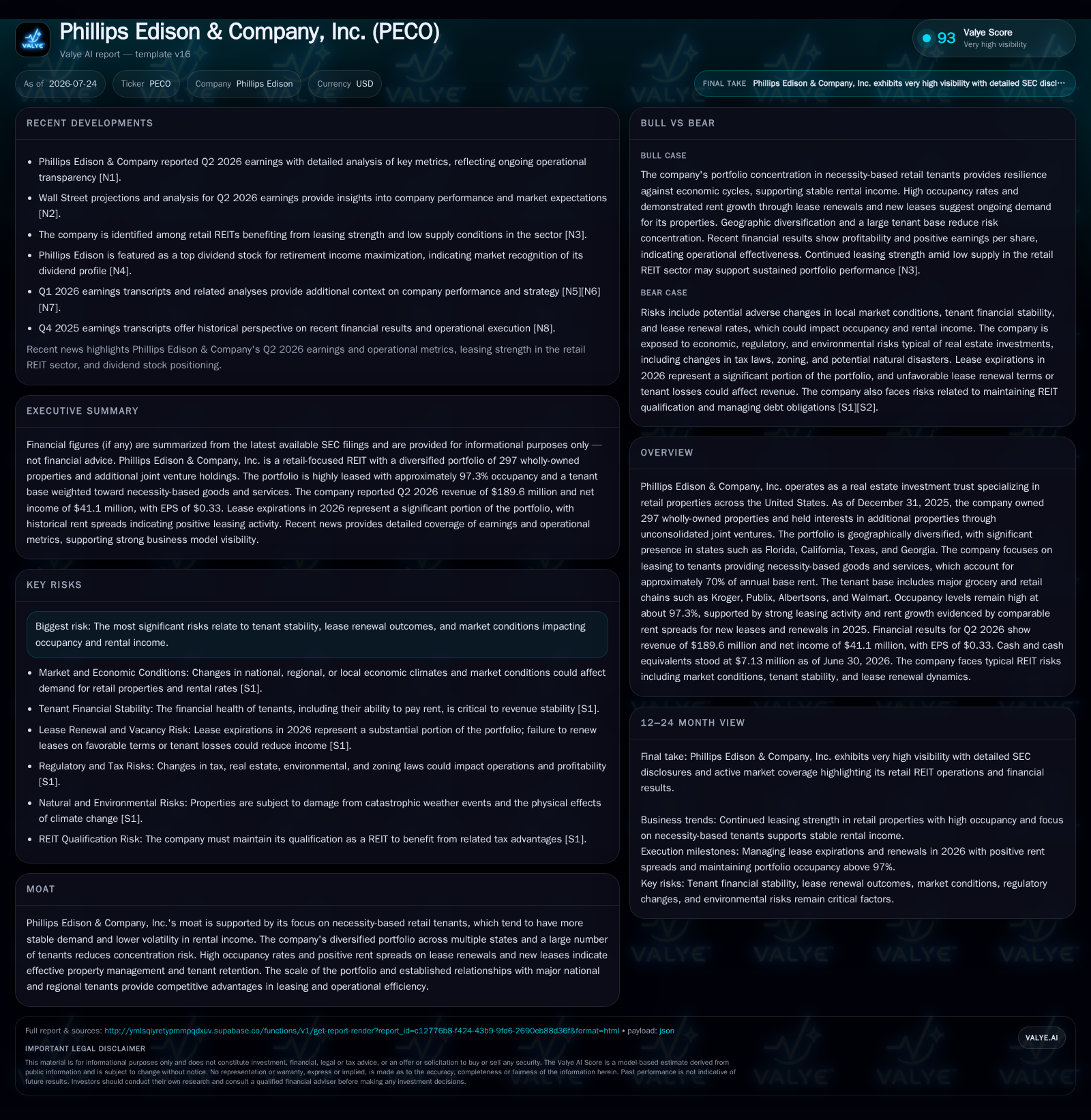
Phillips Edison & Company’s Q2 2026 filing demonstrates strong operating momentum characterized by a high occupancy rate of approximately 97.3%, with around 70% of annual base rent derived from necessity-based retailers such as Kroger, Publix, and Walmart. Positive comparable rent growth on lease renewals and new leases supports net operating income expansion, confirming effective property management amid retail sector challenges. The company’s broad geographic footprint across key U.S. markets further mitigates concentration risk and enhances leasing stability. Capital structure remains solid with manageable leverage, underpinning dividend sustainability.
Q2 Operational Momentum Driven by Necessity-Based Tenant Stability
Phillips Edison & Company’s retail portfolio demonstrated sustained resilience in the quarter ended June 30, 2026, with a high occupancy rate of approximately 97.3% [S2]. This occupancy level reflects effective property management and leasing strategies that prioritize tenant retention and attraction. A key driver of this stability is the company’s concentrated tenant mix, where necessity-based retailers—including major grocery chains and discount stores such as Kroger, Publix, Albertsons, and Walmart—account for roughly 70% of annual base rent (ABR) [S1]. This focus on essential goods providers anchors rental income against the volatility often seen in discretionary retail sectors, reducing vacancy risk and enhancing portfolio cash flow predictability.
Necessity-based retail tenants typically exhibit more stable same-store sales and foot traffic patterns, which translates into steadier rent collections and lower credit risk. This tenant mix also supports Phillips Edison’s ability to maintain consistent net operating income (NOI) growth, as these retailers are less susceptible to economic cycles and e-commerce disruption compared to specialty or luxury retail tenants.
Leasing Dynamics: Positive Renewal Spreads Sustain Income Growth
Leasing activity remains a critical operational lever, with Phillips Edison reporting positive comparable rent growth on lease renewals and new leases extending into early 2026 [S1]. Lease renewal spreads—the percentage increase in rent upon lease renewal compared to the prior lease—serve as a forward-looking indicator of NOI expansion. Positive spreads indicate the company’s ability to negotiate higher rents despite inflationary pressures faced by many retail operators.
This leasing strength contrasts with broader retail REIT sector challenges, where some peers experience rent concessions or elevated vacancy due to e-commerce competition and shifting consumer preferences. Phillips Edison’s grocery-anchored shopping centers benefit from lower tenant turnover and stronger rent escalations, supporting stable funds from operations (FFO) and adjusted FFO (AFFO).
Geographic Diversity as Risk Mitigation and Growth Lever
Phillips Edison’s portfolio comprises approximately 297 wholly owned properties plus additional assets held through unconsolidated joint ventures, spanning over 20 U.S. states [S1]. The company’s geographic diversification helps mitigate concentration risk and exposure to localized economic downturns or regulatory changes. Key concentration markets include Florida (12.3% of ABR), California (10.5%), Texas (9.4%), and Georgia (8.6%) [S1].
Average ABR per leased square foot varies across these markets, with California commanding a premium of $23.65 compared to $12.79 in Ohio, reflecting differing market dynamics and tenant demand [S1]. This geographic spread balances exposure between higher-rent, competitive markets and more stable, cost-efficient regions, enhancing portfolio resilience and growth potential.
Peer Positioning: Benchmarking Occupancy, Tenant Credit Quality, and Capital Structure
Phillips Edison’s occupancy rate near 97.3% places it in the upper tier of retail-focused REITs, comparable to peers such as Regency Centers and Federal Realty Investment Trust, which typically report occupancy rates in the 95-98% range. The company’s emphasis on necessity-based tenants aligns with Regency Centers’ grocery-anchored strategy, which is recognized for limiting rental volatility and credit risk.
From a capital structure perspective, Phillips Edison reported total debt of approximately $2.4 billion as of December 31, 2025, with cash and equivalents of about $7.1 million as of June 30, 2026, resulting in net debt near $2.39 billion [F1]. This leverage level is consistent with investment-grade retail REITs that balance growth initiatives with financial prudence. Metrics such as debt-to-equity and interest coverage ratios, while not explicitly disclosed here, are important to monitor for assessing capital flexibility and dividend sustainability.
Growth Levers: Strategic Acquisitions and Redevelopment Initiatives
The company continues to pursue accretive acquisitions focused on grocery-anchored retail assets, complementing its organic growth through redevelopment projects aimed at increasing ABR per square foot [S1][S2]. In 2025, Phillips Edison invested over $73 million in development and redevelopment capital expenditures, with approximately $69 million committed to ongoing value-add projects [S1]. These initiatives have generated incremental ABR of $1.9 million from completed projects, contributing to recurring NOI growth.
Operational efficiencies in property management and leasing further enhance income by minimizing downtime between tenants and extending average lease durations. These factors collectively support stable cash flows and underpin dividend distributions.
Risks and Watchpoints: Tenant Credit, Lease Expirations, and Interest Rate Sensitivity
Despite strong fundamentals, several risks warrant monitoring. Tenant credit risk remains a concern amid macroeconomic uncertainties that could affect retailer profitability, potentially leading to defaults or lease non-renewals [S1][S2]. The lease expiration schedule requires careful management to avoid occupancy dips, particularly given the clustering of significant lease maturities in late 2026 and early 2027.
Interest rate fluctuations pose refinancing and cost-of-capital risks, as rising rates could increase debt service expenses and pressure payout ratios if not offset by FFO growth. Additionally, evolving retail market dynamics, including e-commerce penetration, continue to challenge traditional brick-and-mortar leasing strategies, though Phillips Edison’s focus on essential retail mitigates some of this exposure.
Upcoming Catalysts: Lease Expirations and Capital Allocation Decisions
Near-term operational focus centers on successfully renewing leases scheduled to expire in late 2026 and early 2027, with positive rent spreads critical to sustaining NOI momentum [S2][S3]. The company’s ability to maintain high occupancy and favorable lease economics during this period will be a key indicator of portfolio health.
Capital allocation choices between pursuing new acquisitions versus advancing redevelopment projects will also signal management’s confidence in market conditions and growth prospects. These decisions will impact future ABR growth and portfolio composition.
Financial Profile: Leverage and Liquidity Supporting Dividend Sustainability
Phillips Edison’s financial position as of mid-2026 reflects approximately $7.1 million in cash equivalents and total debt near $2.4 billion as of year-end 2025, resulting in net debt around $2.39 billion after accounting for cash reserves [F1]. This leverage profile is typical for retail REITs focused on stable income generation rather than aggressive expansion.
This analysis integrates the latest SEC filings with sector-specific insights to provide a detailed overview of Phillips Edison & Company’s operational and financial status as of mid-2026. It does not constitute investment advice.
Disclaimer: This is research-only, informational analysis and not investment advice. It may include AI-generated interpretation and general industry context. Always verify important details using primary sources.

Comments