
Five Point Holdings Advances California Master-Planned Communities Amid Regulatory and Market Dynamics
Q2 2026 highlights reflect ongoing land sales, growth in asset management, and balanced capital structure within California’s complex development environment.
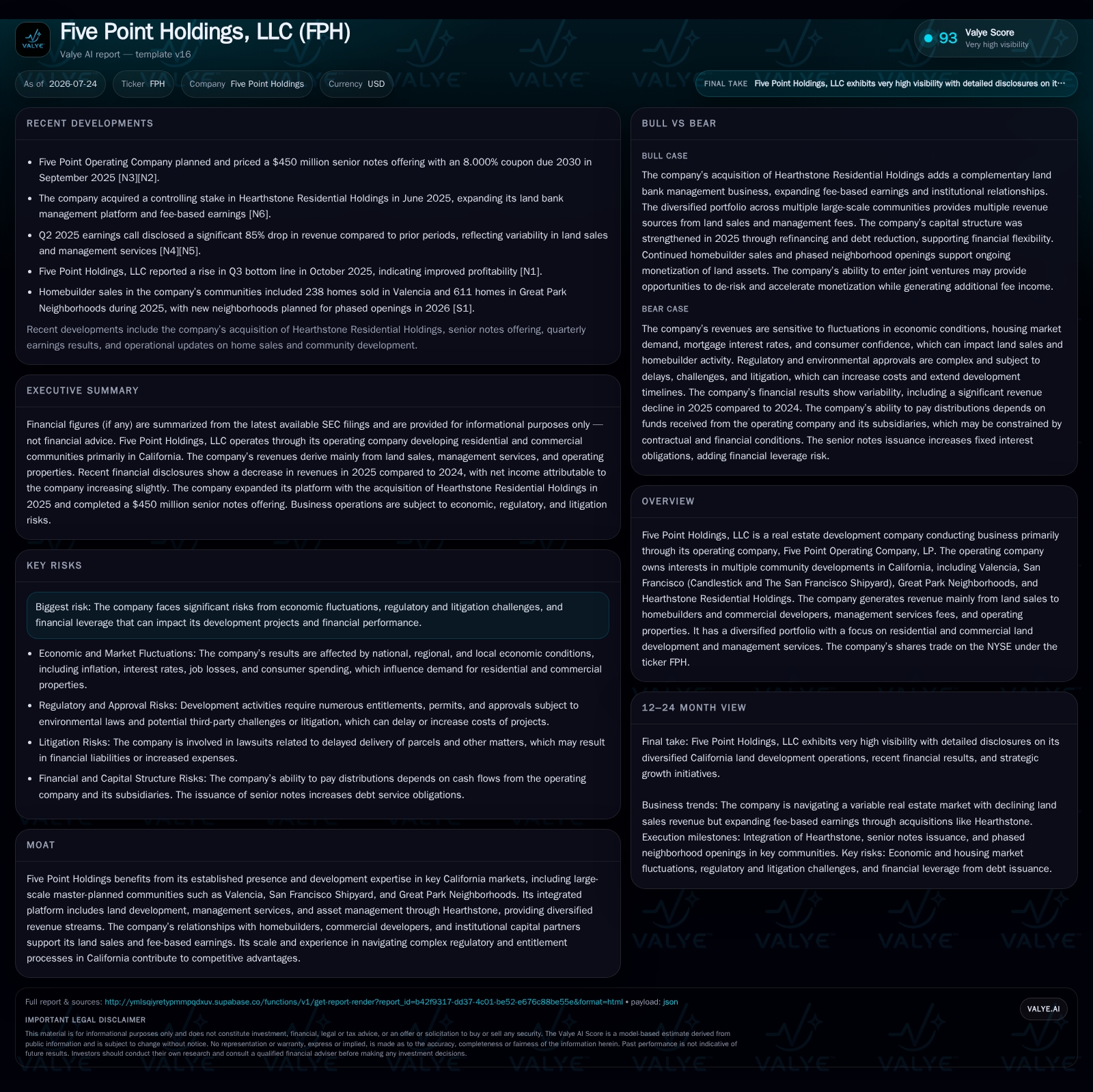
Five Point Holdings, LLC reported steady progress in its master-planned communities with strategic land sales and expansion of its Hearthstone asset management platform. The company’s diversified revenue model encompasses residential and commercial land sales, development management fees, and asset management services, positioning it well within the challenging California regulatory landscape. While financial leverage remains moderate, Five Point’s capital structure reflects prudent refinancing efforts supporting ongoing development and management operations. Key operational metrics to watch include lot absorption rates, infrastructure investment pacing, and regulatory milestones influencing project timelines.
Recent Operating Update
In the second quarter of 2026, Five Point Holdings continued to execute on its core master-planned community projects in California. Land sales to homebuilders and commercial developers remained active but carefully managed to optimize pricing and align with demand conditions. Notably, land sale volumes reflected selective parcel releases rather than broad acceleration, consistent with management's strategy to prioritize value capture over pure volume growth [S2]. This approach follows their previous choice to delay certain residential land sales at Valencia to better time market entry.
The company also highlighted progress within its Hearthstone equity acquisition completed July 31, 2025 [S1]. The controlling interest positions Five Point to benefit from stable asset management fees linked to residential lot option programs funded by institutional capital partners—an important complement to traditional land sale revenues which are more volatile and cyclical. This diversification into land banking services underscores a strategic refinement towards more recurring income streams amidst the capital-intensive development cycle
Business Model: Integration Within Master-Planned Community Development
Five Point operates primarily through its subsidiary Five Point Operating Company, LP, which manages sizable projects across several distinct Californian markets including Valencia (Los Angeles County), Candlestick and The San Francisco Shipyard (San Francisco), Great Park Neighborhoods (Orange County), and Hearthstone Residential Holdings focused on asset management [S1]. Revenue primarily arises from:
- Sales of residential lots to third-party homebuilders who carry out the construction of homes; these builders then sell finished homes directly to consumers.
- Commercial land sales for office, research & development, medical campuses, or industrial uses.
- Development management fees under long-term agreements with joint venture partners such as the Great Park Venture.
- Asset management fees through Hearthstone's funds focused on land banking and lot option programs.
This multi-faceted platform combines upstream entitlement processes—including complex local government negotiations and environmental compliance—with midstream infrastructure buildout (horizontal development) before downstream monetization via land parcel sales. This integration allows Five Point to capture multiple revenue streams while also leveraging longstanding relationships with major homebuilders who absorb lots within its communities.
Compared with peers narrowly focused on residential lot production or pure land banking entities, Five Point's scale across large master-planned communities provides economies of scope but also exposes it to protracted regulatory environments prevalent in California [S1]. The company's capacity to navigate entitlement pipelines and manage phased neighborhood openings effectively is critical both for sustaining lot supply consistency for builders and for managing capital expenditure cadence
Industry Structure and Competitive Position
Master-planned community developers like Five Point operate at a crucial nexus between raw landowners and homebuilding companies. In California’s high-barrier market characterized by stringent zoning laws, environmental restrictions, lengthy entitlement processes, and litigation exposures—such as those surrounding the San Francisco Shipyard parcel remediation—the ability to shepherd large-scale developments through complex approval landscapes is a key competitive moat.
Five Point distinguishes itself through:
- Owning interests in multiple strategically located large-scale community ventures.
- Combining land sale activities with a growing asset management platform via Hearthstone.
- Maintaining established relationships with prominent homebuilders who are key customers absorbing developed lots.
- Leveraging fee-based revenues that smooth earnings volatility typical of cyclical real estate markets.
This positioning contrasts with publicly traded entities more narrowly positioned either as pure residential land developers or as vertically integrated builders; peers such as Lennar Corporation exhibit vertical integration into home construction but face different operational risks tied to housing start cycles directly. Brookfield Residential offers an example of diversified public developers balancing fee income from management services—a model increasingly mirrored by Five Point post-Hearthstone acquisition.
Growth Drivers
Demand for Five Point’s offerings hinges significantly on regional population growth trends in Southern California's urban corridors combined with surging housing affordability pressures that intensify interest in master-planned community living environments. The company benefits from:
- Rising housing demand underpinning lot absorption rates by partner homebuilders within its communities.
- Urbanization patterns fueling mixed-use commercial development in synergistic employment hubs adjacent to residential neighborhoods.
- Strategic expansion into asset management markets serving institutional investors seeking long-term exposure to residential land appreciation without direct construction risk.
- Potential regulatory improvements or streamlining that could accelerate entitlement timelines enhancing project delivery speed.
Robust absorption metrics from guest builder homes closed—such as approximately 238 homes sold at Valencia since May 2021 initiation—offer intermediate signals of continued healthy demand dynamics despite macroeconomic headwinds [S1]. Additionally, incentive compensation linked to development milestones at Great Park enhances cash flow visibility aligned with underlying project execution [S12].
Risks and Watchpoints
The foremost risks impacting Five Point’s model remain rooted in external regulatory uncertainty inherent in California real estate development. Litigation related to environmental site remediation at San Francisco Shipyard presents open-ended timing risk that could delay parcel availability or impact profitability via remediation cost overruns [S1]. Similarly, zoning changes or policy shifts could constrain future entitlement feasibility or prompt community opposition raising political risk premiums.
Financial leverage presents another notable risk vector. Although successful refinancing efforts have moderated near-term interest burdens—e.g., issuance of new senior notes at an 8% coupon maturing in 2030 replacing prior higher-rate debt—the company’s indebtedness requires consistent cash flow generation from property sales followed by disciplined capital expenditure control [S4][S7]. Dependency on third-party homebuilders for lot absorption introduces demand volatility; any deterioration in construction starts prompted by broader economic or mortgage-financing weakness could compress sales velocity materially.
Infrastructure development costs are subject to inflationary pressure risks given prolonged horizontal development schedules; delays can cascade negatively affecting cash conversion timing [S13][S14]
What to Watch Next
Several operating markers will provide forward-looking clarity on execution momentum:
- Quarterly updates on acres of land entitled and number of lots sold/released within each community segment provide direct insight into volume trends sensitive to market cycles.
- Average lot sale price movements capture directional pricing power amidst localized supply-demand dynamics.
- Homebuilder closings per quarter remain critical barometers for underlying demand sustainability within the communities.
- Progress toward milestone completions triggering incentive compensation or development fee recognitions under management contracts such as Great Park Venture indicate operational strength.
- Updates on the resolution timelines related to environmental litigation or remediation requirements at San Francisco Shipyard bearing on final parcel deliveries.
- Capital deployment cadence into horizontal infrastructure as measured by investment outlays balanced against receipts from reimbursable public financing mechanisms such as community facilities districts bonds.
Execution across these dimensions will signal whether the company can sustain its growth trajectory amid inherent sector cyclicality coupled with idiosyncratic regulatory complexity.
Financial Profile Discussion
Five Point closed Q2 2026 with cash and equivalents of approximately $348 million against total debt near $444 million resulting in net debt around $96 million—reflecting a moderately leveraged posture manageable given expected steady cash flows from ongoing land dispositions and fees [F1]
The company’s prior refinancing during 2025 replaced higher coupon senior notes due early (10.5% due 2028) with longer-dated senior notes bearing an 8% coupon through October 2030—extending maturity runway while lowering average interest costs materially enhancing financial flexibility [S4][S7]
Net income for calendar year-end 2025 was about $70.9 million underpinning positive earnings generation despite sector cyclicality; this reflects revenue contributed by diversified streams including incentive fees linked to Great Park Venture performance plus emerging contribution from Hearthstone asset management following its mid-2025 acquisition [F1][S12][S13][S27]
Overall financial discipline appears prudent amid long-duration project lifecycles—the firm aligns major investments closely with reflected demand signals from builders and adjusts lot releases accordingly mitigating excessive inventory risk buildup common among peer developers exposed primarily to raw land holdings without integrated management platforms.
Disclaimer: This analysis is based solely on publicly available information provided through SEC filings dated up to July 24, 2026. It does not constitute investment advice or research views. All estimates are derived strictly from cited evidentiary sources without speculative extrapolation.
Disclaimer: This is research-only, informational analysis and not investment advice. It may include AI-generated interpretation and general industry context. Always verify important details using primary sources.

Comments