
Martin Midstream Partners Navigates Gulf Coast Energy Logistics with Diversified Midstream Services
MMLP's quarterly results reflect stable midstream volumes amid weather seasonality and ongoing debt covenant compliance.
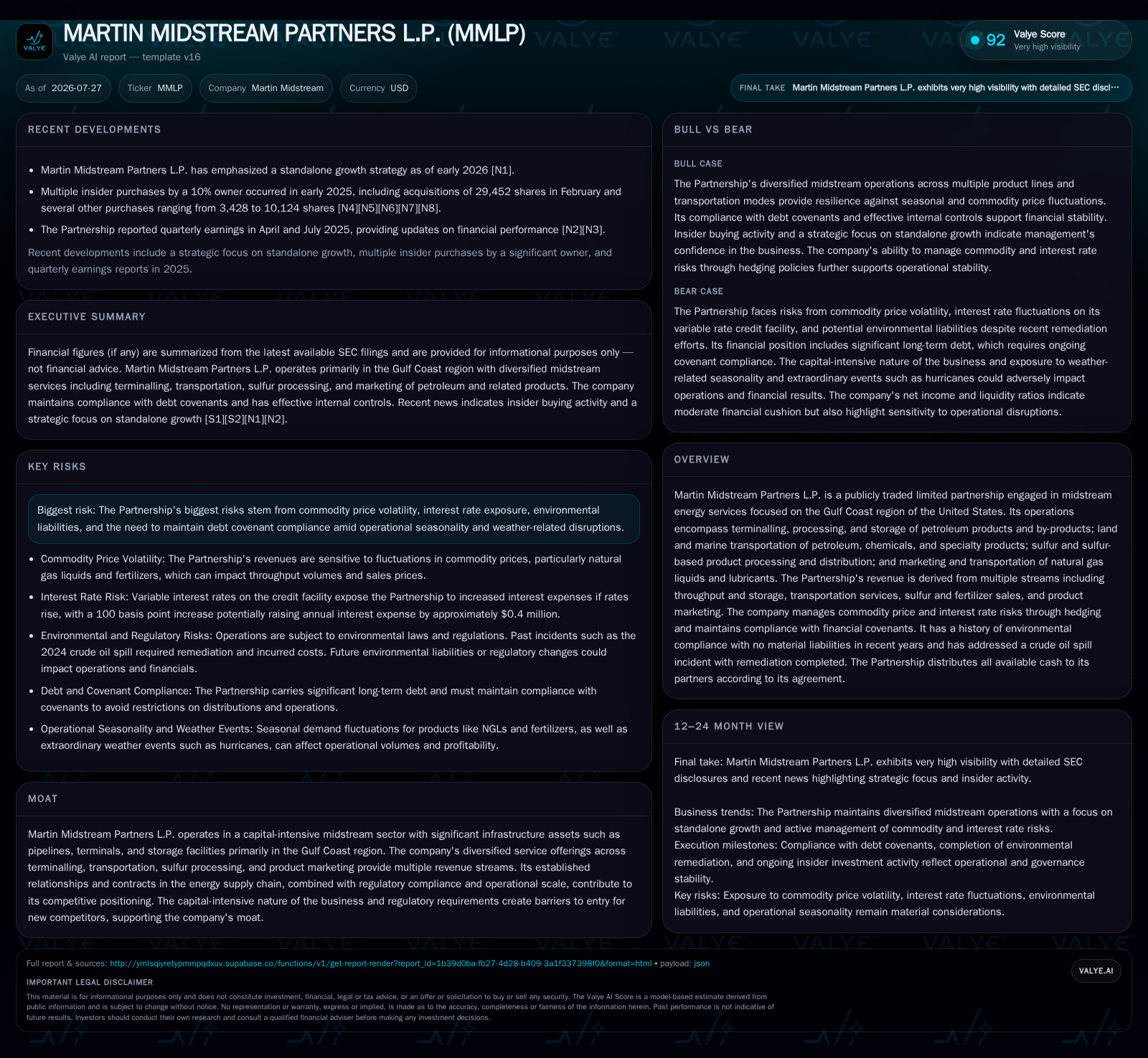
Martin Midstream Partners L.P. (MMLP) reported steady operational performance in Q2 2026, supported by diversified midstream services including terminalling, transportation, sulfur processing, and product marketing focusing on the Gulf Coast region. While throughput volumes and fees remain sensitive to commodity price cycles and seasonal demand for NGLs and fertilizers, the partnership maintains compliance with debt covenants under a capital-intensive model. Environmental compliance remains robust with no recent material liabilities. Key growth drivers include upstream production trends and infrastructure opportunity. Watch for capacity utilization trends and commodity price hedging effectiveness to gauge near-term stability.
Recent Operating Update: Stable Q2 Results Amid Familiar Risks
Martin Midstream Partners L.P. reported its quarterly operating results for Q2 ended June 30, 2026 without material changes in risk factors or business profile [S2]. The Partnership reiterated continued compliance with existing debt covenants following amendments extending its credit facility maturity to November 2027 while tightening leverage ratio thresholds [S8].
Operationally, the company’s diversified midstream portfolio demonstrated resilience despite expected seasonal fluctuations impacting natural gas liquids (NGLs) and fertilizer product sales [S20]. Terminalling and Storage as well as Transportation segments delivered steady throughput volumes and capacity utilization consistent with historical patterns concentrated in the Gulf Coast energy corridor [S1][S14]. Notably, the molten sulfur business—important for both processing fees and related by-product sales—showed minimal seasonal volatility corroborating a more stable earnings contribution.
The company’s updated disclosures confirmed that environmental liabilities remain well-managed. A prior crude oil spill in mid-2024 connecting the Sandyland Terminal to a refinery was fully remediated by October 2024 without any fines or penalties incurred since [S1]. This track record underscores Martin Midstream’s operational discipline within a heavily regulated segment of energy logistics.
Business Model: Fee-Driven Revenue Across Diverse Midstream Services
Martin Midstream Partners operates a multifaceted asset base specializing in terminalling, pipeline transportation, storage services for petroleum products and by-products, sulfur processing and distribution, plus marketing and land/marine transportation of NGLs and specialty lubricants [S1][S10].
The Partnership’s revenue mechanics center primarily on charging throughput fees under long-term or volume-based contracts rather than direct commodity risk exposure. These fees arise from pipeline transportation agreements (land and offshore), terminal storage capacity usage, processing plant activity particularly related to sulfur products, and marketing margins on NGLs plus lubricant packaging services [S22]. While some revenue stems from product sales (e.g., sulfur fertilizers), the bulk remains fee-generated aligning revenues closely with upstream production levels rather than spot commodity prices per se.
Segment revenue mix emphasizes diversification: Terminalling & Storage accounted for approximately $90.8 million in throughput/storage revenue during 2025; Transportation contributed $212.5 million primarily from land/inland/offshore assets; Sulfur services (including fertilizer product sales) generated over $164 million; Specialty products—including NGLs and lubricants—totaled around $249 million [S14][S22]. This blend reduces concentration risk common among pure pipeline operators or spot-market-dependent marketers.
Customer composition spans major integrated energy producers headquartered in the Gulf Coast region requiring reliable logistics solutions to move hydrocarbons efficiently from producing fields eastward toward refining hubs or export terminals. Contracts tend to have embedded volume commitments or minimum fees providing earnings visibility but demand can be impacted by upstream production cycles or seasonal end-use patterns such as agricultural fertilizer application windows [S20]
Industry Structure and Competitive Positioning
Operating within the midstream energy sector—the critical connective tissue between hydrocarbon extraction (upstream) and refining/retail distribution (downstream)—Martin Midstream Partners occupies a capital-intensive niche characterized by substantial fixed asset investments including pipelines, terminals, storage tanks, processing plants and transportation fleets.
The Gulf Coast focus anchors the Partnership in one of North America’s most active hydrocarbon basins offering proximity advantages yet also exposure to intense regulatory scrutiny given environmental sensitivity. Competition arises from other midstream infrastructure companies such as Enterprise Products Partners and Magellan Midstream Partners who operate broader interstate pipeline networks and larger storage footprints. Compared to these peers, Martin Midstream benefits from operational specialization across sulfur services alongside core terminalling/transport roles providing differentiated revenue streams.
Barriers to entry remain significant due to scale requirements of pipeline systems, environmental permitting complexity, and capital expenditure demands necessary to maintain uptime or expand capacity. Long-term contractual relationships underpin customer retention though contract renewal rates will require ongoing management attention given commodity price cyclicality that influences upstream producer budgets.
Growth Drivers: Upstream Momentum Supports Capacity Utilization
Key growth vectors include incremental upstream oil & gas production expanding feedstock volumes needing transport or storage through Martin Midstream's facilities [S16][S18]. Incremental investment patterns—capital expenditures for plant turnarounds ($40 million reported recently) alongside strategic ventures such as a 10% equity stake in DSM Semichem LLC which focuses on electronic-level sulfuric acid production for semiconductor manufacturing—illustrate attempts to expand specialty product capabilities aligned with evolving demand sectors
Volume-related KPIs such as throughput barrels per day at terminals/pipelines alongside storage utilization rates directly influence earnings power due to fee-based monetization mechanics. Seasonal shifts drive variable demand especially at the beginning-of-year fertilizer applications during spring planting seasons supporting sulfur product sales but resulting in cyclic volatility.
Continued transparency around these metrics will illuminate how Martin Midstream navigates mid-cycle industry headwinds while leveraging its diversified service platform within a cost-intensive but strategically vital segment of the oil & gas value chain.
Financial Profile Discussion
As of June 30, 2026, Martin Midstream held $162.7 million in current assets against $134.3 million in current liabilities yielding a current ratio of approximately 1.21—the moderate liquidity buffer adequate for operational needs but underscoring ongoing reliance on working capital management [F1]. Total debt approximates $378 million net of cash equivalents reflecting sustained leverage consistent with midstream peers engaged in infrastructure-heavy operations requiring external financing support for capex commitments [F1][S8].
Cash flow from operations remains pivotal supporting capital expenditures approximating $40 million annually including turnaround costs with additional discretionary spend flexible depending on macro conditions [S11][S18]. Financial discipline will be critical amid potential volatility periods ensuring sustainable coverage ratios facilitating future refinancing opportunities if needed.
This analysis aims to provide an integrative view grounded strictly on recent filings and established industry context without predicting future performance outcomes or advising transactions. Readers should consider disclosed risks carefully while evaluating Martin Midstream’s positioning as a Gulf Coast-focused midstream service provider navigating typical sector cyclicality anchored by diversified logistics capabilities.
Disclaimer: This is research-only, informational analysis and not investment advice. It may include AI-generated interpretation and general industry context. Always verify important details using primary sources.

Comments