
Comprehensive Analysis of Becton Dickinson & Co in the Evolving Medical Technology Landscape
An in-depth examination of BD's strategic positioning, regulatory environment, innovation initiatives, and financial health amidst industry challenges.
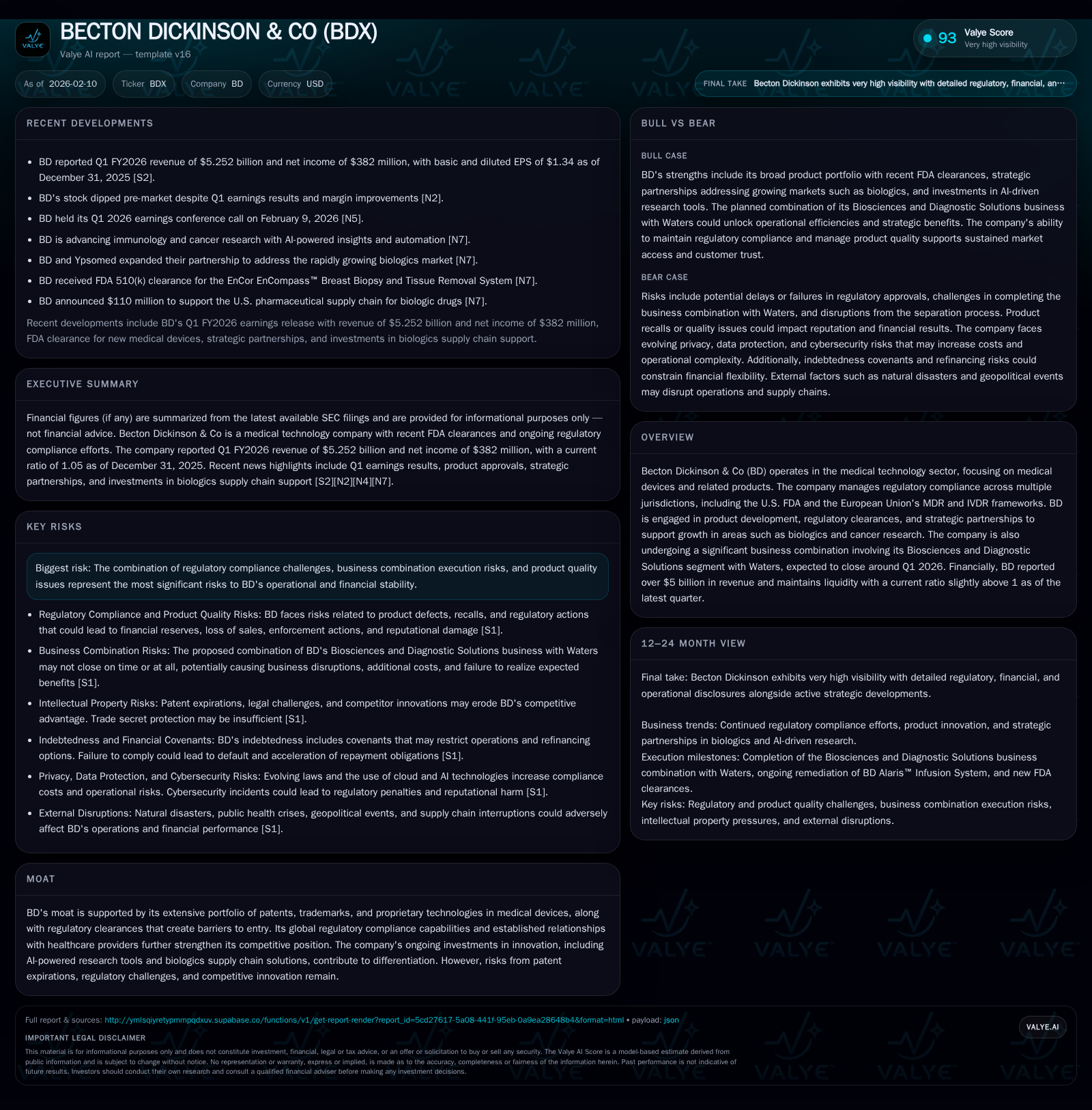
Becton Dickinson & Co (BDX) operates as a global leader in medical technology, balancing a broad product portfolio with advancing regulatory demands. The company’s moat is fortified through extensive intellectual property and regulatory clearances, while its strategic partnerships and AI-driven innovation position it within key growth areas such as biologics and cancer research. Despite robust Q1 earnings performance, BD faces execution risk related to its significant business combination with Waters and ongoing regulatory complexities across multiple markets. Operational risks also include product remediation and global compliance costs, set against a backdrop of evolving data privacy regulations.
Company Overview
Becton Dickinson & Co (BD) stands as an established player in the medical technology sector. The company's core operations encompass the development, manufacturing, and marketing of medical devices across a range of therapeutic areas. With approximately 72,000 associates worldwide spanning 61 countries, BD operates within a highly competitive landscape where regulatory acumen is critical. Its footprint extends beyond device manufacturing into biosciences and diagnostic solutions—a segment currently undergoing a major structural change through an impending business combination with Waters Corporation slated for Q1 2026 [S2][N2]. This move reflects BD's recognition of shifting market dynamics requiring realignment towards specialized diagnostics.
Financial Snapshot
Recent filings show BD generated revenues exceeding $5.2 billion for the quarter ending December 31, 2025, coupled with net income of $382 million [F1]. The company sustains liquidity well above immediate obligations; current assets were about $9.19 billion against current liabilities near $8.76 billion indicating a current ratio around 1.05—a comfortable buffer signaling operational stability despite ongoing investments [F1]. These results included beating earnings estimates for Q1 2026 but prompted mixed investor reactions reflected in pre-market share price dips possibly driven by cautious views on margin progression under macroeconomic pressures [N3][N1].
Regulatory Environment
Regulatory complexity defines much of BD's operational reality. On one front, the U.S. FDA clearance for the updated BD Alaris™ Infusion System marked a critical milestone enabling remediation activities following earlier recalls [S1]. This entails systematic replacement or upgrades at customer sites expected to extend through the next calendar year. Factors such as customer readiness and supply continuity add layers of uncertainty.
Meanwhile, European regulations under MDR (Medical Device Regulation) and IVDR (In Vitro Diagnostic Regulation) impose stringent criteria around clinical evidence generation, quality systems, and post-market vigilance [S1]. Transition timelines have been extended—up to 2027 or beyond for certain higher-risk devices—but challenges persist due to limited notified body capacity which can delay certification processes impacting market access.
Furthermore, data privacy laws globally are becoming more rigorous engaging new requirements as products increasingly leverage cloud infrastructure and artificial intelligence [S1]. This necessitates enhanced investments in cybersecurity measures, compliance mechanisms, and modification of product features to address data protection goals without compromising innovation velocity.
Competitive Moat and Innovation
BD's competitive advantage hinges on multifaceted moats that combine catalogues of patents/trademarks alongside regulatory clearances effectively raising barriers against new entrants. The company's long-standing relationships with healthcare providers foster trust essential for sustained adoption.
Innovation remains central to BD's strategy: recent announcements highlighted application of AI-powered automation tools accelerating immunology and oncology research workflows [N11]. Parallelly, expansion within biologics has proceeded via strategic partnerships such as the one broadened with Ypsomed addressing the fast-growing biologics delivery market [N10]. These efforts reflect BD’s commitment to integrating advanced technology with pharmaceutical/laboratory supply chain solutions.
Talent Management and Cultural Foundations
An indispensable pillar supporting BD’s execution capability lies within its human capital framework detailed extensively in its annual SEC disclosures [S1]. The organization pursues targeted growth initiatives including performance management tied to clear objectives, continuous education via internal platforms like BD University (BDU), and leadership development programs co-created with outside institutions.
The cultural emphasis on inclusion aligns workforce diversity with global patient needs enhancing innovative responsiveness. Compensation schemes are reviewed regularly to ensure fairness across geographies while well-being programs address physical, emotional, financial health recognizing their interplay with productivity.[S1]
Risks and Challenges
While BD enjoys structural advantages there are material headwinds ahead. Operationally executing the complex integration with Waters poses notable risks including timing delays or cost overruns that could pressure margins or distract management focus [S2]. Product remediation costs tied to widespread Alaris system recalls potentially weigh on near-term financials given their scale.
Regulatory dependencies remain precarious particularly within Europe where constrained notified body capacity might delay product approvals jeopardizing commercial momentum [S1]. Patent expirations leave pockets vulnerable to generic competition stressing investment into novel solutions essential over medium-term horizon.
Data privacy risks escalate alongside digital transformation initiatives; breaches or missteps might invite costly penalties or erode customer confidence impacting adoption [S1]. Lastly macroeconomic environments introducing inflationary pressures or geopolitical disruptions present external variables unsettled markets consider impatiently.
Industry Context (Analysis)
Medical technology companies globally face an intensifying regulatory apparatus paired with rapid technological advancement cycles. Incorporating AI or connected health devices demands navigating uncharted compliance landscapes while protecting patient safety remains paramount. Concurrently consolidation trends add pressure for scale economies as reimbursement environments tighten globally.
In this milieu BD’s scale combined with diversified technology disciplines allows diversification mitigating dependence on isolated product lines; however agility remains equally critical—requiring nimble R&D pipelines balancing incremental improvements vs transformative breakthroughs.
Conclusion
BD’s present positioning reveals a company balancing legacy strength with transformational imperatives. Its advanced product portfolio buttressed by extensive intellectual property rights offers resilience amidst shifting regulation. With strategic partnerships fueling innovations targeting biologics and oncology research markets alongside focused human capital investments BD exhibits capacities needed for sustained integrity within competitive medical tech domains.
Nevertheless navigating integration complexities associated with Waters deal alongside managing escalating costs from regulatory compliance will demand disciplined execution from leadership teams going forward. Continued vigilance around data security practices plus proactive engagement in evolving approval frameworks will be crucial components underpinning future operational stability.
Disclaimer: This analysis is provided solely for informational purposes based on publicly available data as of early 2026. It does not constitute investment advice or recommendations regarding security transactions or strategies.
Disclaimer: This is research-only, informational analysis and not investment advice. It may include AI-generated interpretation and general industry context. Always verify important details using primary sources.

Comments