
BetterLife Pharma Advances Clinical Pipeline While Managing Cost and Legal Challenges
Recent quarter highlights progress in drug development and improved operational efficiency but underscores financial and regulatory risks.
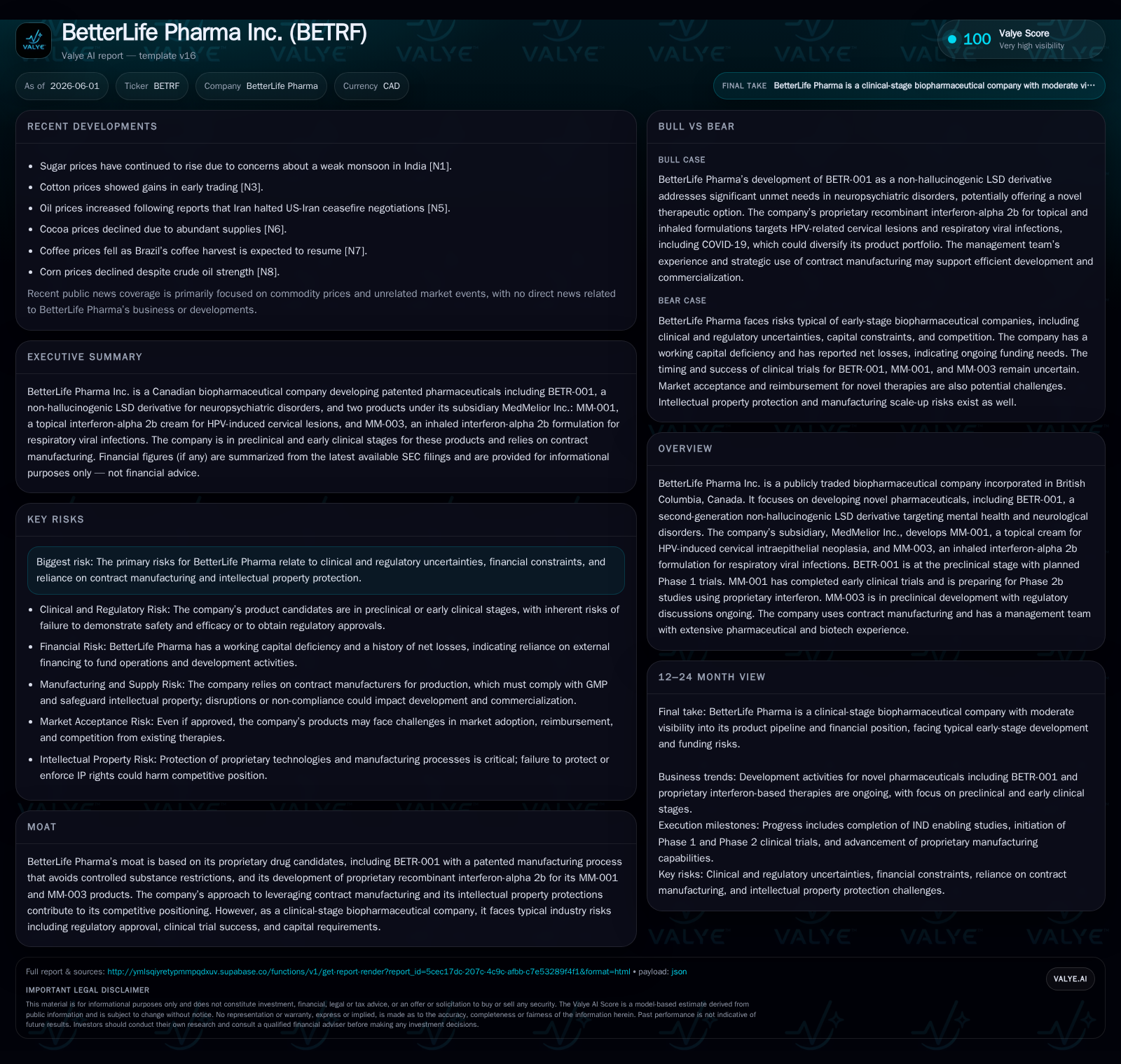
BetterLife Pharma reported a reduced net loss for fiscal 2026 driven by lower operating expenses, mainly from cuts to consulting fees and employment costs. The company continues advancing its pipeline centered on BETR-001, a non-hallucinogenic LSD derivative, and two interferon-based products under its MedMelior subsidiary. Despite no revenues yet, capital resources are deemed adequate to fund R&D initiatives. However, ongoing legal contingencies, modest working capital improvements, and regulatory hurdles remain as significant challenges. The firm relies on contract manufacturing, leveraging patented technology platforms to pursue mental health and infectious disease indications.
Recent Operating Update
BetterLife Pharma's latest quarterly disclosures reveal a meaningful contraction in net loss for the fiscal year ended January 31, 2026. The net loss was $1.51 million compared to $3.62 million the previous year [S2][S8]. This improvement primarily reflects a strategic reduction in operating expenses driven by decreased consulting fees—down from over $1.1 million to under $170,000—and significantly lower wages tied to reduced share-based payments [S8]. Management opted not to grant new stock options during the period, reflecting tightened liquidity conditions and an emphasis on cost containment.
The company maintains no revenue generation as its biopharmaceutical programs remain in development stages [S8]
Business Model Overview
BetterLife Pharma operates as a clinical-stage biopharmaceutical entity focused on innovative neurology and antiviral therapeutics. Its flagship candidate BETR-001 is a chemically modified derivative of LSD designed specifically to emulate purported therapeutic effects of classic psychedelics while circumventing hallucinogenic properties—a crucial differentiator intended to enhance tolerability and regulatory acceptability [S1]. BETR-001's mechanism leverages altered interaction at serotonin 5HT2A receptors via a brominated lysergic acid diethylamide structure generating non-hallucinogenic neuroplasticity benefits [S1]. This molecule remains preclinical but aims for imminent Phase 1 trials.
Complementing this proprietary molecule is BetterLife’s MedMelior subsidiary which develops two primary products: MM-001, a topical interferon-alpha 2b cream aimed at HPV-induced cervical intraepithelial neoplasia; and MM-003, an inhaled IFNa2b formulation targeting respiratory viruses such as SARS-CoV-2 [S1][S23]. MM-001 has completed early clinical phases and is preparing for Phase 2b studies leveraging recombinant interferon alpha developed internally or via strategic collaborations. MM-003 faces regulatory timing uncertainties with ongoing FDA discussions influenced by pandemic dynamics impacting viral disease treatment landscapes.
The commercial model eschews owning manufacturing infrastructure directly; instead it employs contract manufacturing organizations (CMOs) compliant with FDA current Good Manufacturing Practices (cGMP) emphasizing scalability, quality control, and intellectual property protection [S1][S23]. This asset-light approach aids flexibility but creates dependency risks related to third-party operational execution.
Industry Structure and Competitive Position
BetterLife competes within specialty therapeutic areas marked by high scientific novelty but elevated regulatory barriers—psychedelic-inspired neuropsychiatric treatments and interferon-based antivirals/topicals. The mental health drug space is crowded with established antidepressants plus emergent psychedelic modalities undergoing rising clinical validation yet hindered historically by safety/tolerability concerns linked to hallucinogens.
BETR-001’s non-hallucinogenic profile positions it uniquely if clinical data support efficacy without psychedelic side effects—a known limitation challenging wider adoption of classic LSD or psilocybin therapies. Patent protection on its unique chemical synthesis method adds exclusivity critical for eventual commercialization rights valuation.
In infectious disease treatment, IFNa2b formulations like MM-001/MM-003 serve as broad-spectrum antivirals with activity proven in multiple virus families but face competition from novel direct antivirals and monoclonal antibody therapeutics that dominate treatment guidelines. Regulatory scrutiny intensified post-COVID necessitates robust toxicology data and clinical outcome evidence illustrating meaningful benefit-risk ratios.
Growth Drivers
Key growth catalysts for BetterLife hinge on advancing clinical milestones: commencement of Phase 1 trials for BETR-001 will mark de-risking strides in neurology psychiatry where unmet needs remain high globally [S1]. For MedMelior’s products, progression into later-stage efficacy trials (Phase 2b) for MM-001 will validate commercial potential in HPV-associated pathologies while resolving MM-003’s inhalation toxicology studies per FDA guidelines is pivotal before human trials [S23].
Further growth potential lies in partnerships or licensing deals leveraging proprietary recombinant interferon platforms or psychedelic analogs with established pharmaceutical companies possessing commercialization infrastructure. Continued judicious capital management alongside selective talent acquisition enhances execution capabilities while preserving runway.
Risks and Constraints
Persistent financial constraints due to absence of product revenues underscore reliance on external funding via equity or debt issuance which may dilute shareholders or increase leverage [S1][S7]. Market acceptance risks loom large given the niche nature of psychedelic-derived drugs requiring prescriber education amid regulatory label complexities.
Contract manufacturing reliance introduces supply chain vulnerabilities with potential delays or quality compliance lapses impacting development timelines [S1]. Ongoing legal contingent liabilities tied to lease guarantees expose downside financial risk despite recent favorable judgments terminating prior litigation claims [S24][S10]. Intellectual property enforcement across jurisdictions remains uncertain due to variable patent law rigor affecting competitive moats.
Regulatory pathways carry inherent unpredictabilities especially given evolving standards for novel neuropsychiatric drugs amid heightened scrutiny over safety profiles for CNS-active compounds. MM-003’s repositioning post-pandemic evidences regulatory flux impacting project pacing [S23].
What To Watch Next
Upcoming milestones include initiation of Phase 1 clinical trials for BETR-001 expected within the near-term horizon providing first human safety signals. For MedMelior products, successful completion of inhalation GLP toxicology studies directed by FDA guidance will set the stage for IND filing submissions impactful for trial launches. Monitor quarterly earnings disclosures for updated cash runway projections considering R&D spending trends.
Corporate developments such as further settlements of outstanding legal matters or material partnership announcements could significantly influence operational momentum. Observers should track any shift in capital market access conditions influencing BetterLife’s ability to finance its clinical pipeline activation effectively.
Financial Profile Summary
As per the latest annual report ending January 31, 2026, BetterLife Pharma exhibited stringent expense discipline reducing operating losses substantially ($1.6 million compared with $5 million previous year) predominantly achieved through cuts in consulting ($170k from $1.12m) and payroll ($1.08m down from $2.42m) thanks partly to reduced share-based compensation obligations [S8][S22]. Interest, accretion expense also declined reflecting convertible debenture conversions amounting to $618k principal repaid by equity issuance.
Cash flow from operations remains negative (-$625k), though improved versus prior years fueled by controlled expenditures balanced by modest financing inflows totaling approximately $629k largely derived from related party promissory notes and warrant exercises [S7]
No revenue has been generated reflecting inherent stage-of-development status; heavy reliance persists on public markets or private placements for funding capital-intensive clinical phases ahead [S8][S7]. The balance sheet presents typical biotech early-stage financial profiles marked by accumulated deficits nearing $120 million underscoring sustained multi-year investment commitment before potential commercialization revenues emerge.
This analysis is based solely on public SEC filings dated through June 2026 combined with sector-native contextual understanding. It does not constitute investment advice nor predict future performance but aims to provide rigorous insight into BetterLife Pharma’s operational dynamics within the evolving specialty pharmaceutical landscape.
Disclaimer: This is research-only, informational analysis and not investment advice. It may include AI-generated interpretation and general industry context. Always verify important details using primary sources.

Comments