
Universal Corp Grapples with Volume Pressure and Currency Headwinds amid Strong Operating Cash Flow
Universal reported a modest revenue decline and narrowed operating income in Q3 FY2026, reflecting persistent industry and currency challenges despite robust cash generation.
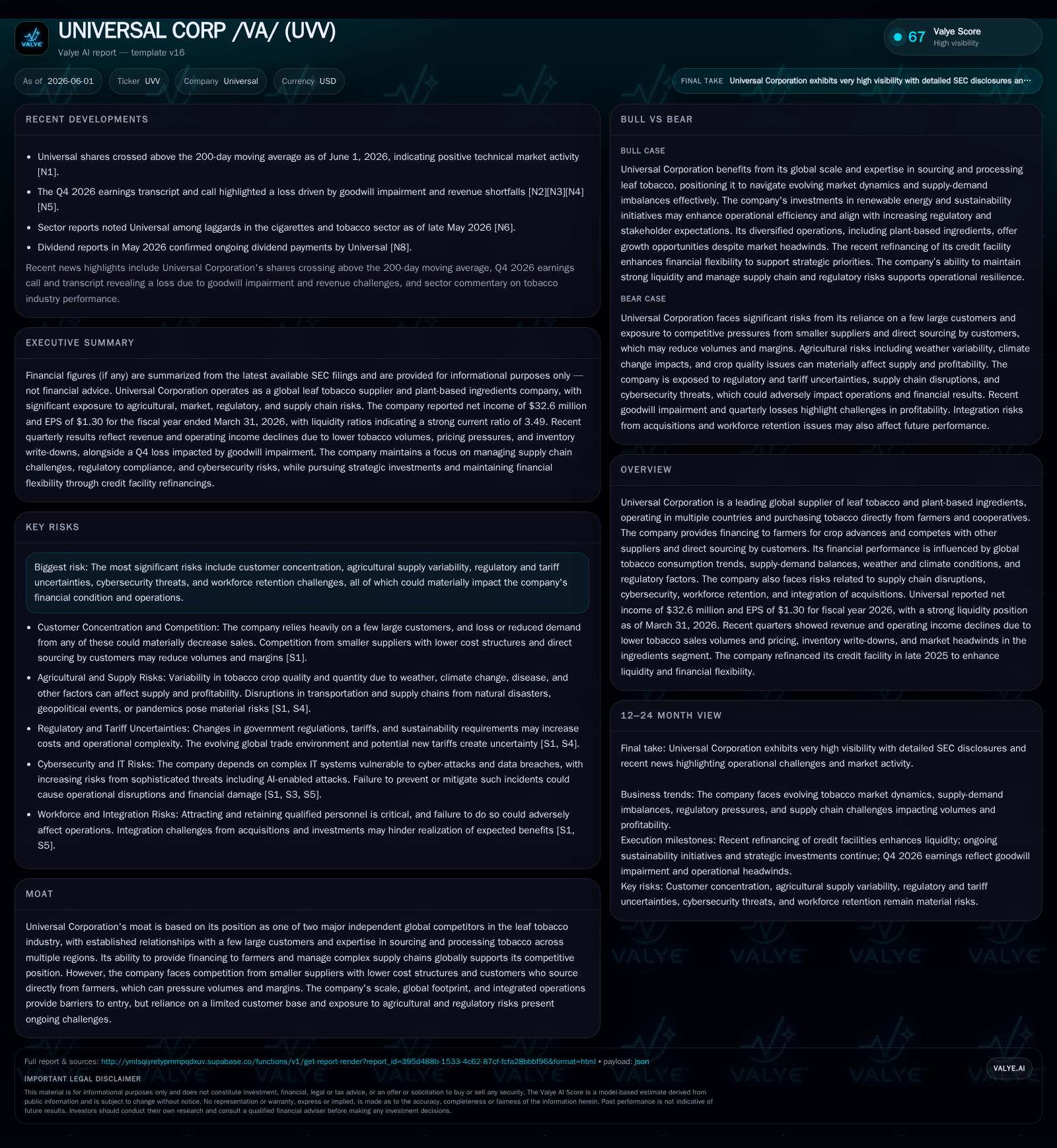
In the quarter and nine months ended December 31, 2025, Universal Corporation faced a 2-8% revenue decline coupled with a 3-21% fall in operating income, weighed by lower tobacco volumes, pricing pressures, and unfavorable currency impacts. The company leverages its global footprint and farmer financing capabilities to navigate competitive leaf tobacco markets dominated by a few large customers. Risks stem from customer concentration, agricultural volatility, direct sourcing trends, and regulatory shifts. While liquidity remains solid with no debt maturities until 2031, growth hinges on managing supply-demand imbalances and expanding its plant-based ingredients segment amid evolving market demands.
Recent Operating Update
Universal Corporation’s latest quarterly filing for the period ended December 31, 2025, reveals a nuanced operating environment marked by headwinds yet underpinned by strategic resilience [S2]. Revenues declined modestly by 2% over nine months and more sharply by 8% in the latest quarter compared to prior strong performance periods. Operating income mirrored this trend with decreases of 3% for the nine-month period and a steeper 21% decline for the quarter. The company’s tobacco operations remain the primary profit contributor, generating $185 million over nine months and $84 million in the most recent quarter despite these pressures.
Key drivers for these declines include reduced tobacco sales volumes influenced by global consumption trends that continue to weigh on demand. Pricing pressure compounded this effect, alongside significant foreign currency headwinds which negatively impacted selling expenses by $10 million year-over-year. While selling, general, and administrative (SG&A) costs were down $3.7 million overall due primarily to lower sales commissions and favorable exchange rates earlier in the period, increased compensation expenses and legal fees partially offset these savings.
Cash balances stood at approximately $85 million at that date with ample committed revolving credit lines exceeding typical working capital needs [S2]. This liquidity cushion is critical given the seasonal spikes in capital requirements aligned with agricultural cycles stretching from March through September.
Business Model and Strategic Positioning
Universal derives its revenue principally from leaf tobacco procurement, processing, and resale [S1]. The company operates globally across multiple regions sourcing tobacco directly from farmers or cooperatives—likely comprising contract arrangements requiring purchase of entire tobacco plants inclusive of diverse leaf styles. UVV provides crop advances to farmers as financing for agricultural inputs creating a unique dual role as both purchaser and financer—a critical point strengthening supplier relationships but introducing risks tied to crop quality and recoverability of advances if marketable standards are unmet
The company’s competitive edge stems from its scale as one of only two dominant independent global leaf suppliers mastering complex logistics spanning multiple continents. This scale enables it to meet stringent customer blend requirements efficiently while managing price negotiations leveraging expertise in various leaf styles sourced worldwide. However, Universal faces significant competition both from smaller suppliers who operate with leaner overheads—given their limited farmer support—and from customers pursuing direct sourcing strategies to capture cost or quality advantages independent of intermediaries like UVV.
Segmentally, the tobacco operations deliver majority earnings while expansion into plant-based ingredients represents an area for diversification though currently contributes marginal operating income [S17][S20]. The company’s ability to tailor product mix per shifting customer preferences plus deploy capital toward efficiency projects or sustainability initiatives (e.g., clean energy deployments in Italy, Dominican Republic) plays an increasingly important role in maintaining relevance as regulatory oversight heightens globally [S16][S10].
Industry Structure and Competitive Dynamics
The leaf tobacco industry is highly concentrated yet fragmented around key players like Universal who must operate internationally under diverse political regimes bearing implications for supply stability. Global consumption patterns are gradually declining due to health considerations driving regulatory measures that influence downstream cigarette manufacturing demand—a principal driver for raw tobacco volumes UVV handles.
Competitive forces include:
- Direct customer procurement efforts cutting out intermediaries,
- Smaller regional suppliers with agile cost structures,
- Regulatory pressures reshaping permissible product characteristics,
- Supplier financial risk due to agriculture-specific variables such as weather affecting crop yields or quality.
Notably, customer concentration is acute; a handful of large multinational tobacco manufacturers constitute most sales volume. Any material changes among these customers risks destabilizing UVV’s revenue base—not just through lost volume but through altered purchasing strategies like vertical integration or portfolio shifts away from certain tobacco styles.
Supply chain complexity combined with extensive farmer financing demands robust risk management capabilities. Universal must ensure crop traceability aligned with tightening nicotine content limits or ingredient restrictions imposed by frameworks such as those advocated by WHO’s Framework Convention on Tobacco Control (FCTC) [S24][S26].
Growth Drivers
Despite headwinds characteristic of structural industry declines:
- Product Mix Optimization: Refining product offerings toward higher-margin tobacco varieties demanded by premium or regulated blends could improve unit economics.
- Expanded Plant-Based Ingredients: Incremental investments here may open avenues into broader food and beverage sectors less dependent on tobacco consumption trends.
- Operational Efficiency: Targeted capital projects aimed at facility modernization (noted planned capex ~$45–55 million) plus sustainability initiatives can yield cost reductions enhancing competitiveness.
- Farmer Financing Leverage: Strengthening farmer networks through credit extensions fosters loyalty securing steady supply chains difficult for competitors lacking such relationships.
Growth is likely incremental rather than exponential given macro industry secular declines; success depends heavily on managing supply-demand balance shifts swiftly alongside nimble customer engagement adapting to evolving regulatory product requirements.
Risks and Constraints
Several critical uncertainties exist:
- Customer Concentration Risk: Revenue dependency exposes UVV to abrupt demand variations driven by strategic shifts or consolidation among major customers.
- Supply Variability: Agricultural risks including weather volatility could impact contracted volume fulfillment risking margin compression if marketable tobacco falls short.
- Competitive Cost Pressure: Smaller suppliers’ low fixed-cost models plus customer direct-sourcing erode standard pricing power.
- Regulatory Landscape: Expanding government regulations concerning product composition limitations or crop diversification incentives threaten traditional sourcing models.
- Geopolitical Instability: Presence in emerging markets engenders political risks potentially disrupting operations or asset recoverability.
- Cybersecurity & IT Systems: Increasing threat environment necessitates continuous investment in safeguarding systems essential for supply chain management.
- Workforce Dependency: Reliance on seasonal agricultural labor strains recruitment and retention impacting operational continuity.
These constraints require vigilant risk management including flexible financing structures—Universal maintains substantial liquidity capacity via revolving credit facilities mitigating liquidity strain during seasonal peaks [S7]
What to Watch Next
Investors and observers should monitor:
- Quarterly updates on volume trends particularly any acceleration/deceleration in consumer demand affecting raw leaf intake metrics.
- Margin developments relating to cost inflation pass-through capability amid currency fluctuations especially in key sourcing geographies.
- Progress on plant-based ingredient revenue contribution as diversification strategy unfolds.
- Regulatory developments globally impacting permissible tobacco usage levels or cultivation policy potentially altering regional sourcing mix.
- Integration outcomes of any acquisitions targeting ingredient sector expansion or niche leaf products.
- Capital expenditure execution & sustainability project milestones signaling operational improvements reducing carbon footprint or cost base inputs.
Guidance revisions accompanying quarterly earnings releases will provide directional cues on how management views evolving external headwinds balanced against internal execution effectiveness [N1][N2][N3]
Financial Profile Summary
As of March 31, 2026, Universal Corporation's balance sheet shows cash and equivalents totaling about $62 million against total reported debt near $620 million yielding a net debt position approximating $558 million [F1]. The company maintains substantial liquidity capacity via revolving credit facilities mitigating liquidity strain during seasonal peaks [S2][S7]. No long-term debt maturities loom before fiscal year 2031, reducing refinancing risk substantially.
In sum, Universal carries an investment-grade style balance sheet adapted to cyclical agricultural financing demands while navigating secular declines tempered somewhat by diversification into plant-based ingredients.
This analysis is based solely on publicly available filings as referenced without incorporation of forward-looking investment advice or proprietary data sources. Readers should consider it informational rather than predictive regarding company valuation or securities performance.
Financial position in context
As of 2026-03-31, companyfacts shows $62mm in cash and equivalents and $620mm of total debt [F1]. The same snapshot implies net debt of roughly $558mm, keeping balance-sheet context relevant but secondary to the operating story [F1]. Current assets of $1972mm and current liabilities of $564mm imply a current ratio near 3.49x for 2026-03-31 [F1].
Disclaimer: This is research-only, informational analysis and not investment advice. It may include AI-generated interpretation and general industry context. Always verify important details using primary sources.

Comments