
Polomar Health Services: Early-Stage Challenges Amid Merger Developments
The latest quarterly filing reveals Polomar Health Services faces critical liquidity constraints while advancing a pivotal merger agreement, underscoring near-term execution risks.
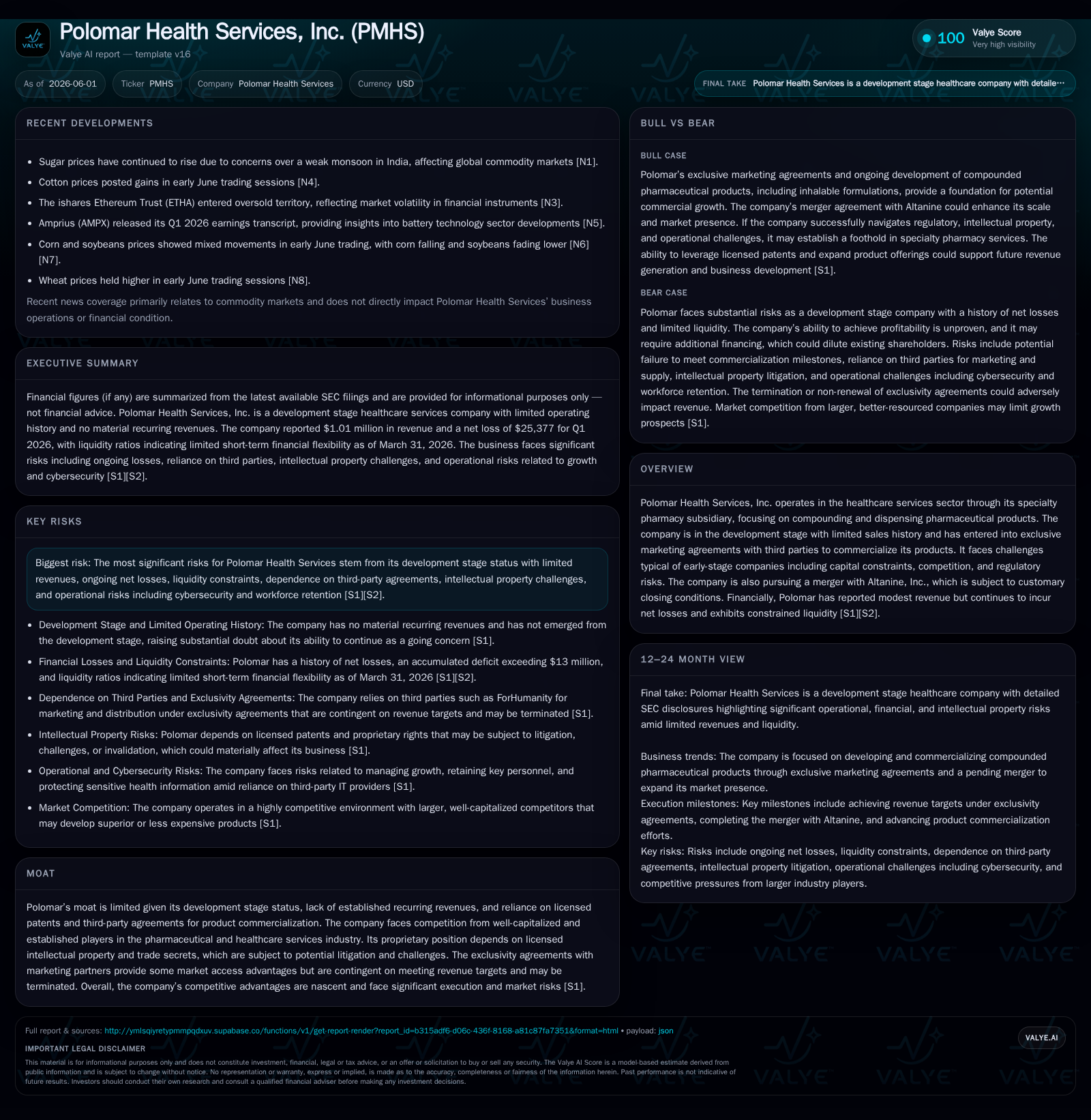
Polomar Health Services remains a development-stage specialty pharmacy operator with limited recurring revenue and significant net losses. Its business model heavily relies on licensed intellectual property and exclusive marketing partnerships to commercialize compounded pharmaceutical products, but capital constraints and competitive pressures challenge its growth trajectory. The company is actively pursuing a merger with Altanine, Inc., which entails a reverse stock split and regulatory approvals as closing conditions. Financially, Polomar’s severely constrained liquidity and low current ratio highlight an acute need for capital infusion to sustain operations and realize merger synergies.
Latest Quarterly Operating Update Signals Liquidity Risks during Merger Progress
Polomar Health Services’ latest Form 10-Q as of June 1, 2026 [S2] reveals stark liquidity challenges that frame the company’s immediate operating context. Cash and equivalents stood at approximately $87,818 at March-end 2026 against current liabilities totaling $1.76 million [F1], yielding a severely depressed current ratio of 0.27. This imbalance signals acute funding pressure and restricted financial flexibility during ongoing operating losses documented in prior annual disclosures [F1]. The company reported net losses exceeding $10.7 million for the year ended December 31, 2025, reflecting the absence of profitable operations despite modest revenue generation from specialty pharmaceuticals [F1].
Concurrently, Polomar has advanced key merger-related developments as articulated in the May 15, 2026 Form 8-K filing [S3]. Material conditions precedent include effectuating a reverse stock split to elevate its share price to $10 per share ahead of closing—a move critical for meeting Nasdaq listing standards—and obtaining SEC effectiveness on the S-4 Registration Statement for the issuance of shares in connection with the Altanine merger. Such regulatory and corporate governance milestones underscore an intensifying urgency around recapitalization efforts.
Business Model: Specialty Pharmacy Focus With Licensing and Marketing Dependencies
Polomar operates primarily through its specialty pharmacy subsidiary specializing in the compounding and dispensing of pharmaceutical products [S1]. Revenue generation depends fundamentally on exclusive marketing agreements with third-party entities authorized to commercialize products developed under licensed patents owned or controlled by Polomar [S1][S2]. These agreements confer market access yet create structural dependencies that complicate direct revenue visibility and margin capture.
Limited sales history constrains meaningful unit economics analysis; commercialization efforts remain nascent with unproven sustainable demand patterns. Reliance on licensed intellectual property—the company owns few proprietary manufacturing capabilities—introduces execution risk tied to both the enforcement of patent rights and maintaining partner exclusivity clauses [S1]. As such, Polomar’s revenue mechanics depend crucially on third-party marketing effectiveness coupled with maintaining regulatory compliance across compounded pharmaceutical offerings.
Competitive Dynamics: Early-Stage Positioning Against Established Healthcare Service Players
Polomar’s competitive standing is circumscribed by its development stage profile. It lacks established recurring revenues or sizable customer bases typical among incumbent specialty pharmacy providers. Furthermore, its intellectual property portfolio is exposed to potential infringement disputes or challenges that could undermine exclusivity or result in costly litigation—risks enumerated prominently in its annual filings [S1][S10].
In this environment, well-capitalized competitors with integrated manufacturing and marketing operations hold an advantage in scale efficiencies, regulatory experience, and brand trust. Polomar’s moat is therefore limited; market success will depend heavily on executing its merger strategy successfully while ramping commercial traction via licensed product lines.
Growth Drivers: Merger Synergies and Market Opportunity for Compounded Pharmaceuticals
Strategic growth prospects for Polomar hinge largely on completing the ongoing merger with Altanine—an event anticipated to infuse operational capabilities and access new distribution channels [S3]. The merger framework contemplates amendments facilitating equity credit lines targeted at securing at least $25 million in new financing alongside governance reforms conducive to scaling sales efforts.
Should these conditions materialize, Polomar could leverage enhanced capital resources toward expanding its specialty pharmacy footprint amid growing acceptance of compounded pharmaceuticals in niche therapeutic areas—a market segment characterized by strong physician demand but stringent regulatory oversight [S1]. Success will also depend on achieving performance thresholds embedded in existing third-party agreements (e.g., minimum revenue generation from ForHumanity Health through exclusivity clauses) slated for evaluation mid-2026 [S27][S28].
Risks and Constraints: Financial Vulnerability, IP Litigation, and Commercial Execution Challenges
Despite potential market opportunities, Polomar's advancement is constrained by multiple headwinds intrinsic to early-stage pharmaceutical service ventures. Net operating losses continue unabated with cash burn undermining balance sheet resilience [F1][S2]. Intellectual property risks loom large given dependence on licensed patents vulnerable to contentious litigation or invalidation proceedings; enforcement costs could impose material financial burdens or limit commercialization scope [S10][S11].
Operational challenges extend to cybersecurity threats affecting protected health information (PHI) managed under HIPAA mandates, reliance on third-party IT vendors whose controls may be imperfect, and difficulties retaining skilled personnel crucial for navigating complex regulatory landscapes—all factors cited as top risk exposures in year-end filings [S6][S17][S25]. Additionally, supply chain dependencies including tariff exposure on imported raw materials create further uncertainties impacting product cost competitiveness.
Near-Term Catalysts: Merger Closing Conditions and Commercialization Milestones
Investors must closely monitor key milestones underpinning the ongoing Altanine merger's progression: (i) obtaining supermajority stockholder approval; (ii) SEC acceptance without stop orders of the S-4 registration statement; (iii) completion of the mandatory reverse stock split boosting share price compliance ahead of Nasdaq listing; and (iv) fulfillment of requisite third-party approvals where applicable [S3][S29]
Successful navigation of these requirements will trigger critical equity funding mechanisms intended to alleviate liquidity pressures. Post-merger integration will also be spotlighted through early commercialization indicators derived from expanded marketing efforts spearheaded by Altanine’s infrastructure—success here will be pivotal in validating Polomar’s growth projections.
Financial Position Highlights the Urgent Need for Sustainable Capital Infusion
The financial disclosures culminating in Q1 2026 elucidate an urgent capital imperative facing Polomar Health Services [F1][S2]. With cash reserves under $90k juxtaposed against more than $1.7 million in current liabilities at quarter-end—resulting in a dangerously low current ratio near 0.27—the company confronts precarious short-term solvency scenarios absent fresh liquidity injections or debt refinancings
This analysis incorporates public SEC filings alongside recent corporate disclosures up to June 2026 to assess Polomar Health Services’ business trajectory absent speculative forecasts or investment research views.
Financial position in context
As of 2026-03-31, companyfacts shows $87818 in cash and equivalents [F1]. Current assets of $467650 and current liabilities of $1762118 imply a current ratio near 0.27x for 2026-03-31 [F1].
Disclaimer: This is research-only, informational analysis and not investment advice. It may include AI-generated interpretation and general industry context. Always verify important details using primary sources.

Comments