
Bunge Global SA: Oilseed Momentum, Grain Volatility, and the Integration Puzzle in Global Agribusiness
Bunge Global SA’s Q3 2026 results highlight robust oilseed processing performance, lifting its 2026 EPS outlook despite ongoing grain market risks. With a diversified portfolio and large-scale operations, the company’s future hinges on margin management, supply chain integration, and navigating commodity volatility.
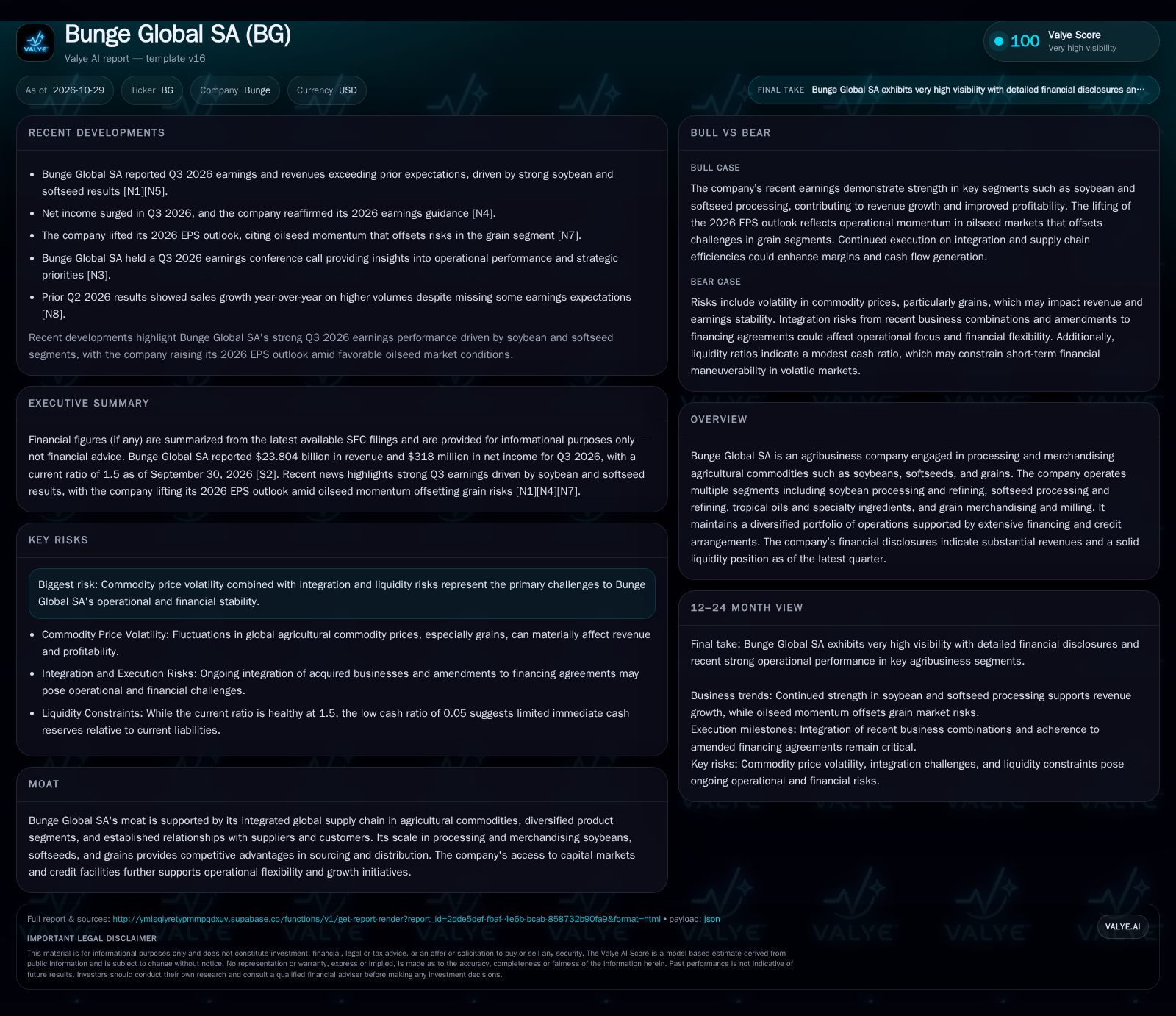
Bunge Global SA reported Q3 2026 revenue of $23.8 billion and net income of $318 million, exceeding expectations on strength in soybean and softseed segments. The company raised its 2026 EPS outlook, citing oilseed momentum as a buffer against grain headwinds. Execution on integration and commodity price risk management will be pivotal for sustaining operational and financial resilience. [S2] [N1] [N4] [N7]
Bunge Global SA’s latest quarter underscores the company’s duality: operational strength in its oilseed and softseed businesses, coupled with persistent exposure to commodity volatility and integration complexity. Q3 2026 results surpassed expectations, prompting a raised EPS outlook for the year as oilseed momentum offsets softer grain conditions. As a global agribusiness heavyweight, Bunge’s ability to maintain margin gains, manage risk, and realize synergies will define its next phase of value creation.
Recent Results Spotlight Oilseed Strength and EPS Momentum
In Q3 2026, Bunge Global SA reported revenue of $23.804 billion and net income of $318 million, with basic EPS of $1.65 and diluted EPS of $1.64 [S2]. These results exceeded prior expectations, driven by outperformance in the soybean and softseed segments [N1] [N5]. The company responded by raising its 2026 EPS outlook, citing continued oilseed momentum as a key offset to lingering grain market risks [N4] [N7].
Balance sheet disclosures show current assets of $29.2 billion against current liabilities of $19.4 billion, yielding a current ratio of 1.5. However, the cash ratio is just 0.05, with $524 million in cash and $366 million in short-term investments [S2]. This suggests Bunge’s near-term reported liquidity position relative to total liabilities, even as operational cash flow remains robust.
Bunge has also completed significant business combinations and amendments to its credit agreements in recent quarters, increasing the complexity of integration and capital structure management [S1]. These developments are material as they add both operational opportunity and execution risk.
How Bunge Monetizes Global Agribusiness Volatility
Bunge’s revenue model is anchored in the high-volume processing and trading of agricultural commodities, primarily soybeans, softseeds, and grains. Its core economics combine low-margin, high-turnover grain merchandising with higher-margin processing and refining of oilseeds and specialty ingredients. Gross margins are typically thin in grain merchandising but can be expanded through scale, logistics optimization, and risk management.
The company’s fixed cost base is significant, reflecting its global infrastructure—processing plants, port facilities, and logistics networks. This creates operating leverage: incremental volume or margin improvements in key segments, such as soybean crushing and oilseed refining, can disproportionately boost earnings. However, this leverage also works in reverse during adverse commodity cycles or supply chain disruptions.
Bunge’s capital needs are substantial, requiring ongoing investment in working capital for procurement, inventory, and hedging activities, as well as maintenance and upgrades to physical assets. The company’s access to credit facilities and capital markets is vital for funding these requirements, as evidenced by its amended and expanded credit agreements [S1].
Pricing power in the agribusiness sector is structurally limited due to global competition and the commoditized nature of core products. However, value-added specialty ingredients, integrated supply chains, and risk management strategies can improve mix and provide some margin insulation. The company’s ability to capture value depends on optimizing procurement, processing yields, and managing commodity price risk through hedging and contract structures.
Scale, Integration, and the Search for Durable Advantage
Bunge operates in an intensely competitive global landscape, facing rivals across commodity processing, grain merchandising, and specialty ingredients. Its major peers include other multinational agribusiness conglomerates and regional processors. The company’s moat is grounded in its integrated supply chain, global sourcing reach, and long-standing relationships with both producers and end customers.
Scale provides Bunge with procurement advantages, logistical flexibility, and the ability to absorb market shocks. Its diversified portfolio across oilseeds, grains, and specialty ingredients mitigates exposure to any single commodity market. However, this diversification also introduces complexity, particularly as the company executes on recent business combinations and supply chain integrations.
Competitive threats include new entrants leveraging technology for traceability or efficiency, vertical integration by large food companies, and the risk of substitution from alternative proteins or synthetic oils. The company’s ability to maintain its edge will depend on continuous investment in operational efficiency, risk management, and the successful integration of new assets and business lines.
Margin Expansion Through Oilseed Outperformance and Integration Synergies
The bullish scenario for Bunge hinges on sustained strength in oilseed processing and successful integration of recent acquisitions. If global demand for vegetable oils and protein meals remains robust—driven by food, feed, and renewable fuels—Bunge could maintain elevated processing margins and realize further operating leverage. Successful execution on supply chain integration may yield cost savings, improved asset utilization, and enhanced pricing discipline.
This scenario would be confirmed by ongoing outperformance in the oilseed and specialty segments, further upward revisions to EPS guidance, and evidence of margin improvement in reported financials. Additional signals would include management commentary emphasizing synergy capture, as well as increased capital returns or debt reduction reflecting improved cash generation.
Conversely, if disclosed, sustained improvement in segment-level margins and return on invested capital (ROIC) would provide further validation that operational changes are translating into durable economic gains.
Navigating Commodity Cycles with Diversification and Risk Controls
The most plausible medium-term outcome is that Bunge delivers stable, if cyclical, earnings by balancing oilseed strength with ongoing grain market volatility. The company’s diversified portfolio and global reach offer some protection against shocks in any single commodity, but margin compression in low-performing segments (such as grains) may offset oilseed gains.
Earnings stability in this scenario would depend on effective commodity risk management, operational discipline, and gradual realization of integration synergies. Guidance would likely remain within a moderate range, with short-term volatility driven by external shocks—such as weather events, trade policy shifts, or sudden moves in commodity prices.
Evidence supporting this scenario would include steady quarterly revenue and net income, management reiteration of existing guidance, and incremental progress on integration milestones. Disclosures around hedging effectiveness or segment-level performance (if provided) would help test the resilience of this diversified approach.
Commodity Price Shocks and Integration Missteps Erode Value
The adverse scenario involves a convergence of sharp commodity price declines—especially in grains—combined with failure to realize anticipated synergies from recent business combinations. Under this scenario, margin compression in key segments could outpace oilseed gains, while integration challenges lead to higher costs and operational inefficiencies.
Additional risks include unforeseen supply chain disruptions, regulatory changes, or adverse shifts in customer demand.
Confirmation of this scenario would come from downward revisions to earnings guidance, negative surprises in quarterly results, rising integration or restructuring costs, and commentary indicating challenges in risk management or liquidity. Deterioration in segment-level margins or rising net debt would further validate the downside risk.
Testing Bunge’s Thesis: Margin Durability, Integration Execution, and Volatility Exposure
Quarterly and segment-level margin trends, particularly in oilseed and grain processing, would help validate the sustainability of recent outperformance if disclosed.
Progress updates on integration milestones, synergy realization, and cost savings from recent business combinations should be closely monitored.
Earnings guidance revisions—both upward and downward—will signal management’s evolving outlook on commodity cycles and operational momentum.
Changes in net debt and credit facility usage, if disclosed, would provide insight into potential financial flexibility and risk appetite.
Management commentary on supply chain resilience, risk management strategies, and competitive positioning during earnings calls will be telling.
External developments—such as major policy shifts, trade disruptions, or weather-related supply shocks—could materially impact segment performance and overall profitability.
Disclaimer: This is research-only, informational analysis and not investment advice. It may include AI-generated interpretation and general industry context. Always verify important details using primary sources.

Comments