
Graham Holdings: Diversification, Margin Dynamics, and the Realities of Operating a Multi-Sector Portfolio
Graham Holdings reported $75.1 million in net income for the quarter ended September 30, 2026, supported by a current ratio of 1.76 and $154.3 million in cash.
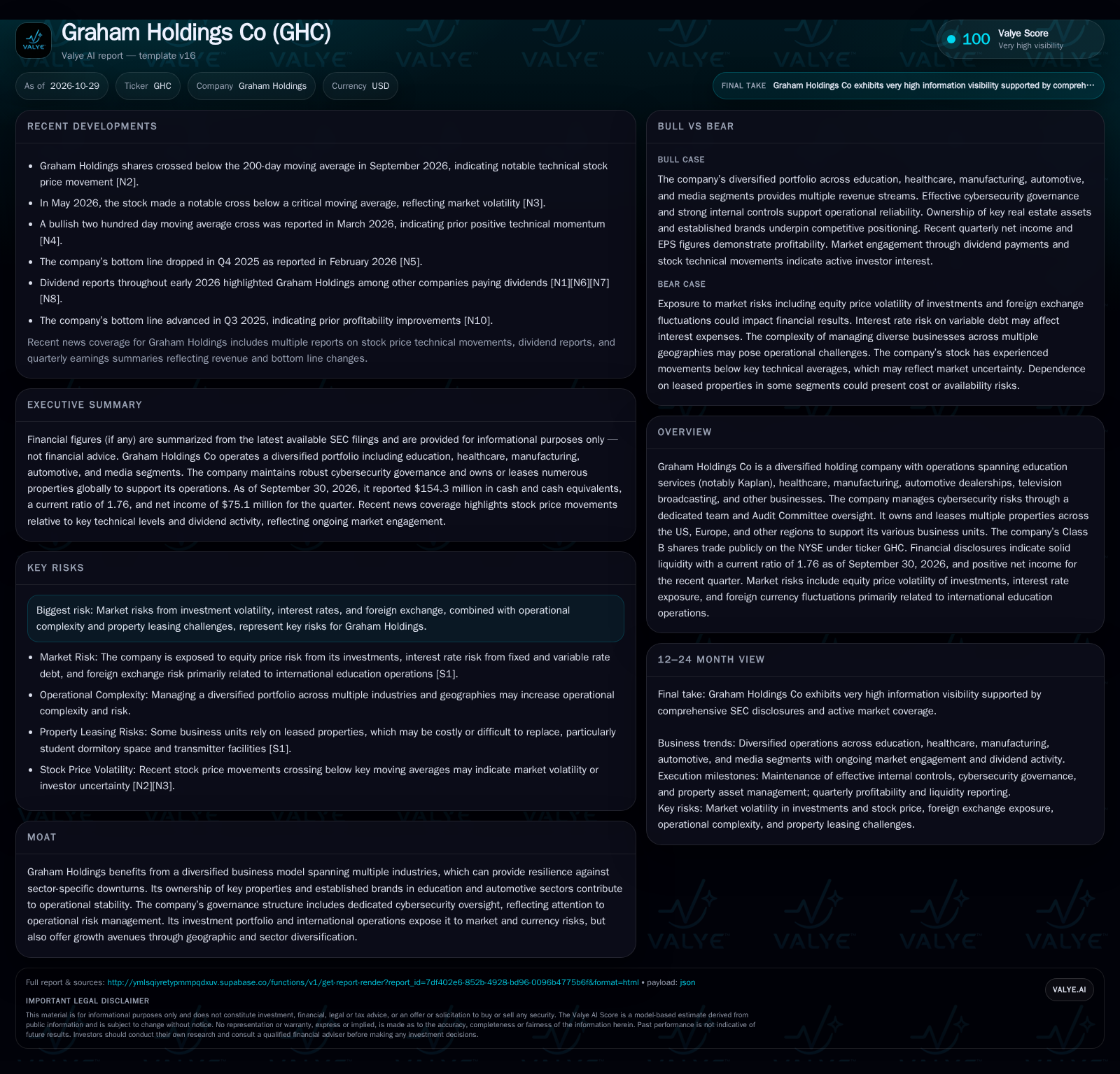
Graham Holdings reported $75.1 million in net income for the quarter ended September 30, 2026, supported by a current ratio of 1.76 and $154.3 million in cash. The company’s diversified model across education, healthcare, manufacturing, automotive, and TV broadcasting provides sectoral risk mitigation but introduces significant complexity, interest rate sensitivity, and international currency exposure. [S2] [N1] [N2]
With Kaplan’s international operations exposing the group to currency swings and interest rate volatility affecting debt costs, the central question for investors is whether Graham Holdings’ diversification can consistently deliver attractive returns—or if the inherent complexity and exposure to multiple macro risks will erode value over time. [S2]
Recent Earnings, Liquidity, and Market Signals: What’s Changed for Graham Holdings
Graham Holdings reported $75.1 million in net income for the quarter ended September 30, 2026, with basic EPS of $17.79 and diluted EPS of $17.60. However, technical stock signals in 2026 have been mixed: shares crossed below the 200-day moving average in both May and September, following a bullish cross in March, signaling shifting investor sentiment and possibly reflecting market concerns over earnings consistency and macro risk exposure. The cited source reports dividend-related activity; that disclosure alone does not establish dividend-policy continuity, management confidence, or a material constraint on capital flexibility. [S2] [N1] [N2] [N3] [N4]
Decoding the Economics of a Multi-Segment Portfolio
Graham Holdings’ revenue streams and margin profiles vary dramatically across its business lines. Kaplan (education) typically operates on moderate margins, with tuition and service revenues, but is exposed to enrollment cycles and regulatory changes. Healthcare and manufacturing segments can offer higher operating leverage, but also carry significant fixed costs and capex requirements. Automotive dealerships rely on inventory turnover and local market dynamics, with variable margins sensitive to consumer demand and financing rates. Broadcasting generates recurring cash flow but is exposed to advertising cycles and regulatory shifts.
Operating leverage is both a risk and an opportunity: if top-line growth is robust across segments, fixed costs in manufacturing, healthcare, and broadcasting can amplify earnings. Conversely, downturns in any major segment can quickly erode consolidated margins. The group’s capital needs are lumpy—acquisitions, property maintenance, and facility upgrades require periodic large outlays, while working capital needs are dictated by inventory and receivables cycles in automotive and manufacturing. Interest rate exposure from variable rate debt directly impacts net interest expense, and foreign exchange fluctuations—primarily via Kaplan’s international operations—can swing reported results.
Further complicating the economic landscape, Graham Holdings’ multi-segment structure necessitates differentiated capital allocation strategies that must balance growth investments against maintaining liquidity across sectors with varying cash flow profiles. For instance, capital-intensive segments like manufacturing and healthcare may require sustained reinvestment to maintain competitive positioning and comply with regulatory standards, whereas education and broadcasting might prioritize digital transformation or content acquisition. This dynamic demands a robust internal capital budgeting framework that can dynamically reallocate resources in response to shifting sectoral conditions and macroeconomic factors. Failure to optimize capital deployment could impair overall return on invested capital and constrain the company’s ability to respond to emerging opportunities or risks.
Additionally, the interplay between fixed and variable costs across segments influences the company’s operating leverage and margin sensitivity. Segments with high fixed costs, such as manufacturing and healthcare, may experience amplified earnings volatility during demand fluctuations, while segments with more variable cost structures, like automotive dealerships, might adjust more flexibly to market changes. This cost structure heterogeneity requires precise forecasting and scenario planning to anticipate how macroeconomic shifts—such as changes in consumer spending, regulatory environments, or supply chain disruptions—could differentially impact segment profitability and consolidated financial performance. Effective risk management practices, including hedging strategies and cost control initiatives, are critical to stabilizing margins.
How Diversification Shapes Graham Holdings’ Competitive Posture
Graham Holdings’ greatest competitive asset is its sectoral diversification: downturns in one industry can be offset by strength in another, offering some insulation from sector-specific shocks. Kaplan remains a well-known education brand, while the company’s automotive dealerships and broadcasting assets are established in their respective local markets. Ownership and leasing of key real estate provides operational flexibility and, where owned, some protection against rising property costs.
However, the breadth of operations also dilutes management focus and can hinder deep specialization in any one sector. Competitor categories vary by business line—education peers include global for-profit and nonprofit universities; automotive faces regional dealership groups; manufacturing competes with both domestic and international suppliers; and broadcasting contends with digital disruptors and local TV rivals. The main counterforce is that dedicated, focused competitors may be able to innovate faster or operate at lower cost in their domains. Switching frictions for customers are generally low in education and automotive, so brand, service quality, and location are key to retention. In broadcasting and manufacturing, customer stickiness is often determined by long-term relationships and contract structures, but these are not guaranteed by the holding company model.
What If Diversification Delivers? Scenario for Margin Expansion and Resilient Growth
If Graham Holdings can achieve synchronized growth or margin expansion across multiple key segments—especially if Kaplan’s international operations outperform, healthcare and manufacturing maintain high utilization, and automotive dealerships capture local share—the company could deliver robust earnings growth with reduced volatility. Effective interest rate management and currency hedging could further stabilize bottom-line results. Upside would be confirmed by sustained multi-segment revenue growth, margin expansion in education and manufacturing, and a pattern of positive earnings surprises. Additional evidence would include strategic acquisitions or disposals that sharpen portfolio focus and improve capital allocation, as well as consistently strong dividend payments and positive technical stock signals.
Managing Through Complexity: The Most Likely Trajectory
The most plausible outcome is continued moderate profitability, with Graham Holdings’ diversified model providing a buffer against major shocks but also limiting outsized upside. Earnings may fluctuate quarter-to-quarter as different segments cycle through industry-specific challenges and opportunities: for example, education may face enrollment pressure, while automotive and manufacturing cycle with consumer and industrial demand. Interest expense and currency volatility will remain persistent headwinds, but not existential threats. Confirmation of the base case would include stable (but not accelerating) earnings, a steady current ratio, and regular but unspectacular dividend activity. Falsification would come from either a sustained earnings decline across multiple segments or, conversely, a breakout period of margin expansion and capital returns driven by strategic repositioning.
When Diversification Fails: How Macro Shocks or Segment Missteps Could Erode Value
The primary downside risk is that Graham Holdings’ complexity becomes a liability rather than a strength. If multiple segments—such as education (due to regulatory or enrollment shocks), automotive (amid weak demand or inventory write-downs), or manufacturing (from cost inflation or supply chain disruption)—underperform simultaneously, consolidated margins and earnings could deteriorate rapidly. Rising interest rates would amplify debt service costs, and significant currency swings could reduce the value of international earnings. Downside would be confirmed by a pattern of quarterly losses, declining current ratio, dividend suspensions or cuts, and persistent negative technical stock signals. Evidence of operational missteps—such as major write-downs, asset sales at distressed prices, or control failures in internal reporting—would further validate the bear case.
Testing the Thesis: Metrics and Developments That Will Matter Most for Graham Holdings
Quarterly segment-level revenue and operating margin trends—especially in Kaplan, healthcare, and manufacturing—would help test the company’s ability to maintain balanced profitability across its portfolio (if disclosed).
Interest expense as a percentage of operating income, particularly in a rising rate environment, will indicate the degree of sensitivity to debt costs and the effectiveness of interest rate management.
Foreign exchange impact disclosures, particularly related to Kaplan’s international operations, should be monitored for signs of increasing currency risk or successful hedging.
Stock price performance relative to technical averages (e.g., 200-day moving average) may provide a market-based signal of changing investor confidence or risk perception.
Major acquisitions, divestitures, or restructuring announcements would indicate management’s willingness to reshape the portfolio in response to changing industry dynamics.
Material changes in property ownership versus leasing (if disclosed), especially in education and broadcasting, could affect cost structure and operational flexibility.
Disclaimer: This is research-only, informational analysis and not investment advice. It may include AI-generated interpretation and general industry context. Always verify important details using primary sources.

Comments