
BorgWarner’s Global Supply Chain: OEM Concentration, Margin Dynamics, and Automotive Electrification Progression
Despite improved Q3 profits and new technology agreements, BorgWarner must contend with customer concentration, global supply dependencies, and fierce competition—especially in China—as the automotive landscape shifts. The company’s ability to adapt its business model, maintain operational resilience, and capture value from electrification will determine its long-term trajectory.
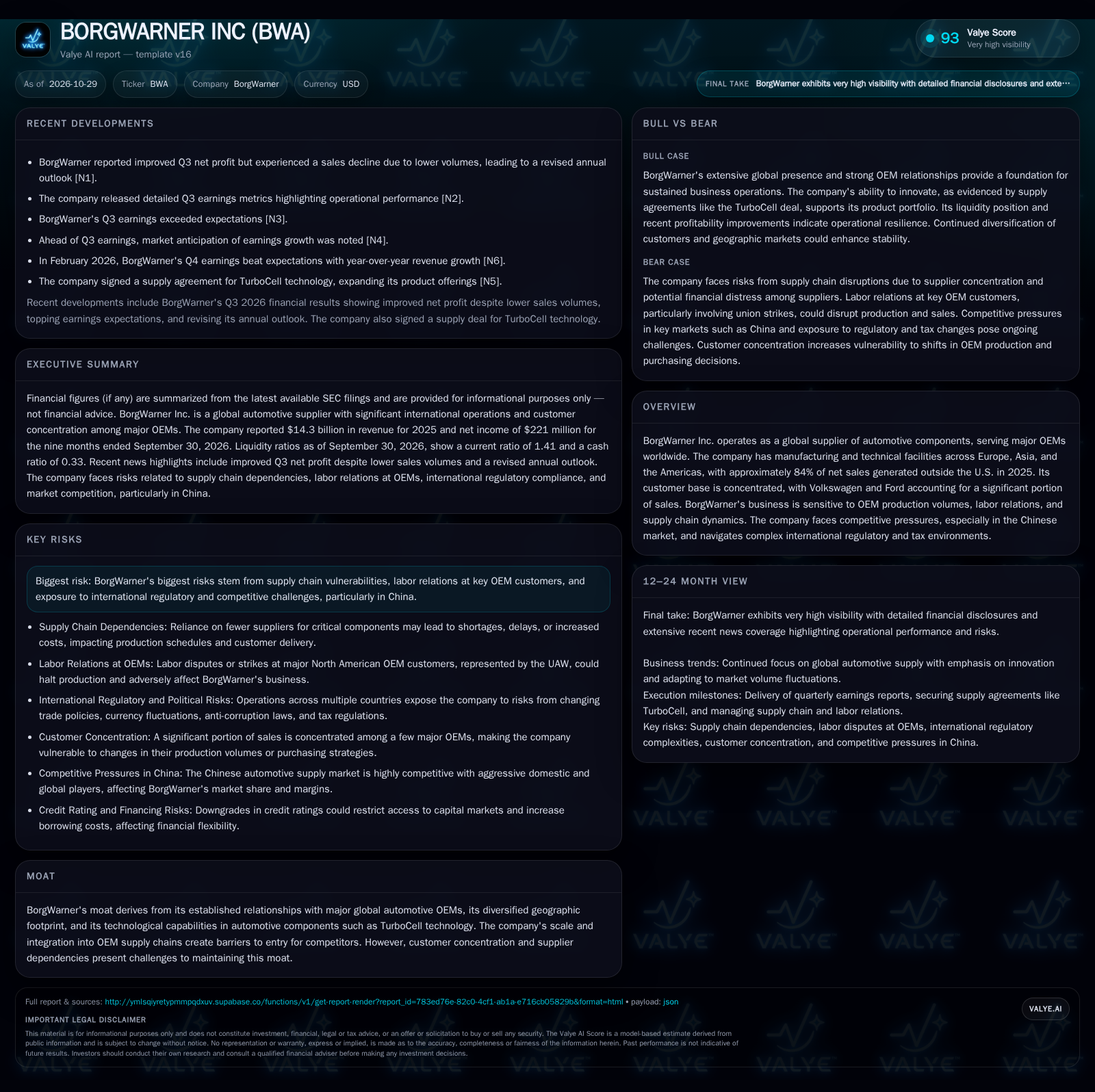
BorgWarner reported improved Q3 net profit in 2026 despite lower sales volumes and revised its annual outlook, highlighting both operational resilience and ongoing margin pressures. The company remains heavily dependent on a handful of major OEMs, faces supply chain and labor risks, and is exposed to heightened competition in China. Recent technology supply deals, such as for TurboCell, underscore efforts to diversify and innovate, but the sustainability of margin improvements and customer diversification remain open questions. The next phase of automotive electrification and OEM production cycles will be critical swing factors for BorgWarner’s economics and market position. [N1] [N2] [N5] [S2]
BorgWarner enters late 2026 at a strategic crossroads. The company’s improved Q3 net profit and technology supply deals demonstrate operational adaptability, yet these positive signals are balanced by persistent headwinds: declining sales volumes, significant dependence on a few OEM customers, and exposure to global supply chain and labor risks. As the automotive sector shifts toward electrification and faces ongoing macroeconomic uncertainty, BorgWarner’s ability to manage customer concentration, maintain margins, and leverage innovation will be decisive for its long-term value creation.
Profitability Gains Offset by Volume Declines and Customer Concentration
In Q3 2026, BorgWarner reported improved net profit despite a decline in sales volumes, prompting management to revise the annual outlook. This operational outcome suggests effective cost control or margin management in the face of softer demand. However, the company’s customer base remains highly concentrated, with Volkswagen and Ford accounting for a combined 25% of 2025 sales and the top ten customers comprising 71% of total revenue. This concentration amplifies the impact of any production disruptions or purchasing shifts by key OEMs. BorgWarner also announced a supply agreement for its TurboCell technology, reflecting continued emphasis on product innovation and potential new revenue streams. As of September 30, 2026, the company’s liquidity included $1.5 billion in cash and equivalents, a current ratio of 1.41, and a cash ratio of 0.33. [N1] [N2] [N5] [S2]
BorgWarner’s Approach to Transforming Automotive Cycles into Cash Flow
BorgWarner’s core business is supplying components—such as powertrain systems, turbochargers, and increasingly, electrification technologies—to global automotive OEMs. Revenue is largely volume-driven, closely tracking OEM production cycles and end-market demand. Pricing power is typically limited by the concentrated, high-bargaining-power customer base and intense competition, especially in mature and commoditizing segments.
Gross margins are pressured by the need to balance input costs, supply chain disruptions, and OEM pricing negotiations. The fixed-cost base—stemming from global manufacturing and technical facilities—means operating leverage can amplify both upswings and downturns in volumes. Capital intensity is moderate to high, given ongoing requirements for plant maintenance, capacity investments, and R&D (especially for electrification and regulatory compliance).
Recent margin improvement, despite lower sales, may indicate short-term cost discipline or a favorable product mix, but sustainability hinges on continued innovation and more diversified revenue streams. The company reported cash and liquidity metrics for the period; these figures do not by themselves establish operating runway, investment capacity, financial flexibility, or financing capacity. [S2] [N5]
The Impact of OEM Integration and Global Competition on BorgWarner
BorgWarner’s competitive position is anchored by longstanding integration into major OEM supply chains, technological breadth (including both legacy and electrification components), and a global manufacturing footprint. These attributes create switching frictions for OEMs and modest barriers to entry for smaller suppliers.
However, the company’s advantages are counterbalanced by several structural vulnerabilities. Customer concentration means that any loss of a major account (or even reduced orders) can have outsized financial impact. Supplier dependencies—especially for critical components—expose BorgWarner to potential shortages or cost spikes, which can erode margins or threaten delivery reliability.
In China, where competition is described as aggressive and 21% of 2025 sales were generated, BorgWarner faces both domestic and international rivals with cost, scale, and regulatory advantages. The local market’s rapid electrification and price competition could compress margins further, particularly if BorgWarner’s advanced technologies are not sufficiently differentiated or if local content requirements intensify. Globally, the ongoing transition to electric vehicles (EVs) introduces new competitors from both traditional and emerging technology backgrounds, challenging BorgWarner to maintain relevance and pricing power.
Margin Expansion Potential from Electrification and Technology Advances
The most favorable scenario for BorgWarner involves accelerated adoption of electrification technologies across global OEMs, with BorgWarner securing a growing share of high-value, differentiated component contracts. Successful execution of supply agreements—such as the TurboCell deal—across multiple platforms and customers would validate the company’s innovation strategy and reduce dependence on legacy internal combustion engine (ICE) products.
This scenario requires that BorgWarner’s R&D investments yield technologies that are both OEM-preferred and defensible against low-cost competitors, particularly in China. If disclosed, increases in electrification revenue as a percentage of total sales, higher average contract value per vehicle, and improved gross margins would confirm the thesis. Additional evidence would include new multi-year technology contracts, expanding customer diversification, and resilience in Chinese market share despite local pressures. Falsification would come from stagnating electrification revenues, margin compression, or the loss of key technology supply agreements.
Managing Cyclical Volatility through Innovation and Customer Partnerships
The most plausible trajectory is that BorgWarner continues to ride the cyclical waves of global automotive production, preserving its entrenched OEM relationships and gradually shifting its portfolio toward higher-value electrification offerings. Margins are likely to remain under pressure from customer bargaining power, input cost volatility, and periodic supply chain disruptions, but operational discipline and selective technology wins should allow for modest profitability improvements.
Key confirming evidence would include stable or slightly growing revenues despite production variability, ongoing announcements of technology supply agreements, and the maintenance of liquidity ratios in line with historical norms. Customer concentration will likely persist, but not worsen, as BorgWarner seeks to expand with both existing and new OEMs. Falsification would involve a sharp drop in OEM orders, persistent margin erosion, or evidence that electrification investments are not translating into commercial traction.
Margin Pressure Risks from Supply Chain Disruptions and OEM Labor Issues
An adverse scenario would be triggered by a combination of supply chain disruptions (such as shortages or cost spikes for critical components), labor strikes at major OEM customers, and intensified competition—especially in the Chinese market. These factors could lead to production stoppages, lost sales, and margin compression, particularly given the company's reliance on a small group of large OEMs.
The situation could be exacerbated if credit ratings are downgraded, restricting access to affordable funding at a time when capital needs escalate. Additional warning signs would include a rapid deterioration in liquidity metrics, loss of key supply agreements, or a decline in market share in China. If disclosed, evidence of supplier financial distress, escalating input costs, or customer loss would confirm the downside scenario. A mitigating factor could be the company’s ability to rapidly adjust costs or secure alternative supply sources, but this is not assured.
Developments Shaping BorgWarner’s Electrification and Customer Volume Outlook
Quarterly changes in sales concentration among top ten customers—if disclosed—would help test progress toward customer diversification.
Revenue share from electrification products versus legacy ICE components, as electrification penetration is a key thesis swing factor.
Gross margin trends, especially in the context of input cost volatility and supply chain disruptions.
Announcements of new technology supply agreements—such as additional TurboCell deals—or evidence of expanded multi-year contracts.
Market share evolution in China, including any changes in competitive positioning or regulatory headwinds.
Evidence of supplier financial distress, delivery delays, or cost escalation impacting production schedules.
Disclosure of OEM strike impacts, production stoppages, or significant changes in OEM labor relations.
Disclaimer: This is research-only, informational analysis and not investment advice. It may include AI-generated interpretation and general industry context. Always verify important details using primary sources.

Comments