
Deckers’ Brand Portfolio, Channel Expansion, and the Tension Between Growth and Supply Chain Complexity
Deckers Outdoor Corp’s record revenue in Q2 FY 2027 underscores the ongoing strength of its HOKA and UGG brands, but the company’s reliance on outsourced manufacturing, extended inventory cycles, and shifting consumer preferences present persistent operational and strategic challenges.
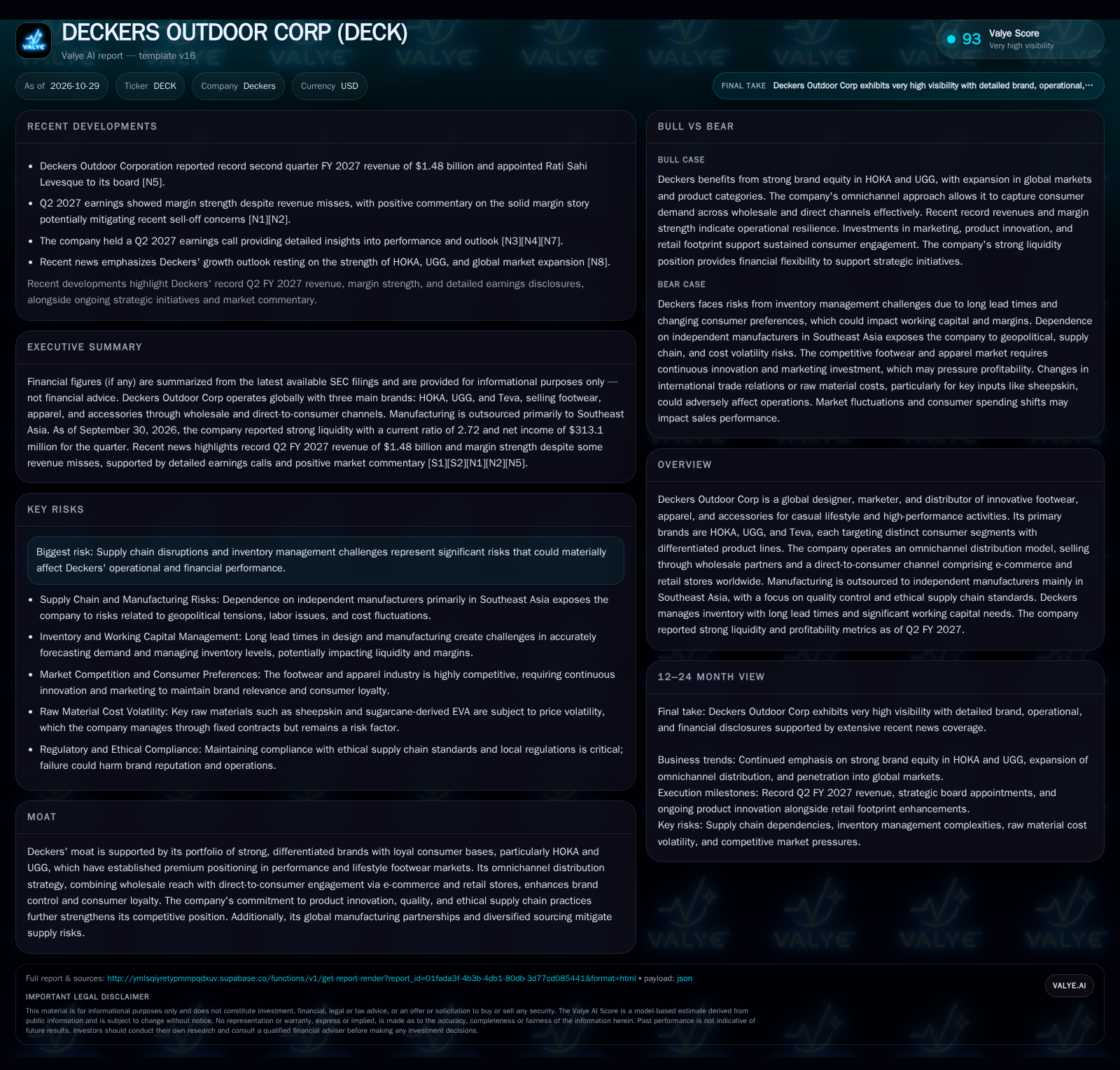
Deckers Outdoor Corp reported record quarterly revenue of $1.48 billion in Q2 FY 2027, driven by its HOKA and UGG brands. The company’s omnichannel model—spanning wholesale, e-commerce, and a global retail footprint—supports broad market access but demands complex inventory management and exposes it to supply chain volatility. While profitability remains robust, long lead times and external manufacturing dependencies increase the company’s sensitivity to demand shifts, input costs, and geopolitical events. The next phase of value creation will likely hinge on Deckers’ ability to balance brand-driven growth with tighter operational discipline and supply chain resilience. [S1] [S2] [N5]
Deckers Outdoor Corp’s Q2 FY 2027 performance demonstrated the continued pull of its flagship HOKA and UGG brands, with record revenue and solid profitability despite some revenue misses relative to expectations. The company’s omnichannel approach—spanning a growing global retail network and extensive e-commerce operations—enables broad consumer access but adds layers of operational complexity, particularly as Deckers manages long production lead times and relies on third-party manufacturers concentrated in Southeast Asia. As the company seeks to sustain its growth trajectory, the critical question is whether Deckers can mitigate inventory and supply chain risks while leveraging its brand equity and retail platform to drive further market penetration. [S1] [S2] [N5]
Q2 FY 2027: Record Revenue, Expanding Retail, and Manufacturing Dependencies
Deckers Outdoor Corp reported record second quarter FY 2027 revenue of $1.48 billion, underscoring the strong demand for its core brands—HOKA and UGG. The company’s global retail footprint expanded to 203 stores as of March 31, 2026, including 141 UGG and 62 HOKA locations, complemented by e-commerce operations in 54 countries. While these distribution channels provide wide consumer access and help diversify revenue streams, they also require sophisticated inventory management and significant liquidity, especially in the face of long production lead times. Deckers’ manufacturing is almost entirely outsourced to independent partners in Southeast Asia, primarily Vietnam and Indonesia, with a deliberate effort to limit exposure to China (less than 5% of production). The company ended Q2 with $1.21 billion in cash and equivalents, a current ratio of 2.72, and net income of $313.1 million, providing a snapshot of both financial strength and resource requirements. [S1] [S2] [N5]
How Deckers’ Brand Engine Drives Earnings—and Where the Friction Lies
Deckers’ revenue model is anchored by two highly differentiated brands: HOKA, which commands premium pricing in the performance footwear segment, and UGG, which leverages its iconic status in lifestyle footwear and accessories. These brands allow Deckers to target both high-growth (performance) and established (lifestyle) consumer segments, supporting a balanced revenue mix. The company’s omnichannel strategy—blending wholesale exposure with DTC channels via e-commerce and owned retail—enables margin expansion opportunities, as DTC sales typically carry higher gross margins than wholesale. However, DTC channels also demand greater investment in inventory and customer experience.
The economics of the business are shaped by outsourced manufacturing, which reduces fixed capital requirements but introduces variable costs and working capital swings. Inventory cycles are long, requiring Deckers to commit significant resources months ahead of actual sales, making it vulnerable to demand forecasting errors and consumer preference shifts. While the company uses fixed contracts for some raw materials (e.g., sheepskin for UGG), price volatility remains a risk, and operating leverage can cut both ways, amplifying both upside and downside from volume changes. The company reported cash and liquidity metrics for the period; these figures do not by themselves establish operating runway, investment capacity, financial flexibility, or financing capacity. [S1] [S2]
Sustaining Brand Power in a Crowded Footwear Arena
Deckers’ competitive edge rests on the strength of its proprietary brands—HOKA’s rapid ascent in the performance running category and UGG’s enduring lifestyle appeal. These brands benefit from premium positioning and loyal consumer bases, which can translate into pricing power and repeat purchases. The company’s omnichannel reach—spanning global wholesale partners, e-commerce, and owned retail—enables it to control brand presentation and capture a wider share of consumer spending.
However, the footwear and apparel market is intensely competitive, with global giants (e.g., Nike, Adidas, Puma) and niche performance brands vying for consumer attention. Barriers to entry are moderate, but scaling a premium brand and sustaining relevance requires continual investment in product innovation, marketing, and retail experience. Deckers’ reliance on third-party manufacturing is typical for the sector but limits direct control over production flexibility and speed. Substitution risk is real, as consumer tastes can shift rapidly, and new entrants can erode share if Deckers fails to keep its brands fresh and distribution agile. [S1]
If Deckers Balances Demand and Supply: Margin Expansion and Global Brand Penetration
The most favorable scenario for Deckers sees continued global demand growth for HOKA and UGG, with the company successfully leveraging its omnichannel platform to convert that demand into higher-margin DTC sales. If Deckers can refine its demand forecasting and inventory planning—using data to align production more closely with real-time sales trends—it could reduce markdowns, minimize working capital drag, and sustain or even expand margins. Expansion of HOKA’s international presence and ongoing product innovation could further extend the brand’s reach beyond core running segments into broader fitness and lifestyle categories.
Evidence that would confirm this scenario includes: accelerating DTC growth as a share of total sales, sustained gross margin improvement, evidence of strong sell-through and low inventory obsolescence, and successful new store openings that drive incremental rather than cannibalistic sales. A continued stable or improving cash conversion cycle—despite global expansion—would indicate that Deckers is managing operational complexity without sacrificing financial discipline.
Brand Momentum Meets Operational Realities: Managing Growth with Caution
The most plausible trajectory for Deckers is continued brand-driven growth, particularly from HOKA and steady contributions from UGG, but with periodic operational friction stemming from inventory and supply chain volatility. The company’s omnichannel strategy is likely to deliver incremental revenue, but the need to balance inventory risk with growth ambitions could result in occasional margin pressure—especially if consumer demand softens or supply disruptions occur.
Deckers is likely to maintain its current liquidity and profitability profile, but working capital swings and raw material cost volatility may periodically weigh on results. Confirmation of this scenario would include stable revenue growth in the mid-to-high single digits, gross margin resilience with some quarter-to-quarter volatility, and periodic adjustments to inventory levels as the company calibrates to demand signals. Falsification would occur if inventory write-downs, persistent gross margin erosion, or repeated supply chain shocks undermine profitability and growth.
When Supply Chain Complexity Overrides Brand Strength
A negative scenario could unfold if Deckers’ long inventory cycles and outsourced manufacturing expose it to significant mismatches between supply and demand. If consumer preferences shift abruptly or a major supply disruption occurs (e.g., geopolitical tensions in Southeast Asia, labor strikes, or raw material shortages), Deckers could be left with excess inventory, markdowns, and compressed margins. The same omnichannel scale that enables growth could amplify losses if operational discipline falters.
Confirmation of this downside scenario would involve a spike in inventory days, rising write-downs, declining gross margins, and weaker cash flows—potentially forcing Deckers to curtail new store openings or pull back on marketing and innovation investments. Evidence of persistent supply chain disruptions, loss of key manufacturing partners, or regulatory/ethical compliance failures would further support this thesis.
Testing the Deckers Investment Case: Brand Traction, Supply Chain Execution, and Channel Mix
Track the mix of DTC versus wholesale revenue by brand and region—an increasing DTC share, if disclosed, would support margin expansion and brand control.
Monitor inventory turnover and days of inventory on hand; a sustained increase could signal demand misjudgment or supply chain bottlenecks.
Watch for changes in gross margin and the underlying drivers (pricing, mix, markdowns, input costs) to gauge the health of Deckers’ brand premium.
Assess new store productivity and e-commerce growth, especially for HOKA, to test the incremental value of retail expansion.
Observe management commentary and disclosures on raw material sourcing—particularly for sheepskin and other key inputs—to gauge exposure to cost volatility.
Follow any signs of supply chain disruption or shifts in manufacturing partner stability, especially in Southeast Asia.
If disclosed, track cash conversion cycle trends and working capital requirements to assess operational discipline as the company scales.
Disclaimer: This is research-only, informational analysis and not investment advice. It may include AI-generated interpretation and general industry context. Always verify important details using primary sources.

Comments