
Preformed Line Products: Infrastructure Demand, Margin Volatility, and the Sustainability Edge
PLPC’s global footprint, technical depth, and broad product portfolio position it for continued relevance as energy and communications infrastructure evolve—but persistent margin pressures, supply chain risks, and regulatory headwinds complicate the path to durable value creation.
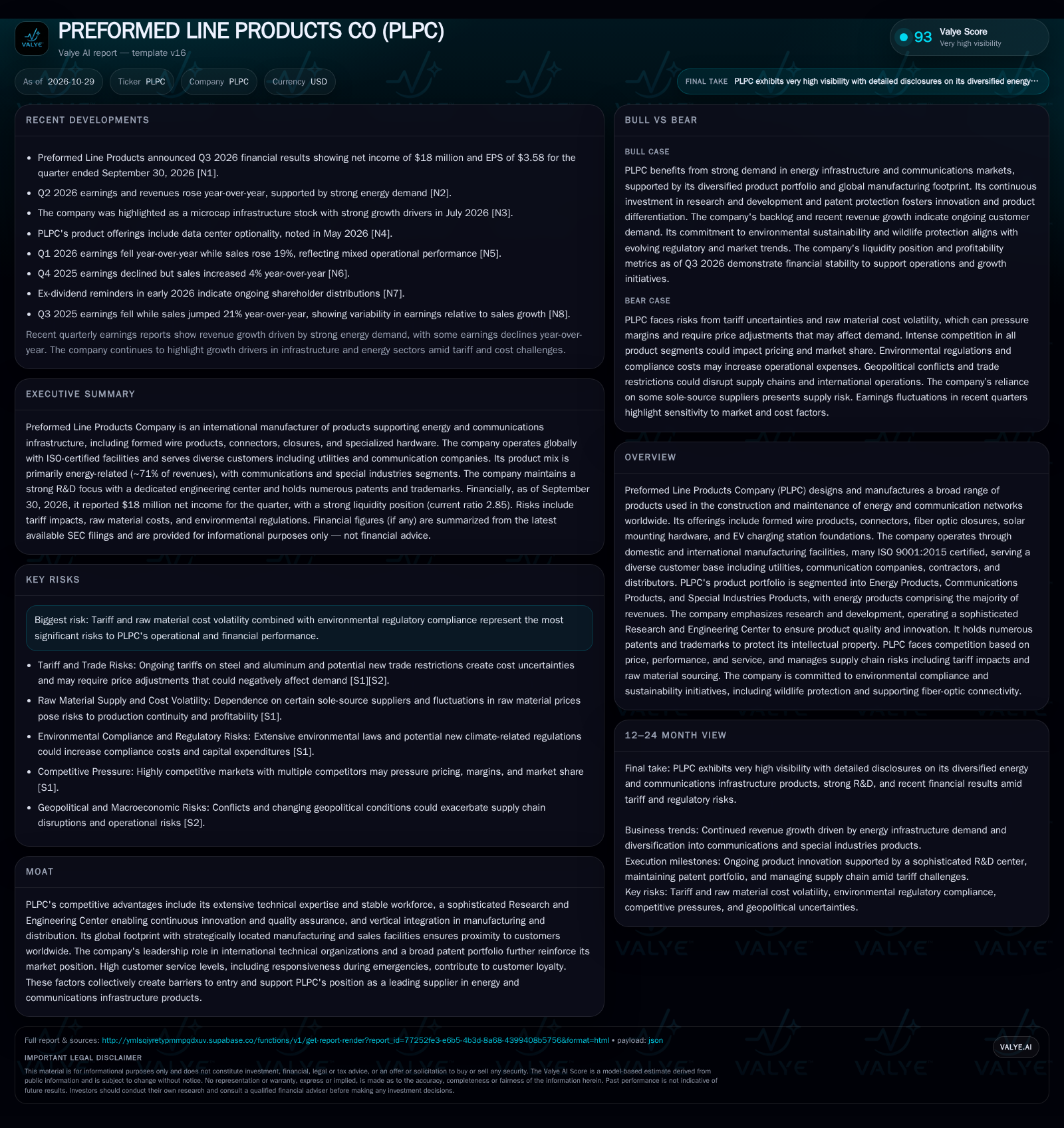
Preformed Line Products (PLPC) serves global energy and telecom infrastructure markets with a diversified product set and a strong R&D culture. Recent quarters show healthy revenue growth driven by energy demand, but margin volatility, exposure to raw material cost swings, and regulatory compliance burdens remain persistent risks. The company’s large backlog, robust patent portfolio, and international reach support its competitive stance, yet pricing power and cost control are critical watchpoints as supply chain and trade uncertainties persist. Execution on innovation and operational flexibility will determine if PLPC can translate infrastructure tailwinds into sustained earnings growth. [S1] [S2] [N2] [N5]
Preformed Line Products (PLPC) occupies a strategic niche in the global buildout of energy and communications networks, supplying the connectors, closures, and hardware that underpin grid modernization and broadband expansion. The company’s recent financials reflect robust revenue growth on the back of strong infrastructure demand, while its diversified customer base and international manufacturing footprint provide resilience against localized shocks. However, persistent margin volatility—driven by raw material cost inflation, tariff exposure, and rising compliance burdens—underscores the challenge of translating top-line momentum into consistent profit growth. As PLPC invests in innovation and sustainability, the company’s ability to manage cost pressures and maintain technical leadership will be central to its long-term value proposition.
Recent Performance Underscores Growth and Margin Tension
PLPC reported $18.0 million in net income for Q3 2026, with basic EPS of $3.58, and reported liquidity-ratio trends of 2.85 as of September 30, 2026. While cash and equivalents stood at $30.9 million, the company’s order backlog was $232.8 million at the end of 2025—mostly expected to ship in 2026—highlighting sustained customer demand. However, recent quarters have shown a pattern where rising sales are accompanied by earnings volatility: Q1 2026 saw sales rise 19% year-over-year while earnings fell, and similar trends were observed in Q3 2025 and Q4 2025. This underscores the ongoing tension between top-line growth and margin sustainability as the company navigates cost pressures from tariffs and raw material volatility. [S2] [N2] [N5] [N8]
How PLPC’s Revenue Mix and Cost Structure Shape Profitability
PLPC’s business model is built on supplying mission-critical hardware for energy and communications infrastructure, with Energy Products representing roughly 71% of revenues, Communications Products 22%, and Special Industries Products 7% as of 2025. The company’s economics hinge on volume throughput and product mix, as many offerings are standardized yet must meet stringent technical specifications. Pricing power is limited in highly competitive, bid-driven markets, particularly when raw material costs (galvanized wire, aluminum, plastics) are volatile and often must be passed through or absorbed, eroding margins.
Operating leverage is plausible in theory—fixed manufacturing and R&D expenses can be spread over higher sales volumes—but recent quarters suggest that input cost swings and tariffs can quickly overwhelm scale benefits. The company’s global manufacturing footprint and vertical integration may help buffer some cost shocks, but exposure to sole-source suppliers and tariffs on steel and aluminum remain fundamental risks. Capital intensity is moderate, with ongoing investment in R&D (including a dedicated engineering center) and manufacturing upgrades necessary to maintain technical leadership and product certifications.
Differentiation Through Technical Depth Amid Intense Price Competition
PLPC claims to be the world’s largest manufacturer of formed wire products for the energy and communications markets, operating in a field where price, performance, and service drive customer choice. Its competitive position is bolstered by an extensive patent portfolio (75 U.S., 104 international patents as of 2025), ISO-certified facilities, and a global network of manufacturing and sales locations—attributes that support technical credibility and customer proximity.
However, the company faces intense competition from other hardware suppliers, contract manufacturers, and regional specialists. Product commoditization is a real threat, especially in mature segments, though PLPC’s ongoing R&D investment, custom engineering capability, and emergency responsiveness provide some insulation. Service levels, technical support, and ability to rapidly meet emergent needs (e.g., storm repairs or grid upgrades) may create switching frictions and modest customer stickiness, but switching costs are not inherently high in this industry. Intellectual property and regulatory know-how are important, but not unassailable, barriers.
Sustained Infrastructure Spend and Innovation Drive Margin Recovery
A favorable scenario for PLPC would see continued global investment in grid modernization, renewable energy projects, and broadband expansion, driving robust demand across its Energy and Communications segments. If the company can leverage its R&D pipeline to launch higher-margin, differentiated solutions—such as advanced fiber closures, wildlife protection products, or solar/E.V. hardware—and pass through cost increases via improved pricing discipline, margin expansion could follow.
Confirmation of this scenario would come from sequential improvement in gross and operating margins, accelerated backlog conversion into higher earnings, and evidence of new product adoption. Further, if regulatory trends favor sustainability and grid resilience—areas where PLPC has invested in product development—the company could capture premium share or benefit from favorable procurement criteria. A durable reduction in raw material volatility or successful hedging could also support this upside.
Revenue Growth Continues, but Margin Compression Remains a Drag
The most plausible near-term outcome is that PLPC continues to deliver steady revenue growth on the back of infrastructure demand, especially in energy transmission/distribution and fiber deployment. Product mix may gradually shift toward communications and special industries, but Energy Products will remain the core driver. Margin pressures, however, are likely to persist given ongoing tariff uncertainty, raw material cost volatility, and competitive pricing dynamics.
Confirmation would include sustained order backlog, stable or improving sales, but earnings growth lagging revenue due to cost absorption and pricing constraints. Falsification would occur if the company demonstrates clear margin improvement despite continued input cost headwinds, or if customer adoption of new, higher-margin products accelerates beyond current trends.
Cost Shocks and Regulatory Burdens Erode Profitability
A negative scenario would materialize if raw material prices (especially steel and aluminum) spike or tariffs are increased, forcing PLPC to absorb costs it cannot pass through due to competitive pressure. Supply chain disruptions, particularly from sole-source suppliers, could impact production continuity or force expensive spot purchases. New or more stringent environmental regulations could further increase compliance and capital costs, weighing on margins and returns.
This scenario would be confirmed by further decoupling of revenue and earnings growth, persistent or worsening margin compression, and signs of lost share in key markets as customers seek lower-cost alternatives. Additional warning signs include lengthening of backlog conversion cycles, unexpected operational disruptions, or regulatory penalties.
Testing PLPC’s Resilience: What Could Shift the Thesis
Gross margin and operating margin trends, especially in quarters of strong sales growth, would help determine if PLPC can translate top-line momentum into sustainable profitability (if disclosed).
Order backlog conversion rates and the proportion of backlog consisting of higher-margin products would clarify revenue visibility and margin mix.
Raw material cost as a percentage of sales and the effectiveness of price pass-through strategies—especially in periods of input cost inflation—would help assess vulnerability to margin erosion (if disclosed).
Customer concentration metrics over time: stability or reduction in the share of revenue from the largest customers would signal diversified demand and pricing resilience.
R&D spending as a share of sales and the rate of new patent filings would indicate commitment to innovation and future product differentiation.
Any material supply chain disruptions, tariff changes, or geopolitical events affecting raw material access should be monitored for near-term risk.
Environmental compliance costs and the roll-out of new sustainability-oriented products may serve as leading indicators of regulatory adaptation and market positioning.
Disclaimer: This is research-only, informational analysis and not investment advice. It may include AI-generated interpretation and general industry context. Always verify important details using primary sources.

Comments