
FMCC’s Structural Role in U.S. Mortgage Finance: Durable Franchise, Regulatory Exposures, and Evolving Market Dynamics
Federal Home Loan Mortgage Corp (FMCC) remains a linchpin in the U.S. housing finance system, reporting $3.235 billion in net income for Q3 2026. Its government-sponsored status delivers both unique advantages and regulatory uncertainties, shaping the company’s risk, return, and resilience profile as housing markets and policy frameworks evolve.
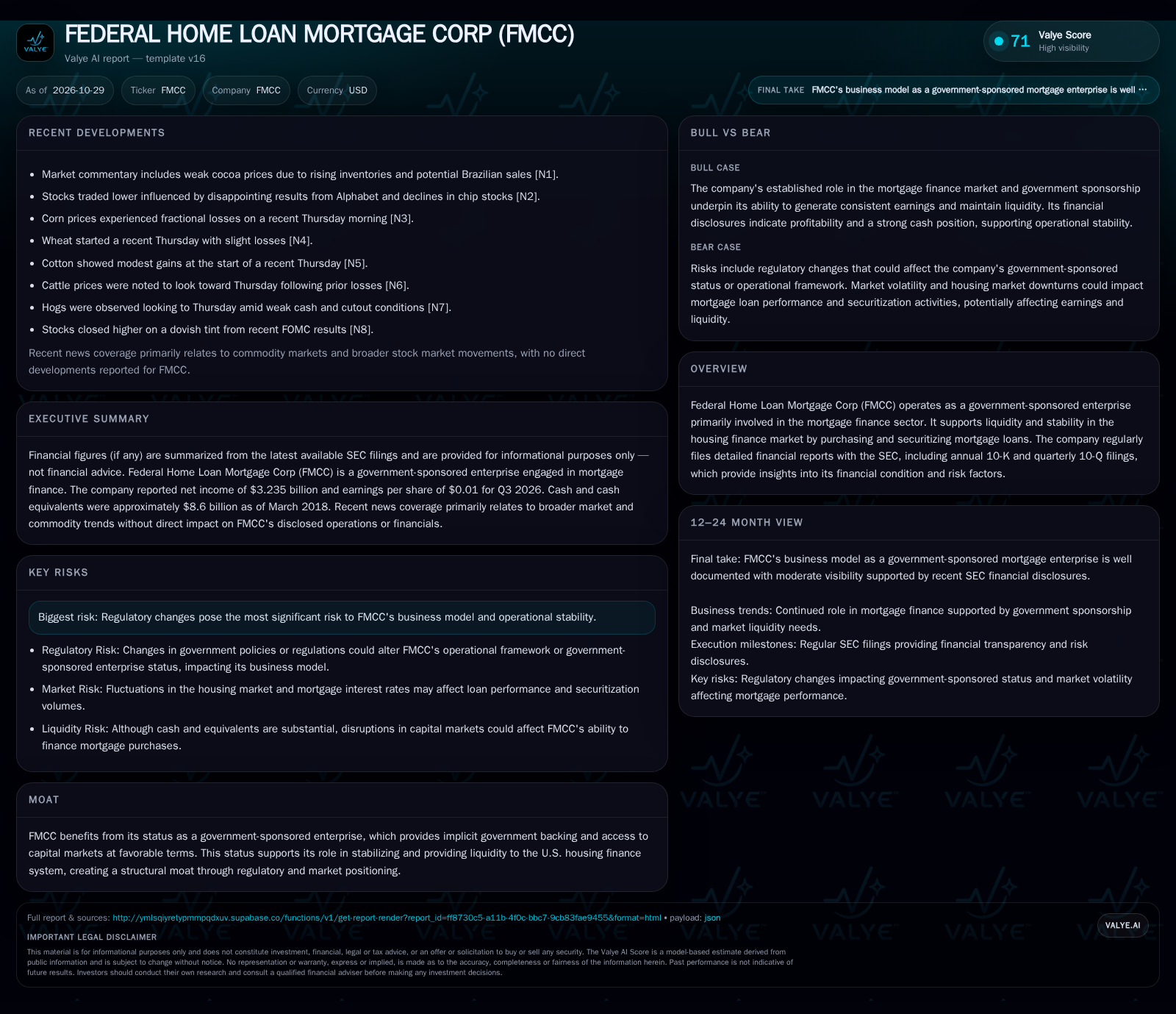
FMCC earned $3.235 billion in Q3 2026, reflecting its continued profitability as a government-sponsored enterprise in mortgage finance. Its implicit government backing underpins access to capital and market stability, but future earnings and capital structure remain exposed to potential regulatory shifts and housing market volatility. Structural advantages persist, but the sustainability of the model hinges on policy continuity and macroeconomic conditions. [S2]
Federal Home Loan Mortgage Corp (FMCC) occupies a singular position at the intersection of public policy and private finance, serving as a government-sponsored enterprise (GSE) that purchases and securitizes mortgage loans to foster liquidity in the U.S. housing market. With $3.235 billion in net income reported for Q3 2026, FMCC’s recent performance underscores the durable economics of its business model—but also highlights the ongoing tension between its regulatory dependence and market-driven results. As policymakers debate the future of GSEs and the housing cycle enters a new phase, FMCC’s operating outlook will be shaped by both external shocks and the evolution of its government mandate. [S2]
FMCC’s Recent Profitability and Its Policy-Linked Foundation
Federal Home Loan Mortgage Corp (FMCC) reported net income of $3.235 billion for the quarter ended September 30, 2026, with basic and diluted earnings per share at $0.01. This profitability reflects continued strong performance in its core function of purchasing and securitizing mortgage loans. However, the company’s business model and access to capital are grounded in its government-sponsored status, which provides implicit guarantees and enables favorable funding terms not available to most private-sector peers. These structural factors not only support FMCC’s earnings, but also shape its risk profile and sensitivity to regulatory changes. [S2]
The company’s regular SEC filings, including 10-Q and 10-K reports, provide transparency into its financial condition and risk exposures, but also reveal the degree to which its financial health is intertwined with government policy and the broader housing finance system. The durability of FMCC’s earnings thus depends as much on the stability of its regulatory environment as on its operational execution.
How FMCC Generates Value: Scale, Securitization, and Government-Enabled Economics
FMCC’s core economics are driven by its role as a conduit between mortgage originators and the capital markets. By purchasing conforming mortgages and pooling them into mortgage-backed securities (MBS), FMCC earns a guarantee fee for assuming the credit risk of underlying loans. This fee-based structure scales with mortgage origination volumes and is relatively capital-light compared to traditional banking, as FMCC is not a deposit-taking institution.
The company’s cost of capital is structurally lower than most private entities due to its GSE status, which markets interpret as carrying implicit federal backing. This enables FMCC to finance large volumes of mortgage purchases at favorable rates, translating to a persistent spread between funding costs and the returns on its mortgage guarantees. Operating leverage is achieved by spreading fixed infrastructure and compliance costs over a massive asset base, while credit losses and prepayment rates are the primary variable risks.
FMCC’s capital requirements and risk management practices are heavily prescribed by regulatory mandates, and its ability to return capital or change its risk posture is constrained by its public mission. Nevertheless, its business model is designed to deliver stable, recurring fee income under typical housing market conditions—though profitability can be significantly impacted by macro shocks or policy interventions.
Structural Moat and Competitive Landscape: Public Mission as Both Strength and Limitation
FMCC’s major competitive advantage arises from its government-sponsored status and the unique role it plays in the U.S. housing finance system. This status confers implicit government backing, which enables funding at near-Treasury rates and supports its mission to provide liquidity and stability to mortgage markets. Few private competitors can match FMCC’s scale, capital access, or regulatory privileges.
However, this moat is also a double-edged sword: FMCC’s operations are closely regulated, and its strategic flexibility is limited by public policy objectives. Its primary peer is Fannie Mae, another GSE with an almost identical mandate and operating model. Private-label securitizers and portfolio lenders represent alternative channels, but they generally lack the scale, cost of capital, or systemic importance to displace FMCC absent major policy changes.
Substitution risk is modest in the current framework, as the GSE model remains central to U.S. housing finance. The more significant threat comes from potential regulatory reform or privatization efforts, which could erode FMCC’s structural advantages or fundamentally alter its business model.
Potential for Enhanced Returns If Policy Stability and Housing Demand Persist
If the regulatory environment remains stable and the U.S. housing market continues to demonstrate robust origination volumes and low credit losses, FMCC could sustain or expand its current earnings power. In this scenario, the company would benefit from steady guarantee-fee income, minimal credit impairments, and continued access to low-cost funding—reinforcing its ability to fulfill its public mission and deliver consistent returns.
Upside could also be realized if policymakers clarify or strengthen FMCC’s GSE status, reducing uncertainty and enabling more efficient capital planning or modest expansion of its guarantee footprint. Confirmation of this scenario would come from sustained profitability, low credit loss provisions, and explicit or renewed policy support for the current GSE framework. A stable or growing share of conforming mortgage originations would further reinforce the positive case.
Enduring Core Franchise, but With Policy-Driven Uncertainty as a Constant
The most plausible trajectory for FMCC is continued operation as a government-sponsored enterprise with periodic earnings variability driven by housing market cycles and interest rate movements. Under this scenario, FMCC’s guarantee-fee business remains central to U.S. mortgage finance, and the company adapts to incremental regulatory adjustments rather than wholesale structural change.
Earnings may fluctuate with macro conditions—such as mortgage origination volumes, prepayment rates, and credit performance—but the company retains its privileged funding access and public mission. The base case would be confirmed by regular SEC filings showing ongoing profitability, stable guarantee-fee margins, and maintenance of GSE status. Signs of increased regulatory scrutiny or policy debate would be expected, but not necessarily result in immediate business model disruption.
Regulatory or Market Disruption Could Erode the Franchise
The most significant risk to FMCC is a major shift in regulatory policy—such as proposals to privatize the GSEs, impose new capital requirements, or restructure the housing finance system. Such changes could undermine FMCC’s access to low-cost funding, force a re-pricing of guarantee fees, or shrink its role in mortgage securitization.
Alternatively, a severe downturn in the housing market—marked by elevated mortgage defaults or collapsing origination volumes—could drive up credit losses and compress fee revenues. This scenario would be confirmed by negative regulatory developments, rapid increases in credit loss provisions, or evidence of declining market share to private-label or bank portfolio lenders. Early signs might include public policy debates on GSE reform, adverse SEC disclosures regarding capital adequacy, or spikes in delinquency rates within FMCC’s guaranteed portfolio.
What Will Shape FMCC’s Resilience and Franchise Value in the Next Phase
Trends in guarantee-fee income and guarantee-fee margins, as disclosed in quarterly SEC filings, will be crucial to understanding core profitability and pricing power.
Any public statements or policy signals regarding the future of GSEs—such as congressional hearings, Treasury proposals, or regulatory rulemaking—would directly affect FMCC’s business outlook.
Disclosure of credit loss provisions, especially in response to changes in housing market conditions or borrower performance, would help gauge risk exposure.
Market share of conforming mortgage originations relative to private-label and bank channels, if disclosed, would provide insight into FMCC’s competitive position.
Capital adequacy ratios and updates on regulatory capital requirements are essential for assessing resilience to shocks or policy changes.
Evidence of changes in access to funding markets—such as shifts in MBS pricing or investor appetite for FMCC-guaranteed securities—would help test the durability of the funding advantage.
Regularity and tone of risk-factor updates in 10-K and 10-Q filings may signal emerging regulatory or market pressures.
A useful metric would be the level and trend of prepayment and delinquency rates in the guaranteed mortgage portfolio, as these directly affect income stability and credit risk.
Disclaimer: This is research-only, informational analysis and not investment advice. It may include AI-generated interpretation and general industry context. Always verify important details using primary sources.

Comments