
Hilton Grand Vacations: Securitization, Capital Allocation, and the Durability of Vacation Ownership Economics
Hilton Grand Vacations’ latest results reflect robust operational execution, ongoing share repurchases, and a heavy reliance on securitization to fund growth. But as industry cyclicality and financial market dependencies loom, the sustainability of its capital-light model and the sensitivity of its receivables portfolio remain central to the long-term thesis.
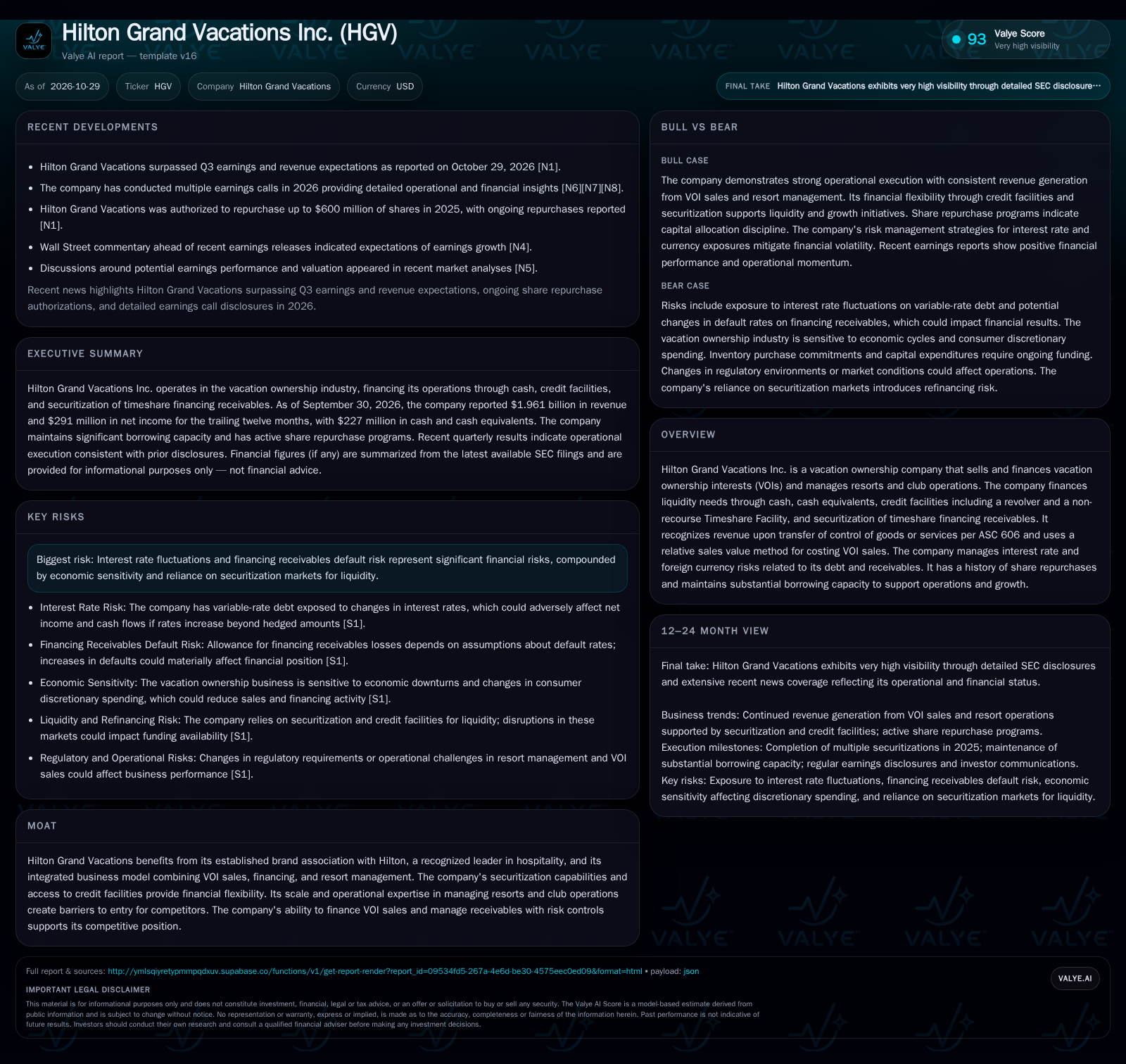
Hilton Grand Vacations reported $1.96B in trailing-twelve-month revenue and $291M in net income as of September 2026, with continued share repurchases and significant borrowing capacity. The company’s growth model leverages securitization of timeshare receivables, but its exposure to consumer credit, interest rates, and economic cycles is structurally high. Sustained earnings power hinges on resilient VOI sales, effective receivables risk management, and uninterrupted access to credit and securitization markets. [S2] [S1]
Hilton Grand Vacations’ recent financials showcase the strengths and structural dependencies of the modern vacation ownership model. With nearly $2 billion in annual revenue and a disciplined capital return strategy, the company’s ability to generate and monetize vacation ownership interest (VOI) sales is underpinned by robust securitization activity and substantial borrowing capacity. Yet, these same mechanisms expose HGV to macroeconomic and credit market volatility, making the durability of its cash flows and the resilience of its receivables portfolio central to the investment debate.
Recent Results Underscore Growth, Capital Returns, and Securitization Reliance
Hilton Grand Vacations reported $1.961 billion in revenue and $291 million in net income for the trailing twelve months ended September 30, 2026. Basic earnings per share was $3.78, with diluted EPS at $3.70. Cash and cash equivalents stood at $227 million at quarter-end. [S2]
The company completed over $1 billion in securitizations of timeshare financing receivables in 2025, using proceeds to pay down debt and fund corporate purposes. As of year-end 2025, it maintained $809 million in available revolver capacity and $235 million under its Timeshare Facility. [S1]
Shareholder returns remain a priority: HGV repurchased 15 million shares for $600 million in 2025, with $428 million in remaining authorization. [S1]
Recent news confirmed HGV surpassed Q3 earnings and revenue expectations, reinforcing operational momentum. [N1]
How Securitization and Recurring Fees Shape the Economic Engine
Hilton Grand Vacations’ core economics are driven by the sale of vacation ownership interests (VOIs), ongoing management and club fees, and the financing of customer purchases. The company recognizes revenue upon transfer of control (per ASC 606), and the cost of VOI sales is estimated using a relative sales value method subject to future pricing, volume, and default rate uncertainties. [S1]
A distinguishing feature of the model is the ability to finance customer purchases internally, then securitize the receivables. This enables HGV to convert illiquid receivables into cash, reducing risk exposure and funding new sales without permanently tying up balance sheet capital. The scale and cost of securitization depend on prevailing credit market conditions, default expectations, and the company’s credit performance history.
Recurring revenue streams—management fees, club operations, and ancillary services—provide a counterbalance to the inherently cyclical nature of VOI sales. However, the upfront capital requirements for inventory acquisition and resort development remain significant, as evidenced by $226 million in inventory-related purchase commitments over the next decade. [S1]
Operating leverage is achieved as fixed resort management costs are spread over a growing owner base, but the model is sensitive to shifts in sales velocity, financing spreads, and credit losses. Capital allocation—particularly share repurchases—serves as a lever to enhance per-share returns, but also increases sensitivity to cash flow timing and market access.
Brand Leverage and Scale Advantages Meet Structural Industry Headwinds
HGV’s primary competitive assets are its Hilton brand association, large managed portfolio, and integrated approach across sales, financing, and resort operations. The Hilton flag provides credibility and marketing reach, supporting customer acquisition and pricing relative to non-branded peers.
Scale brings operational advantages in inventory sourcing, marketing, and resort management, and facilitates access to securitization markets at favorable terms. The company’s ability to underwrite and manage a significant receivables portfolio is a barrier to smaller entrants, as is the complexity of the regulatory environment.
However, the industry faces structural headwinds: vacation ownership is highly discretionary, with sales volumes subject to consumer confidence and macroeconomic cycles. Competition from other branded timeshare operators, alternative vacation models (such as short-term rentals), and evolving consumer preferences could pressure both sales and pricing.
Substitution risk is rising as digital platforms make vacation rentals more accessible, though HGV’s bundled product and loyalty-program integration may help defend share. The company’s recurring fee streams and long-term owner relationships provide some insulation, but switching costs for customers are moderate unless bundled with financing or club benefits.
Sustained VOI Demand and Stable Credit Markets Drive Compounding Returns
In a favorable scenario, consumer demand for vacation ownership remains resilient, supported by the Hilton brand and effective marketing. HGV continues to convert a high proportion of VOI sales to financed transactions, enabling ongoing securitization at attractive spreads.
Stable or improving credit markets allow the company to recycle capital efficiently, funding inventory purchases and share repurchases without material increases in borrowing costs. Default rates on receivables remain within historical norms, preserving net interest margins and minimizing loan loss provisions.
Management executes on inventory development and resort operations, allowing fixed costs to be leveraged across a growing owner base. The company expands recurring fee streams through new club offerings and ancillary services, reducing reliance on new VOI sales for earnings growth.
Evidence supporting this scenario would include continued outperformance on VOI sales, stable or declining delinquency rates, low securitization spreads, and ongoing share repurchases without adverse impact on liquidity. Regular upward revisions to earnings guidance and expansion of managed resort inventory would further validate the thesis.
Normal Cyclicality, Margin Stability, and Prudent Capital Recycling
The most plausible trajectory sees HGV navigating the typical cyclicality of the vacation ownership sector, with periods of robust VOI sales interspersed with softer consumer demand during economic slowdowns.
Receivables performance is steady but subject to modest increases in default rates during weaker macro periods; the company responds by tightening underwriting and adjusting loan loss allowances as needed. Resort management and club fees provide a stabilizing base of recurring revenue, though their growth is slower than that of VOI sales in expansionary periods.
Share repurchases continue opportunistically, balanced against liquidity needs and market access. Capital expenditures are focused on high-return projects and technology enhancements to support sales and operational efficiency.
Confirmation of this scenario would come from steady quarterly revenue and net income, manageable swings in receivables loss provisions, and continued access to securitization at reasonable terms. Falsification would involve a sharp, sustained drop in VOI sales, material tightening in credit markets, or a spike in default rates requiring outsized loan loss reserves.
Credit Market Disruption and Rising Defaults Strain the Model
A material downside could emerge if macroeconomic conditions deteriorate, leading to a contraction in consumer discretionary spending and a sharp drop in VOI sales. Increased unemployment or financial stress among owners could drive up default rates on the receivables portfolio, directly impacting net income and liquidity needs.
If credit markets tighten or securitization spreads widen significantly, HGV could face higher funding costs or limited ability to recycle receivables, forcing reliance on balance sheet cash or more expensive credit lines. Inventory commitments and fixed resort operating costs become a drag on margins in the absence of robust new sales.
Share repurchases are curtailed or suspended to preserve liquidity, and capital expenditures are deferred. The company may be forced to increase allowances for receivables losses; a 0.5% increase in projected default rates would raise the allowance by $26 million, according to management sensitivity analysis. [S1]
Evidence confirming this scenario would be a combination of declining VOI sales, rising delinquency/default rates, higher securitization spreads, and reduced repurchase activity. Negative revisions to earnings guidance or a covenant breach on credit facilities would further confirm adverse conditions.
Evaluating the Durability of Hilton Grand Vacations’ Cash Flows and Capital Structure
Quarterly VOI sales volume and financing penetration rates: Sustained growth or resilience would support the bullish case, while a drop-off may signal demand pressure.
Receivables delinquency and default rates: Rising trends could foreshadow increased loss provisions and pressure on securitization terms.
Securitization activity and weighted average funding costs: Monitoring the volume and pricing of securitizations will reveal the company’s ongoing access to capital markets and cost of funds.
Recurring management and club fee revenue growth: This would help test the thesis that recurring streams can buffer cyclicality in VOI sales.
Share repurchase pace and authorization usage: A slowdown or suspension could reflect internal liquidity concerns or external market constraints.
Inventory purchase commitments relative to sales velocity: If disclosed, this would indicate whether the company is over- or under-committing to growth.
Allowance for financing receivables losses and sensitivity disclosures: Changes here would reveal management’s expectations for credit quality and potential future write-offs.
Covenant compliance and revolver utilization rates: Would help assess liquidity flexibility and balance sheet risk, especially in a downside scenario.
Disclaimer: This is research-only, informational analysis and not investment advice. It may include AI-generated interpretation and general industry context. Always verify important details using primary sources.

Comments