
Trinity Industries: Railcar Cyclicality, Funding Leverage, and the Path to Durable Profitability
Trinity Industries’ latest results highlight the ongoing tension between rail sector cyclicality and the company’s efforts to stabilize earnings through financing and diversified services. With recent profit declines, new debt, and continued dividends, the company’s ability to navigate demand swings and balance sheet risks will shape its medium-term trajectory.
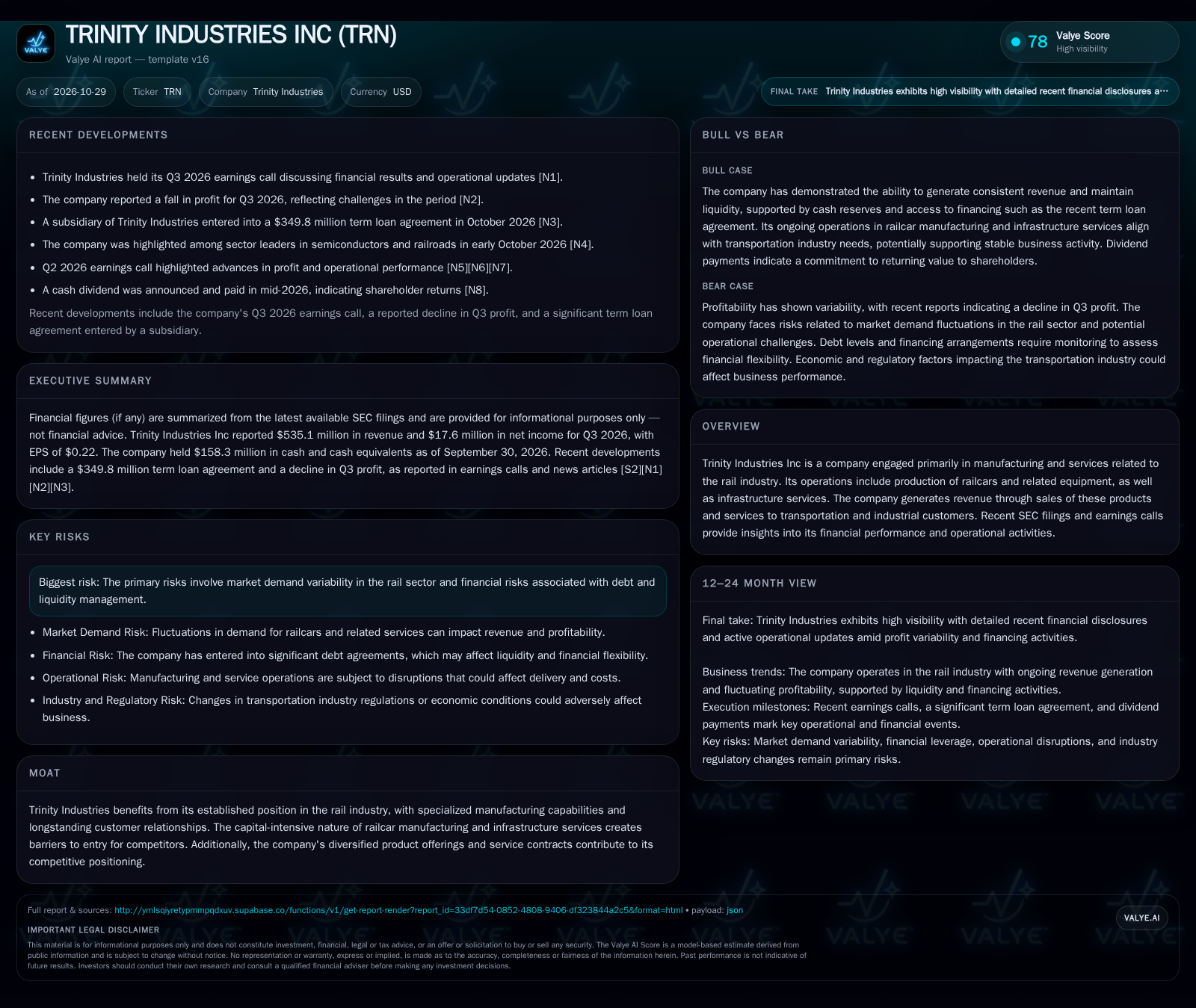
Trinity Industries reported $535.1 million in Q3 2026 revenue and $17.6 million in net income, but profitability fell amid sector headwinds. The company entered a $349.8 million term loan in October, supplementing $158.3 million in cash. Dividend payouts continue, but the interplay between rail demand, debt load, and margin resilience remains central.
Trinity Industries, a major manufacturer and service provider in the North American rail sector, faces a classic industrial conundrum: how to deliver consistent returns in a market prone to sharp demand swings. The latest quarter saw revenue top $535 million, but profit slipped, underscoring the sector’s vulnerability to volume and pricing pressures. The cited source reports dividend-related activity; that disclosure alone does not establish dividend-policy continuity, management confidence, or a material constraint on capital flexibility.
Recent Financial Moves and Profit Volatility Define the Moment
Trinity Industries reported Q3 2026 revenue of $535.1 million and net income of $17.6 million, equating to $0.22 per share [S2]. However, this period also saw a decline in profit compared to prior quarters, as highlighted in recent earnings reports and news coverage [N2]. The company’s liquidity position as of September 30, 2026, was $158.3 million in cash and cash equivalents [S2]. Notably, in October 2026, a subsidiary entered into a $349.8 million term loan agreement, adding considerable leverage to the balance sheet [N3]. Trinity also announced and paid a cash dividend in mid-2026 [N8]. These facts collectively point to a business navigating a tightening margin environment, actively managing its capital structure, and maintaining shareholder returns despite profit headwinds.
Railcar Manufacturing and Services: Margin Dynamics and Capital Intensity
At its core, Trinity Industries generates revenue through manufacturing railcars and providing related infrastructure services. The railcar business is capital-intensive: large up-front investments in plant, equipment, and inventory are required, and working capital needs can spike with order cycles. Revenue is dictated by contract volume (new car builds, refurbishment, leasing, and services), with pricing power generally limited by industry capacity and competitive parity. Gross margins are sensitive to input costs, production efficiency, and utilization rates—when demand softens, fixed costs weigh on profitability.
The addition of a $349.8 million term loan suggests a need for either refinancing, growth capital, or liquidity buffer, but it also increases interest expense and financial risk. The cited source reports dividend-related activity; that disclosure alone does not establish dividend-policy continuity, management confidence, or a material constraint on capital flexibility. Operating leverage can work both ways: strong order books and production efficiency can drive sharp earnings improvements, while downturns expose the business to rapid margin deterioration. The company’s ability to blend manufacturing with services and potential leasing/recurring revenue could, if executed well, help mitigate pure manufacturing cyclicality.
Competitive Edge Hinges on Scale, Relationships, and Barriers to Entry
Trinity’s established manufacturing capabilities, product breadth, and long-standing customer relationships provide some competitive insulation. The capital intensity and technical requirements of railcar production deter new entrants, while regulatory certification and safety standards further raise the bar. However, the rail supply sector is structurally competitive: major peers and substitute offerings (such as trucking for certain freight) limit pricing power, and customers—typically large railroads and leasing firms—have significant negotiating leverage.
The company’s ability to offer integrated services (manufacturing, maintenance, infrastructure support) could be a differentiator if it translates into stickier customer ties and higher share of wallet. Still, the effectiveness of this strategy depends on execution, customer retention, and the degree to which services can smooth the inherent cyclicality of new-build demand. Technological shifts, such as automation or alternative freight modalities, could over time erode traditional advantages if not met with corresponding investment.
A Rebound in Rail Demand and Margin Recovery Could Unlock Leverage
A favorable scenario for Trinity would see a cyclical upswing in North American railcar demand, driven by factors such as industrial recovery, energy and commodity movements, and infrastructure investments. Higher order volumes would allow the company to better utilize fixed manufacturing assets, improving gross margins and diluting overhead. If Trinity can secure multi-year service and leasing contracts, recurring revenue could further stabilize cash flows and reduce earnings volatility.
The recent term loan, if applied strategically (e.g., for capacity expansion, efficiency upgrades, or accretive acquisitions), could amplify returns in a rising market. Confirmation of this scenario would require evidence of a sustained uptick in order backlog, sequential margin expansion, and positive free cash flow after dividends and interest expense. A sharp reduction in profit volatility and improved return on invested capital would further validate this pathway.
Most Likely: Managing Through Cycles with Tight Margins and Capital Discipline
The most plausible outcome is that Trinity continues to operate within the cyclical constraints of the rail manufacturing sector, posting modest revenue growth but facing ongoing pressure on margins. The company’s new debt load will require disciplined capital allocation, as interest expense rises and flexibility narrows. Dividends may continue, but payout levels could become a point of contention if profit softness persists.
This scenario would be confirmed by stable but unspectacular order trends, flat to mildly improving margins, and steady but not expanding cash balances. Any material increase in working capital needs, or evidence that service/leasing initiatives are not offsetting manufacturing cyclicality, would reinforce the challenges of achieving earnings resilience. The company’s ability to service new debt without eroding balance-sheet health will be a key marker.
Prolonged Rail Sector Weakness Could Amplify Financial Strain
If railcar demand remains depressed or deteriorates further, Trinity faces a scenario where fixed costs and higher interest expenses erode profitability. The new term loan, while providing near-term liquidity, could exacerbate downside risk if cash flows weaken—especially if dividend commitments remain unchanged. Prolonged softness could force the company to scale back dividends, delay investments, or even pursue asset sales to shore up liquidity.
Evidence confirming this scenario would include continued declines in net income, shrinking cash balances, rising leverage ratios, and negative operating cash flow. If order cancellations or deferred deliveries spike, or if customers push for aggressive price concessions, the company’s competitive position could further erode. Regulatory or operational disruptions could compound these pressures.
What Will Prove Trinity’s Rail Resilience or Expose Its Weaknesses?
Order backlog trends: Sequential growth or contraction in order backlog would directly reflect demand health and forward revenue visibility.
Gross margin progression: Improvement or erosion in gross margins will indicate the company’s ability to manage input costs and pricing in a competitive market.
Net leverage ratio: Changes in net debt relative to EBITDA will show whether the new term loan is helping or hindering potential financial flexibility.
Dividend coverage: The ratio of free cash flow to dividends paid will test the sustainability of current payout levels, especially in weaker quarters.
Recurring revenue share: If disclosed, the proportion of revenue from services or leasing would help assess progress toward smoothing cyclicality.
Customer concentration: Shifts in the share of revenue from top customers, if disclosed, would indicate vulnerability to contract loss or pricing pressure.
Interest coverage ratio: Trends in EBITDA to interest expense will reveal whether rising debt obligations are manageable.
Disclaimer: This is research-only, informational analysis and not investment advice. It may include AI-generated interpretation and general industry context. Always verify important details using primary sources.

Comments