
CCC Intelligent Solutions: Data Network Effects, AI Leverage, and Merger-Related Crossroads in Insurance Tech
CCC Intelligent Solutions has established itself as the digital backbone of U.S. auto insurance claims, leveraging a vast network, proprietary data, and AI-driven workflow automation. As the company navigates a pending merger, the key question is whether its entrenched ecosystem and innovation pace can overcome operational restrictions and market complexity to sustain growth and profitability.
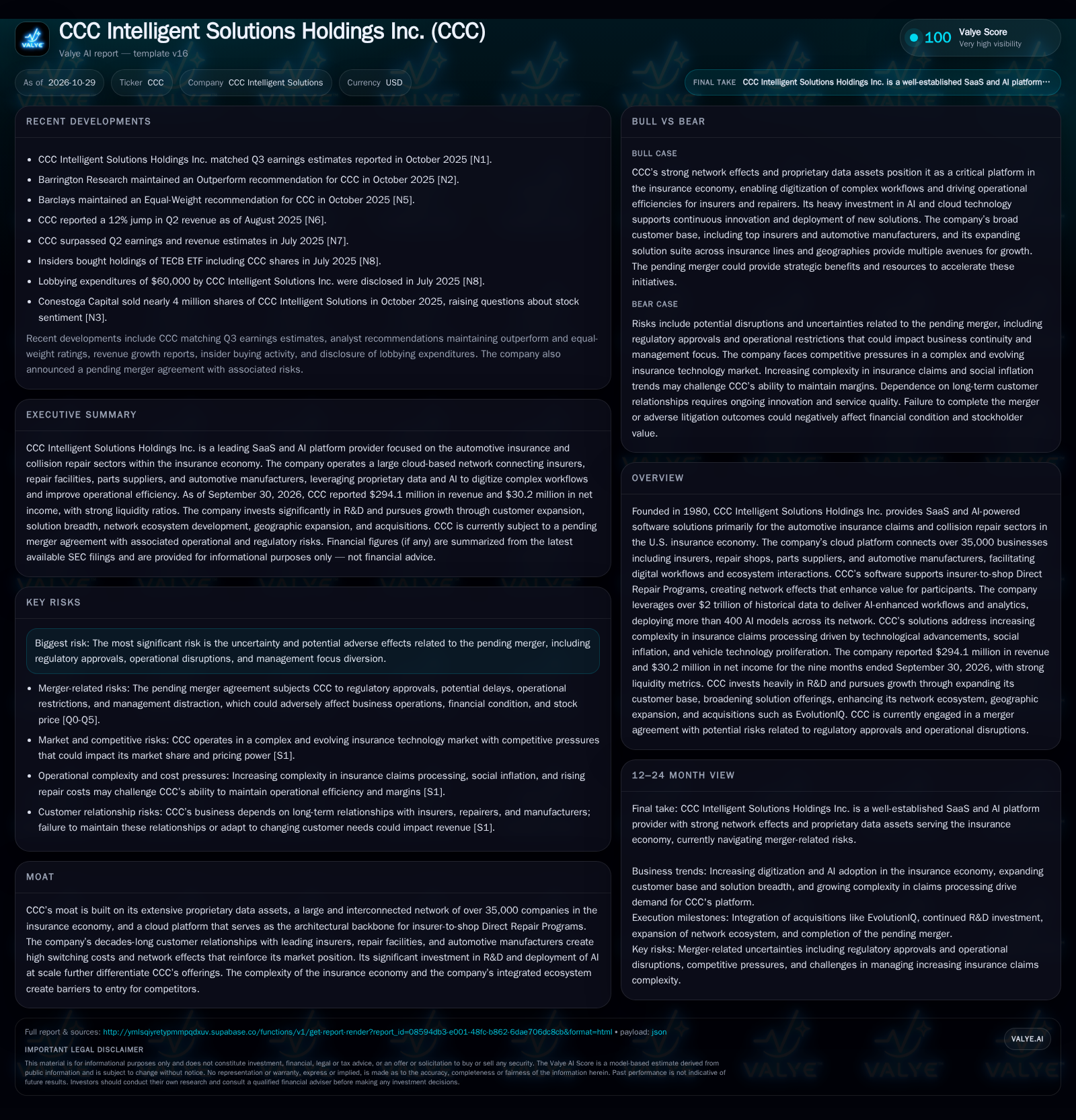
CCC Intelligent Solutions connects major players across the U.S. automotive insurance and repair ecosystem through a cloud-based platform, processes billions of transactions daily, and deploys hundreds of AI models to streamline claims and repairs. With $294.1 million in Q3 2026 revenue and a robust customer base, CCC faces the dual challenge of executing through merger-related constraints and defending its network-driven moat in a dynamic insurance technology landscape. The company's future hinges on its ability to continue innovating and deepening customer integration while managing operational risks and competitive threats posed by evolving claims complexity and regulatory scrutiny.[S1] [S2]
CCC Intelligent Solutions occupies a pivotal role in the U.S. automotive insurance ecosystem, providing the SaaS and AI infrastructure that enables insurers, repair shops, and parts suppliers to digitize and automate complex claims processes. The company’s reach, proprietary data, and embedded AI position it as a critical enabler of efficiency and cost control in a sector under pressure from rising claims complexity and inflation. However, with a pending merger on the horizon, CCC must balance its innovation agenda and network expansion against new operational restrictions, regulatory risks, and potential disruptions to management focus. The durability of its moat and the ability to execute through this transition will determine whether CCC remains the default platform for insurance claims digitization or cedes ground to emerging challengers.
Merger Uncertainty Meets Platform Scale: The Immediate Landscape
The company reported profitability for the period. [S2] [S1] The outcome and timing of the merger will shape CCC’s ability to pursue its strategic agenda in the near term.
How CCC’s Platform Economics Generate Value—and Where Margin Leverage Lies
CCC’s business model is fundamentally SaaS-based, monetizing mission-critical software and data analytics solutions on a subscription or usage-driven basis. Its revenue is tied to the scale and integration depth of its insurance and repair customers, with pricing likely reflecting the value of workflow automation, claims cycle time reduction, and loss cost containment. The company’s economics benefit from high fixed costs—particularly in R&D (27% of revenue in 2025)[S1]—but with strong operating leverage as incremental users, transactions, and new modules can be added at low marginal cost. The platform’s multi-tenant architecture supports 5.7 billion daily transactions, suggesting substantial scale economies.
Proprietary data assets—drawn from over $2 trillion in historical claims and repair transactions—enable differentiated AI models and analytics, justifying premium pricing and stickier customer relationships. However, the capital intensity of continued innovation and the need to maintain 99.9% uptime impose ongoing cost discipline. The pending merger could restrict CCC’s ability to make opportunistic investments or acquisitions, potentially slowing expansion into adjacent insurance lines or geographic markets if regulatory or parent approvals are protracted.
Network Effects, Data Moats, and the Battle for Insurance Workflow Dominance
CCC’s competitive position is anchored by its network effects: the more insurers, repair shops, and suppliers on its platform, the greater the value for each participant, and the harder it is for any single stakeholder to switch to a rival ecosystem.[S1] Its role as the architectural backbone of Direct Repair Programs for most leading U.S. auto insurers creates high switching costs, as both data migration and workflow disruption would be significant. The proprietary data accumulated over decades powers more than 400 AI models, enhancing workflow automation, fraud detection, cost estimation, and customer experience.
Competitive threats may come from insurance-focused SaaS upstarts, verticalized workflow platforms, or large cloud/software vendors seeking to unbundle or replicate CCC’s core offerings. However, the complexity of integrating claims, repair, and parts data across thousands of counterparties creates substantial barriers to entry. The risk is that, as insurance claim complexity grows (driven by vehicle technology and social inflation), alternative platforms or direct-to-insurer solutions could chip away at CCC’s primacy—especially if the company is slow to innovate due to merger-related restrictions or management distraction.
Unlocking Platform Expansion: What Would Signal Sustainable Outperformance
The most bullish scenario for CCC is one where the merger closes smoothly and unlocks additional resources or strategic alignment, allowing the company to rapidly expand its platform into adjacent insurance lines (e.g., property, workers’ comp) or new geographies. Continued deployment of proprietary AI models could further automate claims and repair decisioning, driving increased wallet share among existing customers and new cross-sell opportunities.
Confirmation of this scenario would include above-trend revenue growth, successful integration of recent acquisitions (such as EvolutionIQ), and evidence that new modules or verticals are gaining traction. Additional proof points would be customer wins outside the core auto segment, increasing R&D intensity translating into new product launches, and minimal customer churn despite operational disruptions. If CCC can demonstrate sustained margin expansion and rising average revenue per customer, despite the complexity of the merger, it would signal that the company’s moat is both deepening and broadening.
Enduring as the Default: Most Likely Trajectory for CCC’s Core Franchise
The most plausible outcome is that CCC maintains its position as the foundational SaaS and AI provider for U.S. auto insurance claims, growing in line with the digitization of the insurance economy and increased adoption of AI-driven workflows. Revenue growth would be driven by incremental penetration of its existing customer base, modest expansion into adjacent insurance lines, and ongoing R&D-fueled product enhancements.
This scenario would be confirmed by steady revenue and net income growth, continued high system uptime, and persistent high retention rates among top insurers, repairers, and OEMs (if disclosed). The merger process could weigh on management bandwidth and temporarily slow new initiatives or acquisitions, but would not fundamentally erode the network’s value or customer stickiness. The base case assumes CCC’s ecosystem remains the default for insurers seeking digital claims transformation, with pricing and margins stable unless a major technology or regulatory shock emerges.
Merger Disruption and Erosion of Moat: How CCC’s Core Could Be Challenged
A negative scenario unfolds if the merger process is delayed, fails, or results in prolonged operational restrictions that prevent CCC from investing in innovation or pursuing strategic deals. Meanwhile, the announcement or uncertainty could trigger customer hesitation, competitive encroachment, or internal talent attrition—particularly if regulatory or litigation hurdles drag on.
This scenario would be evidenced by stagnant or declining revenue, rising customer churn (especially among top insurers or repair networks, if disclosed), and missed product development milestones. If new AI or workflow automation competitors begin to win meaningful share, or if CCC is unable to adapt its platform to evolving claims complexity and regulatory requirements, its historical network advantages could erode. Further, if the company faces litigation or reputational fallout related to the merger, the risk of value destruction and market share loss increases.
Milestones That Will Determine the Durability of CCC’s Platform Leadership
Progress and timeline toward regulatory approvals and closing of the pending merger—delays or adverse outcomes would impact strategic flexibility and management focus.
Revenue growth rate relative to the insurance digitization trend; a deceleration could signal customer hesitation or competitive pressure.
Retention rates among top 30 U.S. auto insurers and leading repair networks (if disclosed), as any churn would test network effects and stickiness.
Integration outcomes and contribution from recent acquisitions such as EvolutionIQ—evidence of smooth integration and cross-sell would support the upside.
R&D intensity and cadence of new AI or workflow automation module launches; a slowdown could indicate merger-related or competitive constraints.
Customer expansion outside core auto claims (e.g., property, workers’ comp, new geographies), which would demonstrate platform extensibility.
Incidence and impact of merger-related litigation or operational disruptions, including any changes in management or key personnel turnover.
Sustained system uptime and platform reliability—any material outages could undermine CCC’s mission-critical positioning.
Disclaimer: This is research-only, informational analysis and not investment advice. It may include AI-generated interpretation and general industry context. Always verify important details using primary sources.

Comments