
Huntington Ingalls Industries: Shipbuilding Scale, Nuclear Exclusivity, and the Technology Leverage Puzzle
HII’s dominance in U.S. naval shipbuilding—anchored by exclusive nuclear contracts and an expanding technology arm—offers rare visibility, but the company’s fortunes remain tightly linked to government priorities, execution complexity, and evolving defense tech requirements.
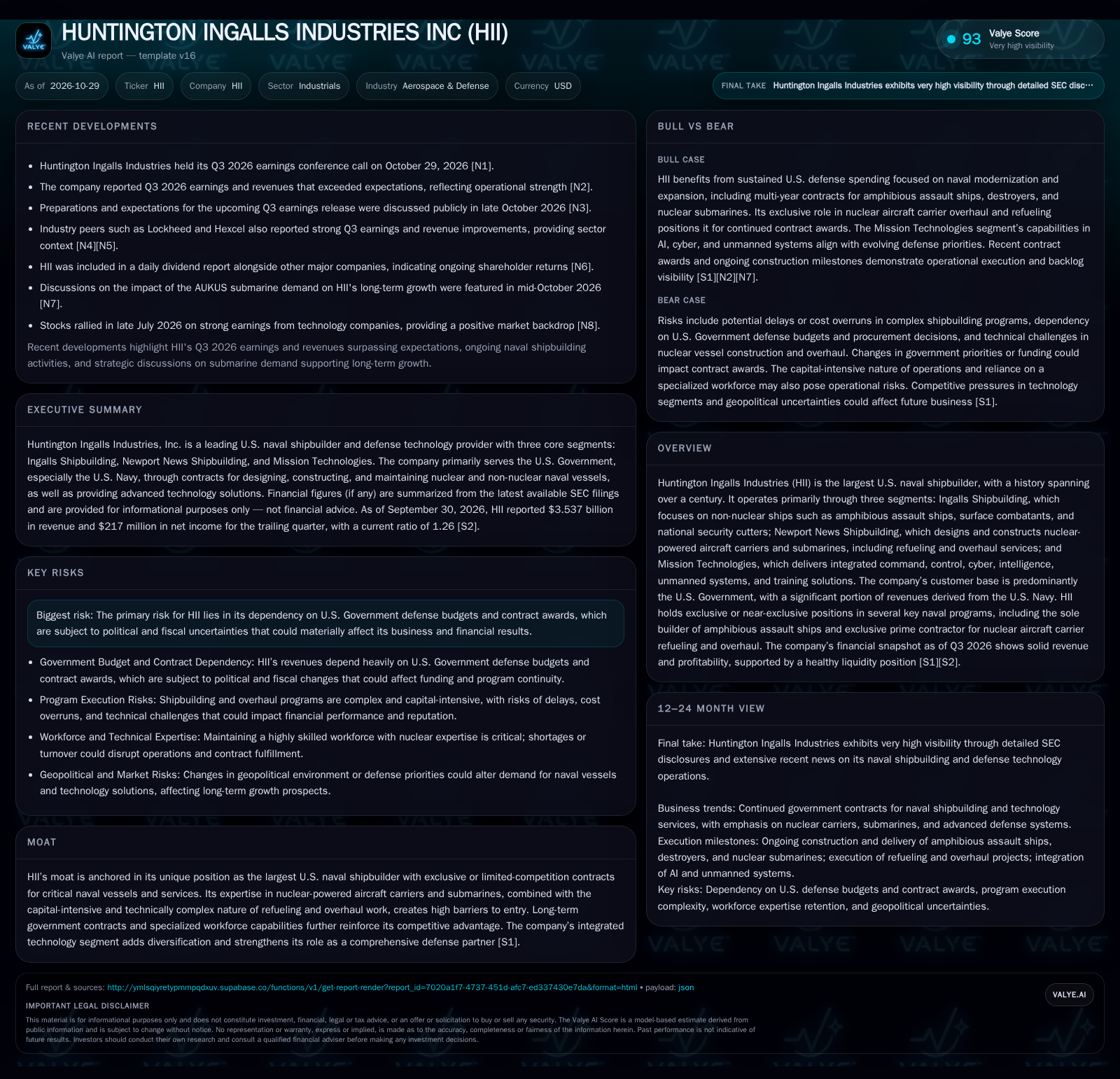
Huntington Ingalls Industries leads U.S. naval shipbuilding through exclusive nuclear carrier and submarine contracts, with Q3 2026 revenue and earnings beating expectations. Execution of major vessel programs and the integration of advanced technologies are central to its value, but the business faces significant exposure to federal budget decisions and capital-intensive project risks. Long-term demand, particularly for submarines under AUKUS, supports potential upside, but program delays or shifts in defense spending could threaten momentum. Watch for contract flow, cost discipline, and Mission Technologies segment traction as leading indicators. [S1] [S2] [N2] [N7]
Huntington Ingalls Industries (HII) stands at the intersection of traditional naval shipbuilding scale and the shifting priorities of 21st-century defense technology. As the only U.S. builder of nuclear-powered aircraft carriers and a key supplier of submarines and amphibious vessels, HII’s contract portfolio is both a moat and a source of unique risk. The company’s Q3 2026 results beat expectations, buoyed by continued execution on major naval programs and optimism around future submarine demand tied to the AUKUS alliance. Yet, with over 80% of revenue tied to U.S. Navy budgets and a capital-intensive, technically complex operating model, HII’s future will hinge on its ability to deliver major projects efficiently while expanding its technology offerings beyond the shipyard. [S1] [S2] [N2] [N7]
Exclusive Contracts and Technology Ambitions Define the 2026 Landscape
As of Q3 2026, Huntington Ingalls Industries reported $3.537 billion in revenue and $217 million in net income for the quarter, with basic and diluted EPS near $5.49. These results outpaced consensus, driven by operational progress on key shipbuilding programs and robust government contract flow. [S2] [N2]
HII is the exclusive prime contractor for the U.S. Navy’s nuclear-powered aircraft carrier refueling and complex overhaul (RCOH)—a role that ensures high visibility and technical lock-in for a core segment of U.S. naval power. [S1]
The company’s business mix remains heavily concentrated, with approximately 81% of revenues tied to the U.S. Navy. This underscores both the stability of multi-year government funding and the vulnerability to political or fiscal changes. [S1]
On the technology front, HII’s Mission Technologies segment continues to push into C5ISR, cyber, AI, and unmanned systems, seeking to capture a growing share of defense technology budgets. [S1] Recent news highlights the potential for long-term growth from submarine demand under the AUKUS alliance, positioning HII to benefit from shifts in global defense priorities. [N7]
Shipbuilding Economics: Fixed-Cost Leverage and the Technology Margin Question
HII’s economics are shaped by the scale and capital intensity of naval shipbuilding, where large, multi-year contracts drive revenue visibility but require significant upfront investment and working capital. Fixed costs—facilities, specialized labor, and nuclear expertise—dominate, creating substantial operating leverage when yards are running at high capacity but exposing the business to margin compression if schedules slip or volumes fall.
Pricing for major vessels is typically negotiated on a cost-plus or milestone basis, offering some inflation protection but limiting upside from efficiency gains unless contracts are structured with incentives. Volume is dictated by federal procurement cycles rather than market demand, so contract flow is more important than price competition.
The Mission Technologies segment offers a potential margin boost through software, services, and integration work. However, this segment faces greater competition and may be less predictable in terms of contract size, renewal rates, and customer stickiness compared to shipbuilding. If HII can scale Mission Technologies to a significant portion of revenue with higher incremental margins, overall profitability could improve—but this remains to be demonstrated at scale.
Cash conversion is lumpy, as contract advances, milestone payments, and inventory swings drive working capital volatility. As of Q3 2026, HII’s current ratio of 1.26 and cash ratio of zero reflect a typical defense prime’s reliance on contract-based liquidity rather than large net cash reserves. [S2]
Barriers, Substitution, and the Limits of Moat in a Changing Defense Landscape
HII’s competitive advantage is rooted in its exclusive or near-exclusive positions for nuclear aircraft carriers and major amphibious ships. The capital, regulatory, and technical requirements for nuclear shipbuilding create formidable barriers to entry—no other U.S. yard matches HII’s scale or nuclear credentials. [S1]
The risk of substitution is low for nuclear carriers and ballistic-missile submarines, as these platforms are central to U.S. naval doctrine and few alternatives exist domestically. However, future shifts toward smaller, more distributed naval assets, unmanned vessels, or increased focus on cyber and space could gradually erode the primacy of traditional shipbuilding.
In technology and C5ISR, HII faces a different landscape: competition is fierce, with peers ranging from large defense IT contractors to specialized cyber and AI firms. Here, barriers to entry are lower, and advantages are more likely to come from integration, speed, and customer intimacy than from physical scale. HII’s ability to leverage its shipbuilding incumbency into technology contracts is a question for the next phase of its evolution.
How AUKUS and Digital Integration Could Unlock Multi-Year Growth
In a favorable scenario, U.S. and allied submarine demand—amplified by the AUKUS agreement—drives sustained growth and high yard utilization for HII’s Newport News segment. Multi-year procurement commitments and the complexity of nuclear refueling and overhauls provide revenue visibility and margin stability.
Mission Technologies succeeds in capturing a larger share of next-generation defense contracts, leveraging its integration with shipbuilding to offer end-to-end solutions in unmanned systems, AI, and cyber. This segment grows as a percentage of revenue and delivers higher incremental margins, offsetting the lumpiness of shipbuilding cycles.
Evidence for this scenario would include new multi-vessel awards for the Columbia and Virginia-class submarine programs, visible backlog growth tied to AUKUS, and disclosures of large technology contract wins or recurring revenue streams from Mission Technologies. Improving consolidated margins and stable or rising free cash flow would further confirm the thesis. [N7]
Steady Execution Underpins a Stable but Exposed Shipbuilding Franchise
The most plausible outcome is that HII maintains its shipbuilding backlog and executes on existing carrier, submarine, and amphibious ship programs with incremental improvements in cost and schedule discipline. Revenue and profitability remain closely linked to U.S. Navy procurement cycles, with periodic boosts from technology contracts but no transformational shift in business mix.
Mission Technologies grows, but remains a modest contributor to overall margins. Shipbuilding continues to dominate both the opportunity and the risk profile. HII’s financials reflect the inherent lumpiness of contract timing, but the company stays within historical ranges for revenue growth and margin.
Confirmation would come from a stable or modestly growing backlog, continued contract flow for flagship programs, and evidence that Mission Technologies delivers incremental rather than breakout results. A lack of major cost overruns or project delays would help validate this scenario.
Budget Shocks or Program Slippage Could Erode Margin and Visibility
An adverse scenario would see U.S. defense budgets decline or shift away from large surface vessels and nuclear platforms, resulting in lower contract awards or delayed procurement. HII’s high fixed costs would amplify the effect of any volume shortfall, compressing margins and potentially forcing restructuring.
Program execution risk—such as cost overruns or technical setbacks in nuclear carrier or submarine projects—could trigger penalties, reputational damage, or even contract renegotiation. In Mission Technologies, failure to win major contracts or achieve scale would limit diversification and expose the business to further concentration risk.
Evidence supporting this scenario would include a shrinking or stagnant backlog, public reports of cost overruns or schedule slips, and reduced visibility on multi-year funding for key programs. Any significant change in U.S. Navy procurement priorities or budget cuts would be a leading indicator.
Company-Specific Developments That Could Affirm or Challenge the Core Thesis
Backlog size and composition: Changes in total backlog, especially for nuclear carriers, submarines, and AUKUS-related programs, would indicate forward revenue visibility and risk.
Major contract awards or cancellations: Announcements of new multi-vessel awards or unexpected program cancellations would test the company’s competitive position and demand outlook.
Cost performance on key programs: Disclosure of cost overruns or schedule delays—especially in nuclear projects—would impact margins and reputation.
Mission Technologies’ contract wins: Large-scale awards or recurring revenue contracts in C5ISR, cyber, or unmanned systems (if disclosed) would signal traction in technology diversification.
Segment margin trends: Improvements or deterioration in segment-level margins, particularly for Mission Technologies and Newport News, would help validate operating leverage assumptions.
Free cash flow and working capital swings: Sustained positive free cash flow or large inventory/advance swings would test the predictability of cash generation.
U.S. defense budget signals: Federal budget proposals or appropriations that affect Navy procurement cycles and shipbuilding priorities will remain the most important external variable.
Workforce retention and technical capacity: Updates on skilled labor availability, especially for nuclear work, would help assess operational resilience.
Disclaimer: This is research-only, informational analysis and not investment advice. It may include AI-generated interpretation and general industry context. Always verify important details using primary sources.

Comments