
Trane Technologies: Innovation-Driven Expansion and Legal Overhangs in Global HVAC Markets
Trane Technologies enters late 2026 with significant revenue momentum, recent acquisitions in data center and refrigeration markets, and a sharpened focus on decarbonization and AI-enabled solutions. While operational execution has been strong, the company faces material uncertainties from ongoing asbestos litigation, geopolitical risks, and the demands of global supply chain resilience.
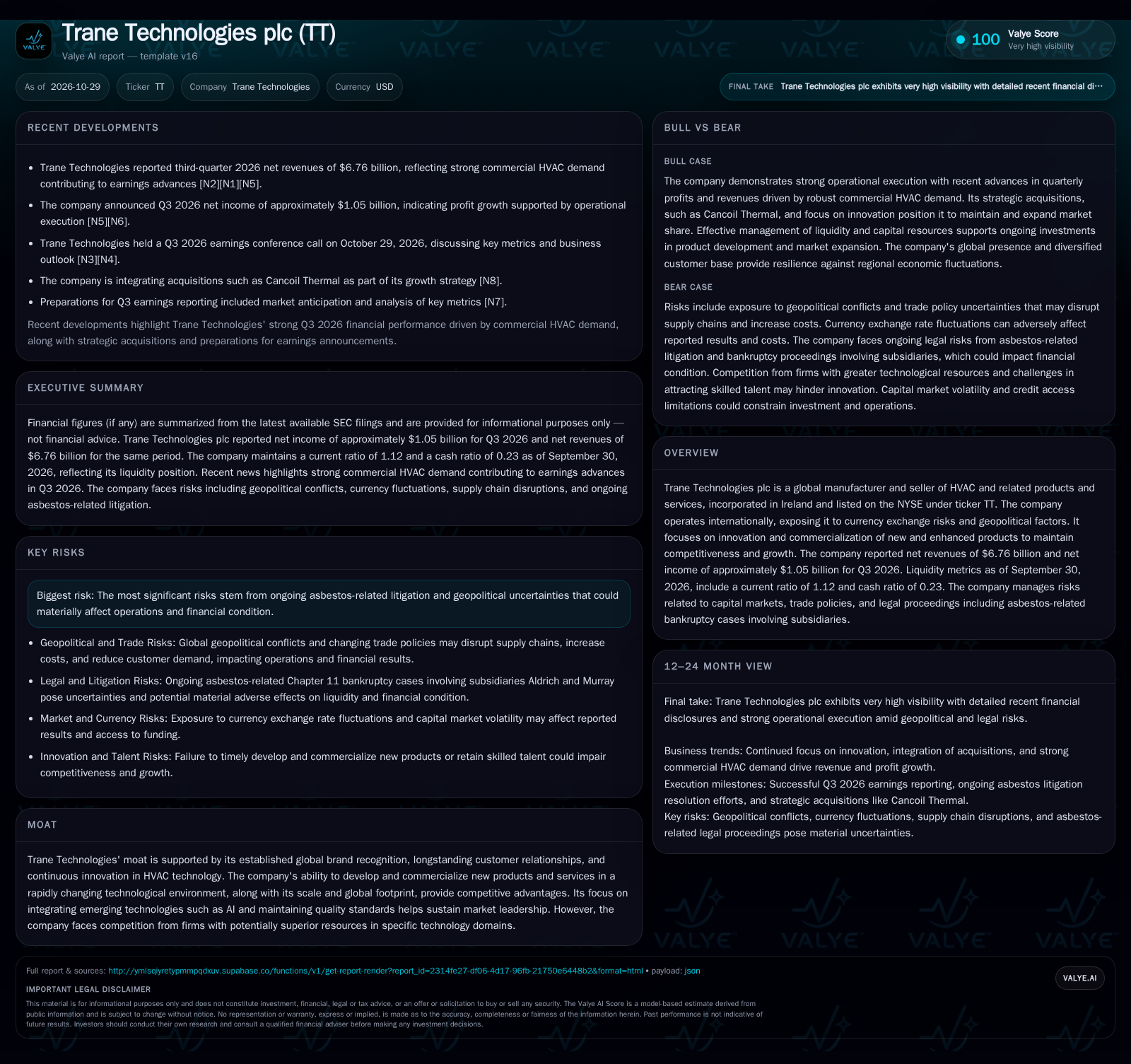
Trane Technologies posted Q3 2026 net revenues of $6.76 billion and net income of $1.05 billion, buoyed by strong commercial HVAC demand and recent acquisitions in cooling and automation. The company is doubling down on sustainability and new technologies, but ongoing asbestos-related litigation and global macro risks remain significant variables for future earnings quality and capital allocation. [S2] [N2] [N5]
Trane Technologies is riding a wave of strong commercial HVAC demand and strategic acquisitions as it exits Q3 2026, posting over $6.7 billion in quarterly revenue and maintaining a high profile in the global push for decarbonization. The company’s aggressive moves into data center cooling and building automation signal a bid to capture emerging growth vectors beyond traditional HVAC. Yet, the persistent shadow of asbestos-related litigation, combined with volatile macroeconomic and geopolitical forces, injects uncertainty into long-term margin and capital allocation scenarios. Investors must weigh Trane’s innovation and market breadth against legal and external shocks that could reshape its risk/reward calculus.
Recent Results and Strategic Moves Define Trane’s Current Landscape
Trane Technologies reported Q3 2026 net revenues of $6.76 billion and net income of $1.0487 billion, reflecting continued strength in its core commercial HVAC markets. The company’s liquidity position as of September 30, 2026, included current assets of $8.71 billion and current liabilities of $7.75 billion, producing a current ratio of 1.12 and a cash ratio of 0.23. Notably, the company completed or announced several acquisitions: Stellar Energy Americas (turnkey data center cooling), full ownership of LiquidStack (advanced liquid cooling for data centers), and the planned acquisition of Cancoil Thermal (heat-transfer products), each broadening Trane’s portfolio and exposure to secular growth markets. At the same time, Trane faces ongoing asbestos-related litigation tied to subsidiaries Aldrich and Murray, with unresolved bankruptcy proceedings that could materially affect future liquidity and financial condition. [S2] [N2] [N5]
How Trane Generates Profits Amid Shifting Technology and Policy Landscapes
Trane’s economic engine is built on the manufacturing and sale of HVAC systems, refrigeration equipment, and related aftermarket services across global commercial, industrial, and residential markets. The company’s revenue mix is typically weighted toward commercial and institutional clients, where multi-year relationships and large project scopes can support premium pricing, but also expose the business to cyclical construction and retrofit cycles. Operating leverage is inherent in the manufacturing footprint: high fixed costs in plant, engineering, and R&D are offset by scale benefits and aftermarket attachment rates. As the company acquires data center cooling and automation assets, the revenue stream may tilt further toward high-value, solution-oriented contracts and recurring service agreements—if integration is successful and customer adoption is robust.
Pricing power is supported by Trane’s ability to deliver energy-efficient, regulatory-compliant solutions, especially as global building codes and decarbonization mandates tighten. The integration of AI and digital controls may allow for incremental value extraction through software-enabled services, though the durability of this advantage depends on customer willingness to pay and the pace of competitor innovation. Capital needs remain significant due to ongoing product development, facility upgrades, and the cost of integrating new acquisitions. The unresolved legal liabilities—particularly the asbestos-related cases—could create outsized cash demands or constrain capital allocation flexibility if adverse judgments materialize.
Trane’s Market Standing: Differentiation, Threats, and Peer Dynamics
Trane’s competitive position is anchored by global brand recognition, a broad installed base, and deep customer relationships in the commercial HVAC and building solutions sector. The company’s multi-decade investments in energy efficiency and sustainability have allowed it to ride regulatory and customer trends toward decarbonization, giving it an edge in markets where green standards are tightening. Recent acquisitions in data center cooling and building automation suggest a bid to expand beyond traditional HVAC, potentially capturing a share of high-growth, high-margin niches as demand for digital infrastructure and intelligent building systems accelerates.
However, Trane operates in a fiercely competitive landscape. Large multinational peers and regional specialists are investing heavily in similar decarbonization, AI, and digital offerings. The risk of technology substitution is real—especially if integrated building management platforms or new cooling technologies reduce the relevance of traditional HVAC hardware. Switching costs for large commercial customers may be significant due to installed base and service contracts, but not insurmountable if new entrants deliver superior energy savings or regulatory compliance. The company’s global scale helps diversify end-market risk but also exposes it to currency swings, supply chain complexity, and geopolitical disruptions.
Unlocking Value Through Innovation and Decarbonization Leadership
A favorable outcome for Trane hinges on its ability to consistently out-innovate peers and capture outsized share in growth vectors like data center cooling, building automation, and energy transition projects. If the integration of recent acquisitions drives cross-selling and higher-margin solution revenue, and if decarbonization mandates accelerate customer adoption of premium, AI-enabled systems, Trane could see sustained revenue growth and margin expansion. The company’s 2030 and 2050 sustainability commitments—if translated into differentiated products and demonstrable customer ROI—could further entrench its position with large institutional buyers.
Evidence that would confirm this scenario includes above-peer revenue growth in data center and automation segments, higher aftermarket/service attachment rates, and successful roll-out of AI-driven solutions that command premium pricing. Resolution of asbestos liabilities on favorable terms would further unlock capital for reinvestment and shareholder returns.
Steady Execution Amid Mixed Macro and Legal Backdrop
The most plausible trajectory is one of continued operational execution with incremental gains from new products and geographies, but offset by persistent legal and macroeconomic headwinds. Trane is likely to maintain its core share in commercial HVAC while growing selectively in data center and automation, though not at a pace that radically alters the revenue mix in the next 12–24 months. Margin performance could be stable, with modest improvement from scale and mix, assuming supply chain disruptions and input cost pressures remain manageable.
Legal proceedings surrounding asbestos liabilities are likely to remain an overhang, with periodic cash outflows or settlement costs impacting capital allocation flexibility. Confirmation of this scenario would come from steady, mid-single-digit revenue growth, normalized margins, and continued legal disclosures without material adverse judgments. Conversely, a sharp increase in litigation charges, significant supply disruptions, or loss of major contracts would falsify the base case.
Litigation and External Shocks Threaten Capital and Earnings Power
A negative outcome could materialize if asbestos-related litigation escalates or results in materially adverse judgments, leading to sudden cash drains, higher insurance costs, or restricted access to capital markets. Simultaneously, a severe geopolitical event—such as trade barriers, regional conflict escalation, or acute supply chain breakdown—could disrupt manufacturing, inflate input costs, or impair cross-border sales, particularly in sensitive markets like China or the Middle East. If macroeconomic conditions deteriorate, especially in commercial construction or data center spending, Trane could face revenue declines and operating deleverage.
Falsification of the downside scenario would require clear evidence of legal resolution with manageable cost, robust demand in core geographies despite external shocks, and preservation of operating margins even in the face of supply chain or economic volatility.
Data Points That Will Shape Trane’s Risk/Reward Profile Going Forward
Progress and eventual resolution of asbestos-related bankruptcy proceedings, including any new disclosures on settlement amounts, insurance recoveries, or adverse judgments.
Revenue and margin contributions from recently acquired businesses—Stellar Energy Americas, LiquidStack, transport refrigeration distributors, and Cancoil Thermal (post-close).
Trends in backlog, order intake, and pipeline for data center, automation, and decarbonization projects; a useful metric would be segment-specific growth rates if disclosed.
Customer adoption rates and pricing realization for AI-enabled and energy-efficient product lines.
Supply chain stability and input cost inflation, especially in regions with ongoing geopolitical or trade disruptions.
Currency impacts on reported results, particularly exposure to euro, renminbi, and emerging market currencies.
Retention and recruitment of skilled engineering and technology talent, which will influence the pace of new product commercialization and digital transformation.
Disclaimer: This is research-only, informational analysis and not investment advice. It may include AI-generated interpretation and general industry context. Always verify important details using primary sources.

Comments