
KBR’s Dual-Engine Model: Contract Complexity, Strategic Focus, and the Next Phase of Growth
KBR’s mix of long-cycle government contracts and proprietary sustainable technology solutions has yielded improved profitability despite only modest revenue growth.
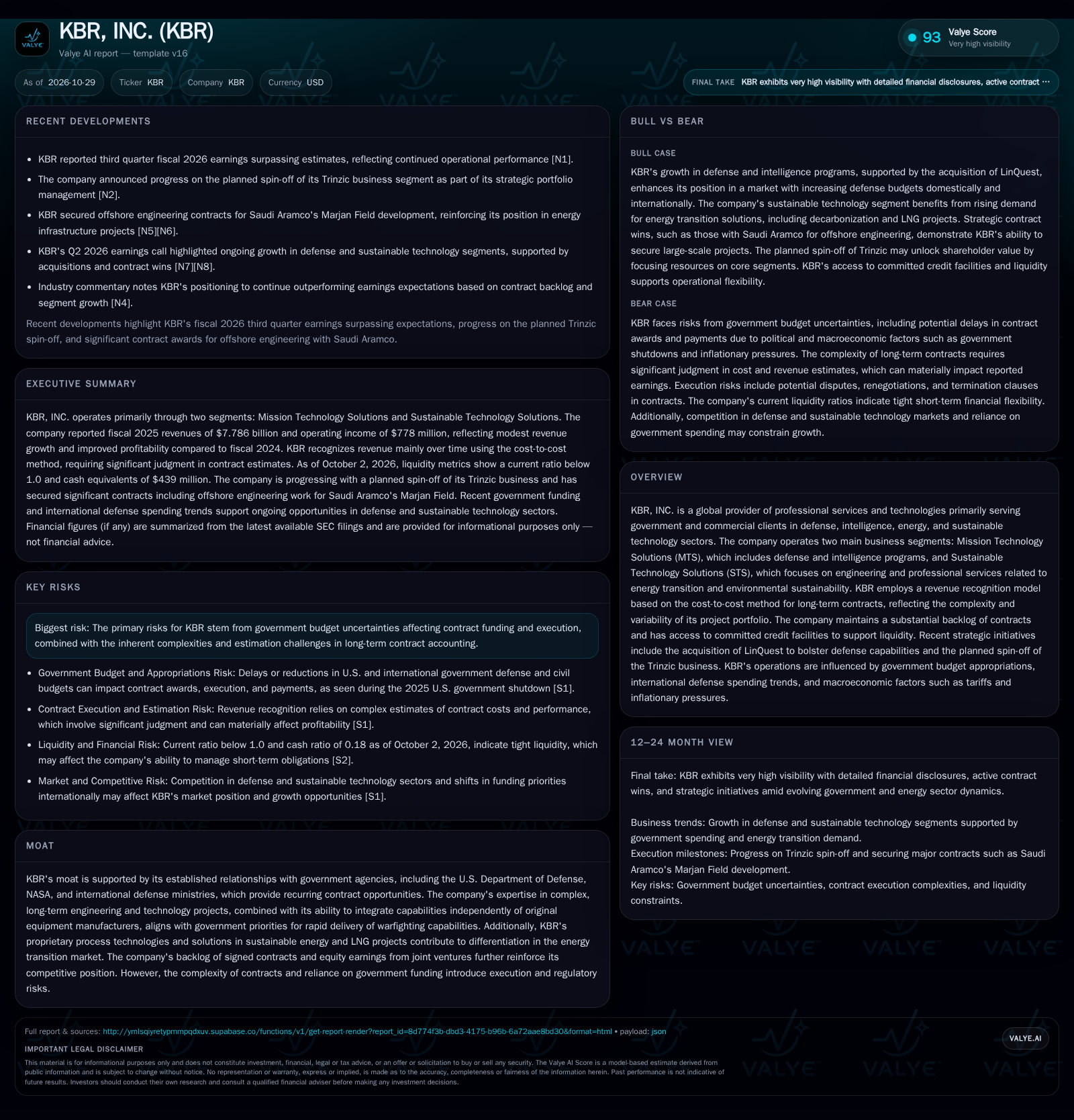
KBR reported fiscal 2025 revenues of $7.786 billion (up 1%) and operating income of $778 million (up 18%), demonstrating margin expansion despite sluggish top-line growth. The company’s results reflect a portfolio centered on government-funded defense/intelligence and proprietary sustainable technology contracts, both of which rely on complex, judgment-driven revenue recognition. Recent wins in offshore energy engineering and ongoing international defense spending trends support the near-term outlook, yet execution and estimation risks are embedded in KBR’s business model. [S1] [S2] [N2] [N5] [N6]
KBR, Inc. stands at a strategic crossroads, balancing the complexity of government and commercial contracts with the need for sharper operational focus. Fiscal 2025 results show the company’s ability to translate modest revenue growth into substantial profit gains, thanks in part to a portfolio that straddles defense/intelligence and sustainable technology solutions. The recent spin-off initiative and major contract wins highlight both the opportunity and the inherent complexity of KBR’s dual-engine business model.
Recent Performance and Portfolio Realignment Shape KBR’s Near-Term Focus
KBR reported total revenues of $7.786 billion for fiscal 2025, reflecting a modest 1% increase from the prior year, but operating income rose 18% to $778 million—a sign of margin expansion despite slow top-line growth [S1]. Mission Technology Solutions (MTS) generated $5.581 billion in revenue, while Sustainable Technology Solutions (STS) contributed $2.205 billion [S1]. Net income attributable to KBR climbed to $415 million, up 11% year-over-year [S1].
The company reported a current ratio of 0.94 for the period. [S2] These figures highlight a tight liquidity position, emphasizing the importance of project execution and cash conversion cycles.
Strategically, KBR is progressing with the spin-off of its Trinzic business—an indication of intent to focus on core segments. The company also secured major offshore engineering contracts for Saudi Aramco’s Marjan Field, underscoring its international reach in energy infrastructure [N2] [N5] [N6]. The acquisition of LinQuest in 2024 continues to support MTS growth, particularly in defense and intelligence [S1].
Contract Structure, Revenue Recognition, and Margin Leverage in KBR’s Model
KBR’s economics are fundamentally shaped by its portfolio of long-term, often government-funded contracts. The company recognizes revenue primarily over time using the cost-to-cost method, which matches revenue to the proportion of costs incurred versus total estimated costs at contract completion [S1]. This approach enables smooth revenue recognition for multi-year projects, but it also embeds significant estimation risk—errors in cost forecasting can materially impact reported profitability.
Variable economics are evident: while overall revenue growth was muted, operating income outpaced sales, suggesting improved project execution, favorable contract mix, or a shift toward higher-margin work [S1]. The STS segment, in particular, benefits from proprietary process technologies and advisory services, which may carry higher margins than traditional engineering or construction contracts if pricing power and IP leverage are sustained.
KBR’s capital needs are moderate by heavy industrial standards, as the business is services- and technology-driven rather than asset-intensive. However, working capital swings, project milestone payments, and the timing of government appropriations can create cash flow volatility. The company reported cash and liquidity metrics for the period; these figures do not by themselves establish operating runway, investment capacity, financial flexibility, or financing capacity. [S2]
Defending the Moat: Government Relationships, Technology, and Execution Risk
KBR’s competitive position is rooted in longstanding government relationships—particularly with U.S., U.K., and Australian defense agencies—and a portfolio of proprietary technologies for the energy transition. Its ability to offer full-spectrum solutions across research, systems integration, and complex program management creates a barrier to entry for smaller or less specialized firms.
However, the competitive landscape is dynamic. In defense, KBR contends with major government contractors, engineering consultancies, and increasingly, firms with advanced digital or AI capabilities. In sustainable technology, competition comes from both engineering giants and technology-focused startups seeking to commercialize decarbonization, circular economy, and process-efficiency solutions.
Switching frictions for government clients can be high due to the complexity and integration of KBR’s services, but contract renewals are never guaranteed—particularly as governments reevaluate spending priorities. In commercial energy transition, differentiation depends on the continued relevance and performance of KBR’s proprietary process technologies, as well as its ability to bundle services and maintain client relationships amid a crowded field.
How Margin Expansion Could Outpace Revenue Growth: The Bullish Chain
The most favorable scenario for KBR is one in which operating leverage drives continued profit growth even if headline revenues remain relatively stable. This would likely require a sustained shift toward higher-margin, IP-driven contracts in the STS segment, as well as disciplined execution and cost control in government programs.
A successful spin-off of the Trinzic business could sharpen management focus and capital allocation on core areas, potentially unlocking shareholder value if the market rewards the streamlined portfolio. New contract wins—especially in international defense and large-scale energy transition projects—could further fill the backlog with work that supports both top-line and margin expansion.
Confirmation of this scenario would include continued double-digit operating income growth, evidence of rising STS segment margins (if disclosed), and additional large contract awards in defense and energy infrastructure. Falsification would occur if margin gains stall or if cost overruns in major projects erode profitability despite ongoing revenue growth.
Steady Execution Amid Cyclical and Political Volatility
The most plausible trajectory for KBR is a continuation of modest revenue growth paired with incremental margin improvement, contingent on stable government funding and disciplined contract management. The company is likely to benefit from ongoing defense modernization cycles in the U.S., U.K., and Australia, as well as from policy-driven demand for decarbonization and energy efficiency in STS.
Contract estimation complexity and cash flow timing will remain persistent challenges—KBR’s results could be lumpy, with periods of strong margin performance interrupted by project-specific setbacks or delays in government appropriations. The planned Trinzic spin-off may simplify the portfolio and improve segment focus, but it is unlikely to fundamentally alter the company’s risk profile in the short term.
This scenario would be confirmed by low- to mid-single-digit revenue growth, stable or slowly improving operating margins, and continued progress in backlog conversion. It could be falsified by a major government shutdown, a material contract dispute, or a liquidity squeeze that forces asset sales or dilutive financing.
When Complexity Turns Costly: Contract Risk and Funding Shocks
KBR’s business model is vulnerable to adverse shifts in government spending or significant errors in contract cost estimation. In a negative scenario, a prolonged U.S. or allied government shutdown, defense budget cuts, or project cancellations could lead to delayed awards, unbilled receivables, and working capital stress.
Contract performance issues—such as cost overruns, disputes, or the invocation of termination clauses—could expose KBR to margin compression or even losses on major projects. The company’s reliance on the cost-to-cost revenue recognition method means that unexpected cost increases can have immediate and material impacts on reported earnings.
This scenario would be confirmed by declining backlog, negative operating cash flow, or the need to draw further on credit facilities. It could be further evidenced by announced contract disputes, major project write-downs, or a deterioration in liquidity ratios below already tight levels.
Testing the Thesis: What Will Reveal KBR’s True Trajectory?
Trinzic spin-off progress, including transaction terms and management’s post-spin capital allocation priorities, would help clarify the strategic direction.
Backlog growth and composition by segment, especially the mix of higher-margin STS contracts versus lower-margin legacy work, would provide insight into future revenue and margin potential.
Disclosure of segment operating margins, particularly in STS, would help determine if proprietary technology solutions are delivering superior profitability.
Cash flow from operations and working capital trends, if disclosed, would directly test KBR’s ability to convert backlog into cash amid tight liquidity.
Major new contract awards or renewals in defense/intelligence and energy transition, and associated project scopes and durations, would signal competitive standing and future workload.
Evidence of cost overruns, contract disputes, or regulatory/governmental delays—such as those seen during the 2025 U.S. government shutdown—would indicate execution or funding risk.
Additional utilization of credit facilities or changes to borrowing terms could signal liquidity stress or improved potential financial flexibility, depending on context.
Shifts in international defense or energy transition spending trends, especially in the U.K., Australia, and Middle East, would influence both opportunity set and risk.
Disclaimer: This is research-only, informational analysis and not investment advice. It may include AI-generated interpretation and general industry context. Always verify important details using primary sources.

Comments