
Hershey’s Growth Outlook: Snacking Innovation, Pricing Strategy, and Maintaining Competitive Strength
Recent earnings reveal Hershey’s ability to manage cost inflation and drive margin expansion through pricing, but the company’s push into broader snacking and international markets tests the limits of its brand, supply chain resilience, and innovation cadence.
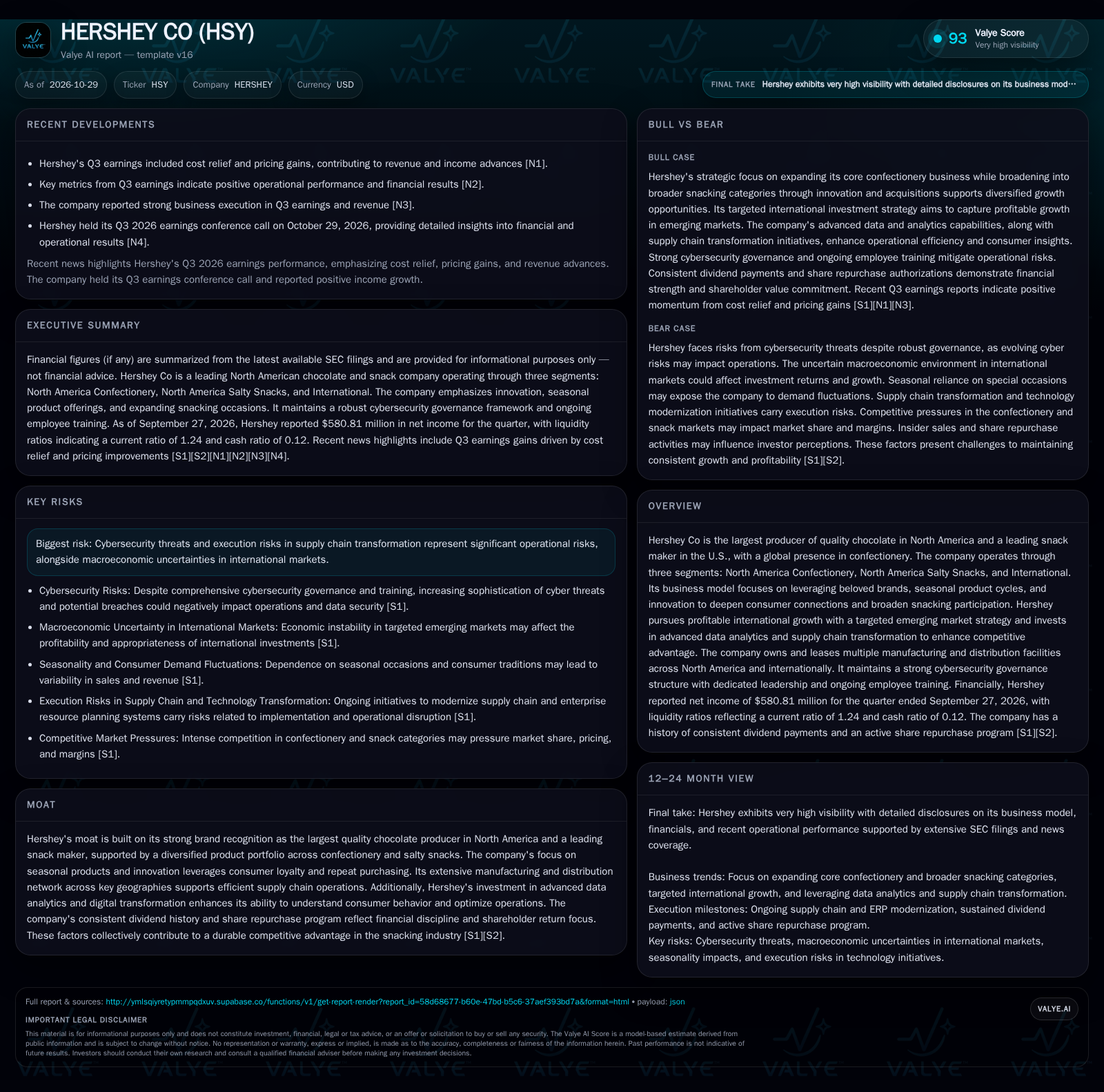
Hershey’s latest quarter featured strong net income and evidence of pricing-driven margin gains, reflecting effective cost management and market power in core categories. The company is leveraging its iconic brands and supply chain upgrades to expand beyond confectionery. However, execution risks in digital and operational transformation, as well as the challenge of maintaining growth in a competitive, seasonal, and increasingly global snacking market, remain central to the long-term thesis. [S1] [S2] [N1] [N2] [N3] [N4]
Hershey’s latest quarterly performance underscores its continued strength in core chocolate and confectionery while signaling measured progress in broader snacking and international expansion. With net income of $580.81 million for Q3 2026 and improved margins attributed to cost relief and pricing actions, the company demonstrates ongoing pricing power and operational discipline. Yet, as Hershey invests in data analytics, supply chain modernization, and international growth, the durability of its competitive edge will hinge on execution, innovation, and the ability to navigate both macroeconomic and category-specific headwinds. [S2] [N1] [N3]
Quarterly Results Highlight Pricing Strength and Cost Discipline
Hershey reported net income of $580.81 million for the quarter ending September 27, 2026, with recent earnings driven by cost relief and pricing improvements. This result highlights the company’s ability to offset commodity and input cost pressures through strategic pricing, a lever that has become increasingly important in the inflationary environment of the past several years. The company reported cash and liquidity metrics for the period; these figures do not by themselves establish operating runway, investment capacity, financial flexibility, or financing capacity. Hershey’s 384th consecutive quarterly dividend and remaining $470 million on its $500 million share repurchase authorization reinforce a consistent approach to shareholder returns. [S2] [S1] [N1] [N3]
The Business Model: Brand Power, Pricing Strategy, and Seasonal Demand Patterns
The core of Hershey’s economic engine remains its branded confectionery portfolio, which benefits from high consumer loyalty, strong shelf presence, and the ability to drive premium pricing—particularly around holidays and special occasions. This seasonality, while a source of margin strength, also creates periods of revenue concentration and exposure to demand variability. Pricing power has been a critical offset to rising input costs, and recent quarters suggest Hershey continues to pass through cost increases to consumers without significant volume decline, at least in its core segments.
The company’s push into salty snacks and international markets is designed to smooth seasonality and diversify revenue streams, though these segments may initially carry lower margins and require investment in distribution, marketing, and localized innovation. The capital intensity of manufacturing and distribution is mitigated by scale and operational efficiency, but ongoing supply chain transformation projects and technology upgrades introduce both fixed costs and execution risk. If successful, these investments could drive further operating leverage, especially as data analytics and automation improve forecasting, inventory management, and promotional effectiveness.
Maintaining Competitive Edge Through Brand Loyalty, Shelf Positioning, and Innovation
Hershey’s competitive advantage is anchored in its brand equity, established distribution relationships, and ability to command prime shelf space in North America. This moat is reinforced by a diversified product portfolio, with both chocolate and non-chocolate snacks, and a reputation for quality and consistency. However, the snacking landscape is increasingly crowded, with large multinational food conglomerates, regional snack brands, and private label competitors all vying for share. Substitution risk is real—both within confections (alternative sweets, better-for-you options) and in salty snacks, where category boundaries blur and consumer tastes shift rapidly.
Innovation is necessary but not always sufficient: the challenge is to generate incremental growth without cannibalizing core brands or diluting brand equity. Hershey’s investments in advanced data analytics and supply chain modernization aim to create a feedback loop for faster, more targeted innovation, but success will depend on execution speed, consumer resonance, and the ability to maintain retailer partnerships in the face of changing category dynamics.
Potential Gains from Digital Initiatives and Supply Chain Efficiencies
A favorable scenario emerges if Hershey’s supply chain transformation and data analytics investments deliver material improvements in efficiency, inventory turns, and promotional ROI. If the company succeeds in expanding its salty snack and international businesses without significant margin dilution, overall profitability could rise as fixed costs are spread over a broader revenue base. The test will be whether new product launches and snacking occasion innovations drive incremental volume, rather than simply shifting share within its portfolio.
Confirmation would come from sustained margin expansion (particularly in the non-confectionery segments), rising international revenue contribution, and evidence that pricing power holds even as input costs stabilize or decline. If the company can maintain or grow market share while increasing operating leverage, it would signal that its transformation and innovation strategy is working.
Balancing Core Business Stability with Expansion Challenges
The most plausible trajectory is that Hershey continues to generate robust cash flow and maintain its leadership in North American confectionery, with incremental growth in salty snacks and selected international markets. Seasonal and innovation-driven sales cycles persist, and pricing remains a lever to manage modest input cost volatility. Investments in supply chain and analytics yield gradual improvements in efficiency and responsiveness, but do not radically change the margin profile in the near term.
Evidence for this path would include continued stable or modestly improving margins in the core business, a steady pace of product launches and seasonal promotions, and incremental gains in international and salty snack segments. If competitive pressures intensify or innovation fails to resonate, growth may be limited to low single digits, but the company’s cash generation and dividend discipline would remain intact.
Risks from Operational Issues or Market Demand Fluctuations Impacting Margins
Adverse outcomes could arise if Hershey’s supply chain and technology modernization initiatives run over budget, disrupt operations, or fail to deliver anticipated efficiencies. A major cyber incident—despite the company’s governance focus—could impair operations or erode customer trust. Intensifying competition, especially from private label or disruptive snack brands, could pressure both volume and pricing, particularly if consumer preferences shift more rapidly than Hershey can respond.
Further downside risk stems from macroeconomic shocks in key international markets, or a severe downturn in seasonal demand tied to changing consumer behavior or weakened holiday spending.
Key Developments Shaping Hershey’s Strategic Direction
Sustained gross and operating margin trends, especially in the salty snack and international segments, will reveal the success of supply chain and innovation investments if disclosed.
Growth rate of international sales and profitability, with specific attention to emerging markets, will indicate whether targeted investments are yielding returns.
Rate and impact of new product launches and their contribution to incremental volume versus cannibalization of existing brands would help test the innovation thesis.
Evidence of pricing power—such as the ability to maintain or raise prices without significant volume loss—remains a critical KPI in a mature category.
Progress and spend on supply chain transformation projects, including any disclosed ROI metrics, would clarify execution risk or upside.
Cybersecurity incident disclosures, if any, and management commentary on operational impacts will be important given the stated risk profile.
Market share trends in both core confectionery and expanded snacking categories, if disclosed, will show whether Hershey is defending or conceding ground.
Disclaimer: This is research-only, informational analysis and not investment advice. It may include AI-generated interpretation and general industry context. Always verify important details using primary sources.

Comments