
Principal Financial Group: Managing Investment Income Volatility Through Diverse Revenue Sources
The company's multi-segment structure, spanning asset management, retirement solutions, and protection, shapes its capacity to manage cyclical pressures and pursue growth—yet leaves open questions around segment-specific profitability and the durability of its current profit trajectory.
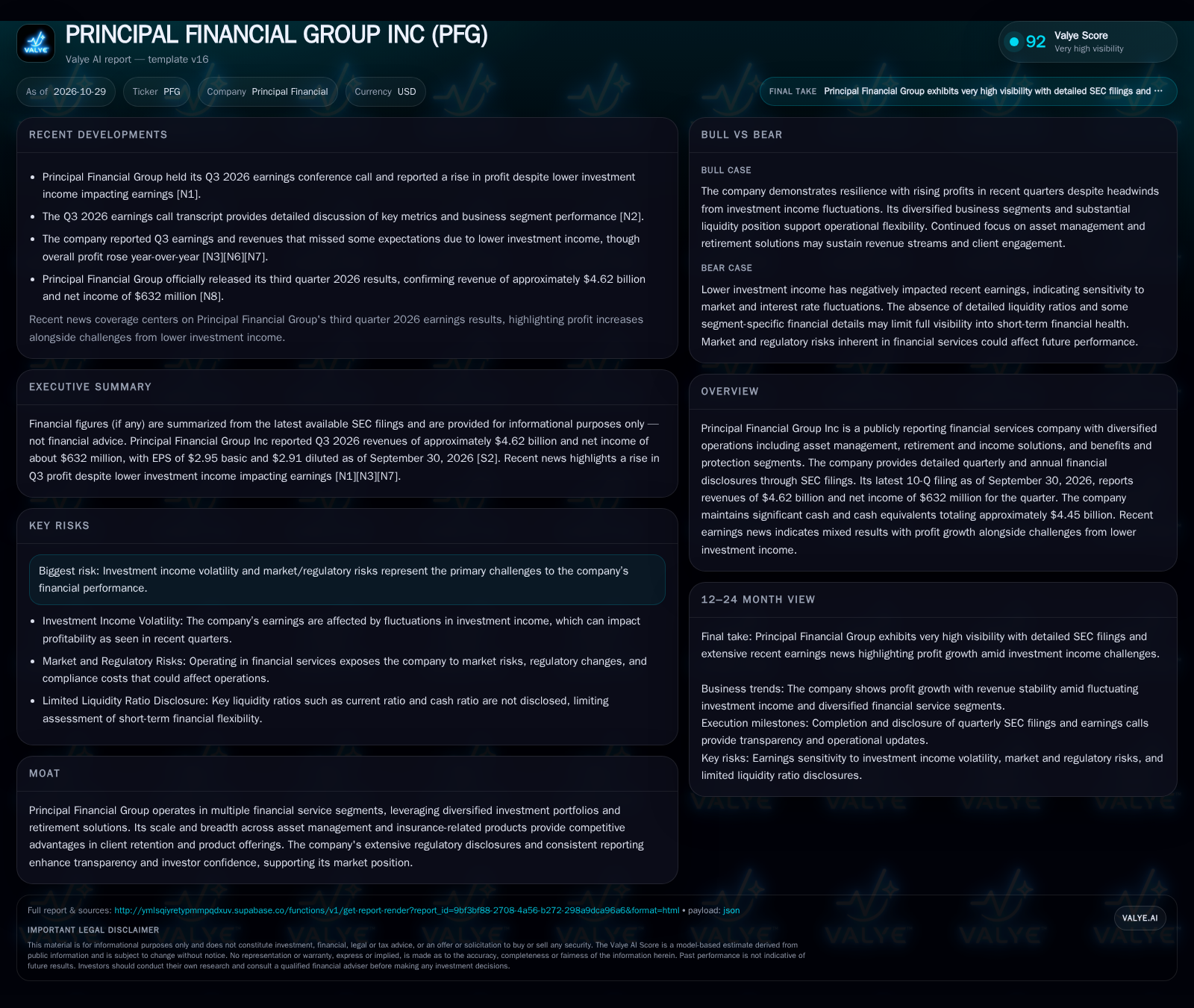
Principal Financial Group reported Q3 2026 revenues of $4.62 billion and net income of $632 million, with profit rising year-over-year despite lower investment income. The company’s diversified operations across asset management, retirement, and protection segments provide some insulation from market swings, but recent results highlight sensitivity to investment returns. The next phase hinges on segment-level execution, investment income normalization, and the evolving competitive landscape. [S2] [N1] [N3] [N6] [N7]
Principal Financial Group’s latest quarter underscores a central tension for diversified financials: the ability to grow profits even as investment income—a key revenue lever—fluctuates. While Q3 2026 saw net income rise year-over-year to $632 million on revenues of $4.62 billion, the company missed some analyst expectations due to lower investment returns. With a broad portfolio spanning asset management, retirement, and protection products, Principal’s multi-segment approach offers both a buffer and a source of complexity. The coming quarters will test whether Principal can convert its scale and diversification into durable, high-quality earnings in a volatile macro environment. [S2] [N1] [N3] [N6] [N7]
Quarterly Results Show Profit Gains Despite Investment Income Challenges
Principal Financial Group reported Q3 2026 revenues of $4.62 billion and net income of $632 million, with basic earnings per share of $2.95 and diluted EPS of $2.91. Despite overall profit rising year-over-year, the company missed consensus expectations due to lower investment income—a reminder of the importance of asset returns to the company’s business model. The company’s operations span asset management, retirement and income solutions, and benefits and protection, providing multiple revenue streams but also increasing complexity in performance attribution. [S2] [N1] [N3] [N6] [N7]
Understanding Principal Financial’s Revenue Drivers and Risks
Principal Financial Group’s revenue model is built on fee-based income from asset management, spread income from insurance and retirement products, and investment returns from its own portfolio. The asset management segment typically generates recurring fee income tied to assets under management (AUM), making it sensitive to both market valuations and net flows. Retirement and income solutions rely on net interest margins and longevity assumptions, while benefits and protection products (life, disability, etc.) blend premium income with underwriting and investment results.
Fixed costs include personnel, technology infrastructure, and regulatory compliance, while variable costs scale with distribution and sales activity. The company’s investment portfolio—comprising debt securities, mortgage loans, and related assets—introduces both yield opportunity and mark-to-market risk. In periods of rising rates or credit volatility, investment income can swing sharply, impacting both reported earnings and, potentially, capital adequacy. Operating leverage exists, but the degree to which it can be harnessed depends on stable net flows, disciplined underwriting, and the ability to manage investment risk without excessive capital consumption.
Capital needs in this model are ongoing: regulatory capital for insurance operations, seed capital for certain investment products, and reserves to manage claims and redemptions. [S2]
Assessing Principal’s Competitive Strengths in Financial Services
Principal Financial Group operates in fiercely competitive markets—asset management, retirement solutions, and group benefits—where scale, product breadth, and distribution relationships matter. Large diversified peers, as well as specialized asset managers and insurance companies, vie for institutional and retail clients. Principal’s advantage lies in its integrated offering: cross-selling between business lines, leveraging data and client relationships, and achieving cost efficiencies at scale.
However, the commoditization of investment products, regulatory scrutiny, and the rise of low-fee passive options erode traditional fee margins. Digital platforms and fintech disruptors heighten pressure on legacy distribution and customer engagement models. Switching costs in retirement and insurance products can be meaningful, but are not insurmountable—particularly as technology lowers barriers to comparison and transfer.
The durability of Principal’s ‘moat’ depends on its ability to deliver superior client outcomes, maintain trusted relationships, and innovate in product design and delivery. Its diversified revenue base provides some insulation from single-segment shocks, but also dilutes focus and may mask underperformance in lagging units.
Conditions for Principal’s Outperformance: Leveraging Segment Integration and Market Opportunities
The favorable scenario for Principal Financial Group involves stabilization or improvement in investment income, robust net flows into asset management, and disciplined underwriting in protection products. If market conditions support higher asset values and interest rates remain supportive for spread-based products without triggering credit losses, Principal could see outsized earnings growth. Effective cross-selling between segments—such as converting retirement clients into asset management or insurance customers—could enhance customer lifetime value and lower acquisition costs.
Confirmation would come from rising segment-level margins, sustained net inflows in asset management, and evidence of market share gains in retirement and protection. Disclosure of improved investment yield, positive operating leverage, and successful technological initiatives (such as digital onboarding or self-service platforms) would further support the upside. A key falsifier would be stagnating or negative net flows, persistent fee compression, or a lack of improvement in segment profitability despite favorable markets.
Projected Outcomes: Controlled Volatility Without Significant Growth Acceleration
The most plausible near-term path is that Principal Financial Group continues to deliver stable, if unspectacular, earnings—balancing periodic investment income swings with the benefits of diversification. Modest net flows, gradual fee compression, and competitive pricing in retirement and protection products characterize this environment. The company may maintain or slightly grow its top line, but margin expansion is limited by cost pressures and ongoing investment in technology and compliance.
This scenario is confirmed by continued positive, but not accelerating, net income and revenue; regular but limited product innovation; and stable, but not expanding, market share. Falsification would involve either a material deterioration in investment income (beyond industry trends) or an inability to defend fee and margin levels in core segments.
Consequences of Continued Investment Income Declines on Margins and Capital
A negative scenario would unfold if market volatility or credit events further depress investment income, exposing the company to earnings shortfalls and potential capital adequacy concerns. Fee compression in asset management and rising claims or surrenders in protection and retirement products could compound the pressure. In this environment, Principal may be forced to cut discretionary spending, slow product development, or even divest non-core units.
Confirmation would come from a sequential decline in net income, negative net flows, elevated claims or surrenders, and any management commentary on capital conservation or restructuring. Falsification would be indicated by a rebound in investment income, improved segment profitability, or evidence of successful cost mitigation offsetting top-line weakness.
Factors Influencing Principal’s Earnings Stability and Operational Strength
Segment-level profitability trends—especially in asset management versus retirement and protection—would help clarify where future earnings growth (or pressure) is concentrated, if disclosed.
Net flows in asset management and retirement products are leading indicators of client demand and revenue sustainability.
Investment portfolio yield and credit quality, as disclosed in future filings, will signal the company’s ability to manage market-driven income swings.
Fee margin trends across the business, if disclosed, would provide insight into competitive pressure and pricing power.
Expense ratios and cost discipline, particularly in technology and distribution, will affect operating leverage and margin resilience.
Regulatory or rating-agency commentary on capital adequacy, if mentioned, would help assess the company’s capacity to absorb shocks.
Product innovation pace and adoption—such as digital platforms or new insurance/retirement solutions—would indicate the company’s ability to adapt and grow in evolving markets.
Management guidance or commentary on liquidity deployment, capital allocation, or strategic priorities in upcoming earnings calls will be important for interpreting the direction of cash balances and risk appetite.
Disclaimer: This is research-only, informational analysis and not investment advice. It may include AI-generated interpretation and general industry context. Always verify important details using primary sources.

Comments