
Service Corporation International: Scale, Preneed Leverage, and the Realities of Deathcare Economics
Service Corporation International’s vast network and $17 billion preneed backlog provide revenue visibility in an industry with shifting consumer preferences and regulatory complexity.
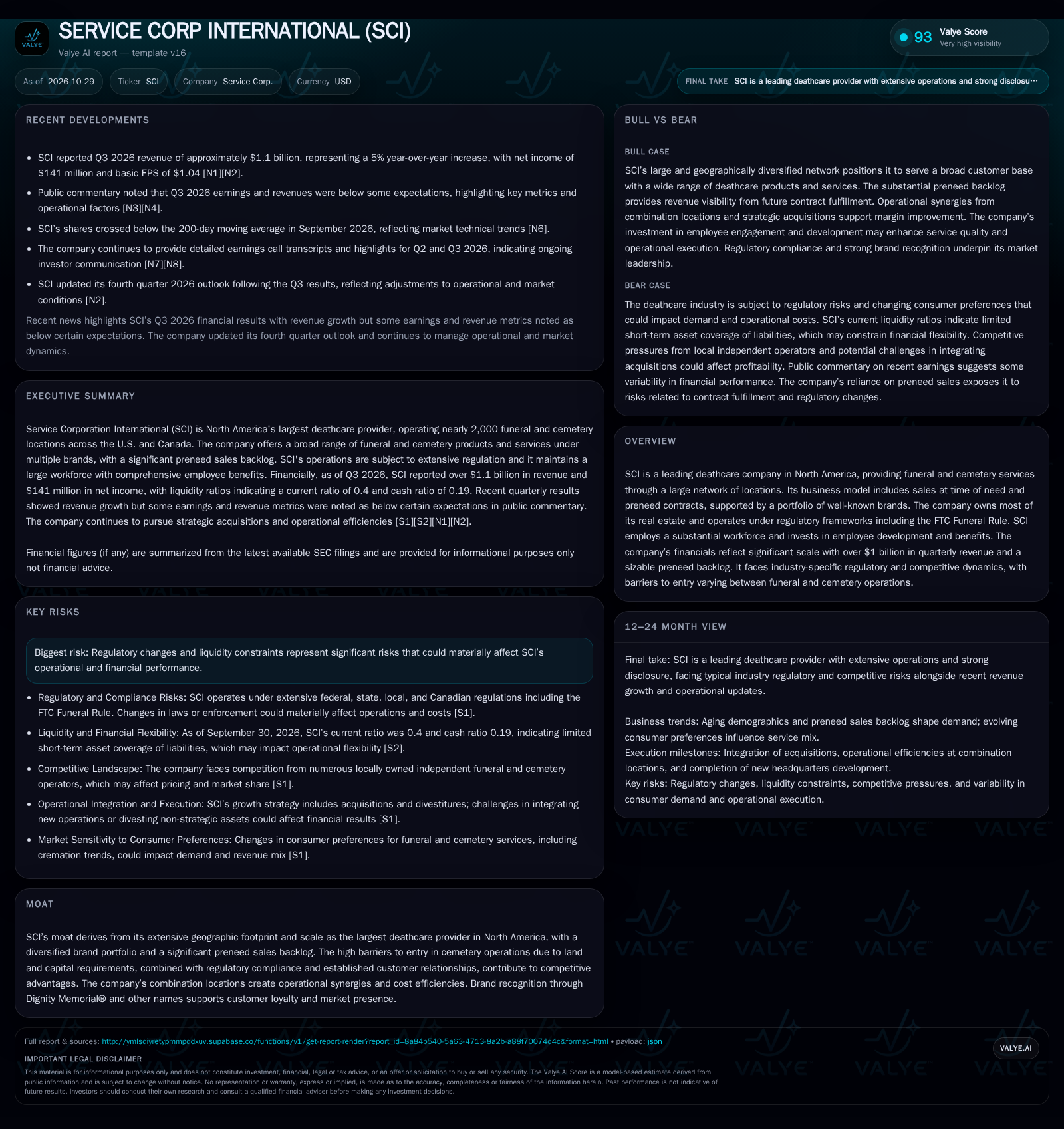
Service Corporation International (SCI) operates the largest deathcare network in North America, supported by strong brand breadth and a significant preneed contract backlog. While its scale and real estate ownership confer advantages, recent results highlight below-expectation earnings and reported liquidity position. The company’s ability to integrate acquisitions, manage evolving consumer trends, and address regulatory and financial pressures will shape its medium-term outlook. [S1] [S2] [N1] [N3] [N4]
Service Corporation International (SCI), North America’s largest deathcare provider, sits at the intersection of demographic inevitability and evolving consumer expectations. Its sprawling network, extensive brand portfolio, and $17 billion preneed backlog offer a degree of revenue predictability rare in many industries. As SCI navigates regulatory scrutiny, acquisition integration, and changes in how families approach end-of-life services, its ability to leverage scale and adapt its business model will determine whether it can sustain its leadership position or face margin erosion and competitive encroachment. [S1] [S2] [N1] [N2] [N3] [N4]
Recent Financial Performance and Preneed Backlog Shape the Near-Term Landscape
SCI reported Q3 2026 revenue of $1.107 billion, a 5% year-over-year increase, but both earnings and revenue fell short of some analyst expectations. Net income for the quarter was $141.3 million, with diluted EPS of $1.03. As of September 30, 2026, the company’s liquidity position included $172.7 million in cash and equivalents, a current ratio of 0.4, and a cash ratio of 0.19, reflecting limited short-term asset coverage relative to liabilities. The preneed backlog—future funeral and cemetery contracts not yet fulfilled—stood at $17.0 billion at year-end 2025, providing a significant source of future revenue. SCI’s shares also crossed below their 200-day moving average in September, reflecting market caution. These facts highlight a business with substantial embedded demand but also real operational and financial pressures. [S1] [S2] [N1] [N3] [N4] [N6]
How SCI Monetizes Deathcare: Revenue Streams, Margins, and Capital Intensity
SCI’s economics are anchored in two core revenue streams: at-need services (immediate arrangements) and preneed contracts (advanced sales of funeral and cemetery services). Preneed contracts not only provide future revenue visibility but also enable the company to collect funds in advance, which are typically held in trust or insurance products until service delivery. The mix between high-margin cemetery operations—where SCI owns 90% of its real estate—and more commoditized funeral services influences blended margins. Combination locations (funeral home plus cemetery) offer operational synergies and cross-selling opportunities, but also require substantial upfront capital for land and facilities.
The capital structure is asset-heavy, with significant fixed costs tied to real estate and regulatory compliance. Operating leverage is present but sensitive to volume fluctuations, as fixed overhead must be absorbed across variable numbers of services. SCI’s scale allows for some purchasing and administrative efficiencies, yet the need to continually invest in acquisitions, maintenance, and regulatory adaptation means capital allocation discipline is critical. The company’s modest current ratios suggest that while the business generates substantial cash flow over time, liquidity can tighten during periods of investment or operational stress. [S1] [S2]
Scale, Brand Portfolio, and Barriers—But Local Competition Remains Fierce
SCI’s estimated 18% North American market share by revenue is underpinned by its vast network and multi-brand strategy, with well-known names such as Dignity Memorial® and Neptune Society™. The company’s dominance in cemetery operations is protected by substantial barriers to entry—namely land acquisition, permitting, and capital outlays. In contrast, funeral services exhibit lower barriers, and SCI faces persistent competition from thousands of local independents, many with deep community ties and pricing flexibility.
Brand recognition and geographic breadth confer advantages in marketing, procurement, and the ability to serve corporate and institutional contracts. However, these strengths are partly offset by the industry’s fragmented nature and the risk that local operators can undercut on price or deliver more personalized service. The rise of alternative service models (e.g., direct cremation, online planning) could also erode traditional advantages if SCI cannot adapt its service mix and delivery model accordingly. [S1]
Synergy Gains and Consumer Preferences Could Boost Margins
A favorable scenario for SCI would see robust preneed contract conversion, effective integration of acquisitions, and successful adaptation to evolving consumer preferences—such as higher-margin cremation services or value-added memorialization products. If operational efficiencies at combination locations are realized, and if SCI can leverage its brands to capture a greater share of the preneed market, margins could expand even as the overall volume environment remains stable or grows modestly with demographic trends.
Confirmation would come from sequential margin improvement, growth in average revenue per service, and evidence that recent acquisitions deliver synergies without integration disruptions. Accelerating preneed sales and a rising proportion of higher-margin service offerings would also support the bull case. Greater disclosure on contract fulfillment rates, customer retention, and successful up-selling of new service formats would further validate the upside thesis. [S1] [N2]
Demand Stability Counters Rising Costs and Competitive Dynamics
The most plausible path for SCI is one in which demographic tailwinds (aging population, stable death rates) provide a predictable baseline for at-need and preneed services, but revenue growth is partially offset by rising wage, regulatory, and integration costs. The preneed backlog continues to convert at historical rates, but shifts toward lower-cost cremation and increased price competition from local independents constrain pricing power.
Under this scenario, SCI maintains modest revenue growth and stable—if pressured—margins, while using selective acquisitions to replace attrition and expand in markets with favorable demographics. Confirmation would come from persistent mid-single digit revenue growth, stable or slightly contracting margins, and continued acquisition activity. Falsification would be signaled by accelerating margin compression, meaningful declines in preneed sales, or operational disruptions tied to integration missteps or regulatory changes. [S1] [S2] [N1] [N2]
Operational Risks from Liquidity and Regulatory Changes
A negative scenario would involve a convergence of regulatory tightening (e.g., changes to trust requirements, consumer protection, or environmental rules), unexpected preneed contract fulfillment costs, or a sharp shift in consumer preferences toward low-cost providers. In this context, SCI’s low current and cash ratios could translate into operational strain, forcing the company to limit investment, sell assets, or take on expensive financing.
Integration failures following acquisitions or a major compliance failure could further erode margins and harm reputation. Confirmation of the bear case would include covenant breaches, asset sales to raise liquidity, sustained negative earnings surprises, or a material decline in market share. A spike in regulatory costs or a sharp drop in preneed sales conversion would also be red flags. [S1] [S2] [N3] [N4]
SCI’s Competitive and Financial Trajectory Depends on These Dynamics
Preneed contract conversion rates and fulfillment timing—particularly any deviation from historical patterns or changes in regulatory requirements affecting preneed funding and recognition—would help test the resilience of future revenue streams if disclosed.
Trends in average revenue per service, especially the mix shift between traditional funeral, cremation, and memorialization products, as a proxy for margin trajectory.
Integration progress and realized synergies from recent acquisitions, including any disclosed cost savings or disruptions.
Quarterly and annual margin trends, with an emphasis on gross and operating margins relative to wage, real estate, and compliance cost inflation.
Liquidity management actions, such as new financings, asset sales, or changes to dividend or buyback policies, in light of modest current and cash ratios.
Market share changes across major metro areas or specific service lines, particularly if SCI begins to lose ground to local or digital-first competitors.
Regulatory developments at the federal, state, or provincial level—especially those impacting preneed trust accounting, consumer disclosures, or environmental standards.
Employee retention and labor relations data, as wage pressures and service quality are both material to the business model, if disclosed.
Disclaimer: This is research-only, informational analysis and not investment advice. It may include AI-generated interpretation and general industry context. Always verify important details using primary sources.

Comments