
BILL Holdings: Navigating the Growth-Profitability Conundrum in SMB Expense Management
BILL Holdings struggles to translate robust revenue growth into sustainable profitability amid a fiercely competitive SMB expense management landscape.
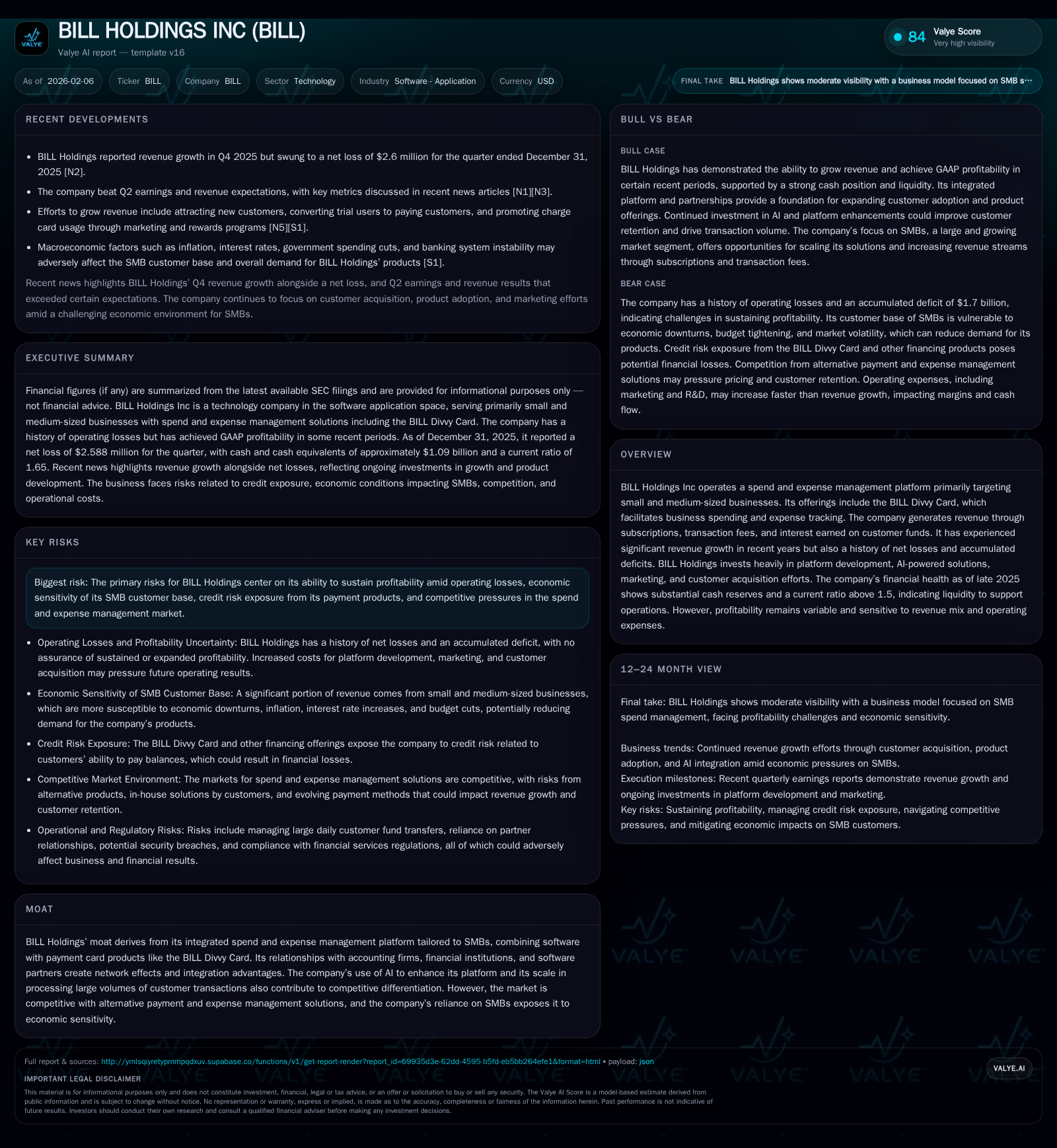
BILL Holdings Inc has demonstrated strong revenue momentum fueled by its integrated spend and expense management platform designed for small and medium-sized businesses. Despite this, the company continues to grapple with consistent net losses driven by heavy investments in technology, AI enhancements, and customer acquisition. Its moat rests on embedded payment solutions like the BILL Divvy Card coupled with strategic partnerships, though economic sensitivity of its SMB customer base and credit risk from its payment products introduce notable challenges. The path forward demands disciplined execution to scale profitably without undermining growth.
High Growth Meets Profitability Hurdles: A Delicate Balance
BILL Holdings Inc's narrative is one of stark contrasts—on one hand, its financial disclosures reveal impressive top-line acceleration; on the other, consistent net losses highlight persistent challenges in marrying growth with profitability. The company reported meaningful revenue gains in Q4 2025 even as it swung back into net loss territory [N2]. This duality underscores a fundamental tension: aggressive investments intended to solidify market position and expand client adoption continue to pressure margins.
Such dynamics are not unusual for tech-enabled financial services firms targeting SMBs—a sector prized for its size yet notoriously difficult due to smaller account sizes and higher churn risk. For context, BILL ended calendar year 2025 with net losses of approximately $2.6 million despite nearing or surpassing revenue milestones analysts watch closely [F1]. This suggests that while top-line metrics comfort investors, bottom-line improvement remains elusive.
Decoding the Latest Earnings: Revenue Strength Amid Operating Losses
Dissecting the latest earnings reveals nuanced trends shaping BILL's financial trajectory. The Q2 report reflected beats on both earnings and revenue estimates [N3], driven by stronger-than-expected subscription growth linked to deeper platform adoption. However, these gains were counterbalanced by sustained high operating expenses—spanning AI development initiatives, marketing campaigns focused on increasing charge card usage, and expanded customer support infrastructure.
Liquidity metrics offer a silver lining; the company boasted cash and equivalents north of $1 billion at year-end, alongside a current ratio near 1.65—comfortably above typical benchmarks for operational runway [F1]. Such financial flexibility affords management time to recalibrate spending without immediate solvency concerns. Yet, underlying operational leverage means any deceleration in revenue could quickly pressure cash flow.
The fine line BILL must tread is between fueling growth-enabling functions like R&D and marketing versus tightening the cost structure enough to push toward positive operating income—something investors anticipate as critical to valuation inflection.
The Moat in Motion: Platform Integration and AI-Driven Differentiation
At the heart of BILL’s competitive edge lies its fully integrated spend management ecosystem marrying SaaS capabilities with embedded payment cards—the BILL Divvy Card serves as both a transaction facilitator and data collection tool enriching spend analytics [valye_report_excerpt]. This blurring of software and fintech creates switching costs often difficult for competitors focusing solely on software or payments.
Moreover, BILL leverages AI-powered features that automate expense categorization, detect fraud patterns, and optimize budgeting workflows enhancing user efficiency. These AI elements are not mere add-ons but core pillars that deepen engagement.
Strategic alliances with accounting firms and financial institutions further buttress the platform’s stickiness through interoperable integrations within clients’ broader financial stacks [S2]. Such network effects can stave off commoditization even amidst an increasingly crowded field lined by legacy software firms expanding offerings and newer fintech entrants targeting niche segments.
SMB Market Dynamics: Opportunity and Economic Sensitivity
Focusing predominantly on small- to medium-sized businesses positions BILL within a vast addressable market characterized by fragmented technology adoption and significant upside potential [valye_report_excerpt]. However, this clientele also tends to be more sensitive to economic cycles; downturns can constrict their spending budgets impacting subscription renewals and transaction volumes.
Macroeconomic shifts directly influence customer cash flow resilience—inhibiting their ability to carry balances on payment cards or engage in invoice financing programs sustained by BILL [S2]. Consequently, revenue streams exhibit variability tied closely to broader economic conditions beyond company control.
In this light, while the SMB market offers growth fuel, it simultaneously imposes volatility which makes forecasting less predictable compared to enterprise-focused peers.
Credit Risk and Financial Stability: Managing Exposure in Payment Products
A key dimension of BILL’s model involves extending credit-like features via its Divvy Card product. This exposes the company to credit risk stemming from business customers potentially defaulting or delaying payments—risks amplified during economic slowdowns or within more financially fragile SMB segments [valye_report_excerpt].
Invoice financing services add another layer of exposure where nonpayment or fraudulent invoicing can disrupt expected cash flows.
To mitigate these risks, BILL employs multifaceted risk management frameworks including advanced AI-driven fraud detection algorithms aimed at early identification of suspicious activities [S2]. Still, inherent uncertainties in underwriting smaller business credit underline a persistent vulnerability that requires constant monitoring as scale expands.
Strategic Investment in Innovation and Customer Acquisition
The narrative of elevated operating costs finds roots largely in deliberate strategic investments aimed at future-proofing the platform through ongoing R&D focused heavily on AI enhancement [valye_report_excerpt]. Additionally, sizable marketing spends seek to boost brand recognition among target customers while incentivizing use frequency through rewards programs tied to card transactions.
Though essential for building differentiation and expanding market share, these expenditures weigh heavily against near-term profitability objectives—a classic double-edged sword faced by companies innovating in competitive fintech sectors [S2]. Carefully balancing pace of innovation investment relative to realized returns will be pivotal going forward.
Competitive Pressures and Partner Ecosystem Dependencies
BILL operates amidst intensifying competition ranging from established SaaS expense management providers broadening product suites toward integrated payment solutions, to pure-play fintech startups innovating rapidly on user experience dimensions [valye_report_excerpt]. This competitive density necessitates continuous enhancement lest client acquisition slows or attrition creeps upward.
Moreover, much of BILL’s value accrues through symbiotic relationships with partner banks facilitating card issuance and financing arrangements alongside collaborations with accounting firms enabling seamless workflow integration [S2]. While these allies reinforce platform utility they also introduce risks related to reliance—shifts in partner priorities or terms could materially impact service delivery or cost structures.
Navigating these external dependencies carefully will be as much a managerial challenge as building direct customer loyalty.
Risks Lurking Behind The Numbers: What Investors Should Watch
A granular examination of disclosed risks spotlights several interlocking threats requiring vigilance. Chief among them is the company’s prolonged history of net losses despite rapid top-line expansion underscoring operating leverage vulnerabilities [S2]. Sustained inability to shift this dynamic could impair long-term viability under competitive pressure.
Economic sensitivity inherent in predominantly SMB revenue exposes BILL cyclically; downturns impairing customer cash flows directly jeopardize subscription retention and payment product usage thereby compressing revenues further [S2].
Credit risk linked to spending balances extends beyond standard fintech exposure given volume of funds transferred daily creating reputational hazard if breaches or fraud occur. Reliance on partners—banks, accounting firms—heightens operational risk complexity potentially affecting customer satisfaction unexpectedly [S2]. Finally technological execution risk surrounding successful deployment of increasingly sophisticated AI tools poses both upside opportunity and downside legal/reputational consequences if not properly managed.
Looking Ahead: Scaling Profitably Without Sacrificing Growth
The road forward for BILL Holdings lies in deftly integrating three imperatives: sustaining innovative platform enhancements fueled by AI capabilities; prudently managing credit exposures intrinsic to expanding payment products; and imposing sharper discipline around sales & marketing efficiency alongside cost containment efforts [valye_report_excerpt][N1][N3][S2].
Successfully navigating this requires not merely pushing for growth at all costs but prioritizing profitable unit economics even if that tempers near-term topline expansion velocity. Market leadership within SMB spend management demands demonstrating durable value creation evidenced by improved margins accompanied by stable recurring revenues anchored on high retention rates.
Execution risks remain nontrivial given economic uncertainty impacting smaller business clients coupled with evolving competitive landscape relying heavily on maintaining partner trust. Yet BILL’s formidable liquidity position coupled with distinct integration advantages provides a foundation upon which thoughtful strategic choices may steer it beyond cyclical pitfalls toward sustainable profitability.
This analysis synthesizes publicly available company filings as of early 2026 along with reported industry events without providing investment advice or recommendations. Readers should consider this discussion as contextually informative rather than prescriptive regarding securities decisions.
Disclaimer: This is research-only, informational analysis and not investment advice. It may include AI-generated interpretation and general industry context. Always verify important details using primary sources.

Comments