
Bio Essence Corp Boosts Revenue Through Strategic Software Acquisition While Managing Liquidity Pressure
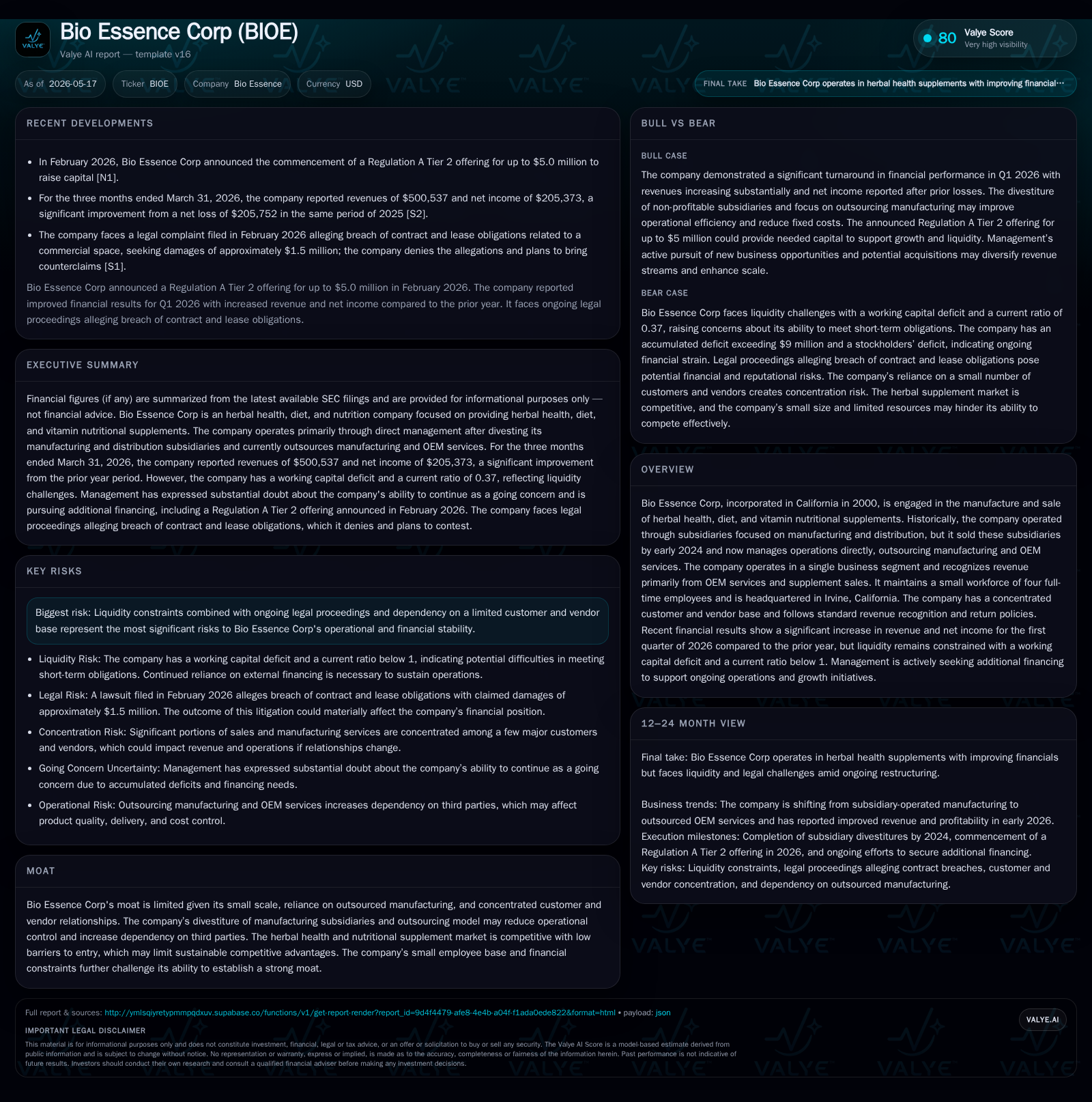
Bio Essence Corp's Q1 2026 results reflect revenue growth and net profitability alongside a major AI software acquisition, offset by persistent liquidity challenges and legal disputes.
In the first quarter of 2026, Bio Essence Corp reversed prior losses with a significant net income swing fueled by higher OEM supplement sales and tighter expense control. The April acquisition of MediFlow AI software represents a strategic move to diversify offerings beyond traditional herbal supplements. Despite improved earnings, the company grapples with a substantial working capital deficit and ongoing litigation related to lease and contract breaches. Its operational shift from owning manufacturing subsidiaries to an outsourced OEM model enhances flexibility but deepens dependencies on concentrated vendors and customers in a competitive low-moat industry.
Q1 2026 Operating Results Signal Positive Momentum
Bio Essence Corp’s latest quarterly filing dated May 15, 2026, marks a notable turnaround in financial performance [S7]. For the three months ended March 31, 2026, the company reported net income of $205,373 compared to a net loss of $205,752 in the comparable period last year—representing nearly a 200% improvement [S2, S7]. This shift was primarily driven by increased revenues from OEM supplement services alongside disciplined expense management. Cost of revenues rose to $181,184 reflecting higher sales volume but general and administrative expenses dropped substantially by over $122K year-over-year partly due to lower office rents and consulting fees
Credit risk remains conservatively managed as Bio Essence maintains a policy for allowances on accounts receivable; notably no bad debt allowance was required as of both March 31, 2026 and December 31, 2025 indicating solid collection quality despite customer concentration [S2]. However, revenue remains highly concentrated with one major customer comprising nearly half (49.9%) of total sales this quarter versus five customers sharing roughly similar proportions across last year's period—a change signaling deepened dependency [S4]. At the supply side, two key vendors accounted for over 95% of outsourced manufacturing services indicating manufacturing reliance is quite centralized as well [S4].
Business Model Evolution Post-Subsidiary Divestitures
Originally structured through subsidiaries handling manufacturing (BEP) and distribution (BEH), Bio Essence divested these production-focused arms by early 2024 after selling BEP in December 2023 for $300K and BEH in March 2024 for $400K [S1]. The company currently operates with a lean structure of just four full-time staff headquartered in Irvine, California, directly managing sales and OEM customer relationships while outsourcing all manufacturing operations to third-party vendors [S1, S2].
This operational pivot reduces fixed costs associated with in-house production facilities but increases exposure to supply chain risks given vendor concentration. The company specializes exclusively in herbal health supplements sold mostly through OEM services under one business segment showing limited diversification but focused expertise [S1, S4]. Such outsourcing is typical among smaller supplement firms aiming for asset-light operations though it inherently cedes some quality control and supply chain leverage.
Competitive Environment in Herbal Health Supplements
Bio Essence’s competitive environment is shaped by a highly fragmented market with low barriers to entry in herbal nutritional supplements. The company faces pressure from numerous competitors producing commoditized products that limit pricing power [S1]. With only four employees and no direct manufacturing capacity following divestitures, Bio Essence’s scale disadvantages hamper proprietary innovation potential or extensive marketing reach
Additionally, customer and vendor concentration further expose the firm operationally—typical vulnerabilities for small players reliant on few key relationships. Given the limited breadth of products confined largely to herbal supplement formulas under OEM arrangements, differentiation within functional or brand parameters is constrained.
Strategic Acquisition of MediFlow AI: Implications and Ambitions
On April 20, 2026, Bio Essence entered an Asset Purchase Agreement acquiring MediFlow AI software from Zhituo Software Co., Limited based in Hong Kong [S3,S8]. This included ownership rights to all software codebases, architecture frameworks, data sets, application program objects (APOs), and related IP valued at approximately $3.5 million via issuance of 7 million shares at $0.50 each
This move signals an ambitious step towards integrating digital health technologies into Bio Essence’s primarily herbal supplement-based portfolio—potentially enabling new product offerings blending AI-powered diagnostics or health monitoring alongside traditional supplements. The acquisition suggests management seeks to diversify revenue beyond physical consumables into technology-enabled solutions that could enhance customer engagement or open novel OEM partnerships.
Growth Prospects Driven by Innovation and Market Demand
Bio Essence’s recent top-line improvements are underpinned primarily by enhanced OEM service sales reflecting successful deployment of outsourced manufacturing resources [S2]. The addition of MediFlow AI could serve as an incremental driver if effectively integrated into marketing or product development strategies enabling value-added offerings.
While scale remains limited—with just four employees servicing OEM clients—the combination of technology assets with traditional supplement manufacturing might carve out niche use cases or specialized client segments requiring blended health tech products. The lawsuit seeks damages exceeding $1.5 million which Bio Essence disputes but acknowledges as probable loss exposure reflected in accrued lease liabilities [S1, S9]. This litigation adds material uncertainty about future cash outflows potentially impacting operational continuity.
Vendor concentration also intensifies supply chain risks; reliance on two primary manufacturers accounting for more than 95% outsourcing creates dependency bottlenecks that may affect delivery timelines or cost efficiency.
Upcoming Milestones and Watchpoints for Execution
Crucial near-term factors include monitoring developments in ongoing litigation concerning lease payments—outcomes here will materially affect expense forecasts and balance sheet contingencies [S9]. Additionally crucial is tracking how effectively the newly acquired MediFlow AI software assets integrate into Bio Essence’s product/service mix—measurable indicators would be new client acquisitions using AI-enhanced offerings or licensing revenues.
Operationally the company needs to manage working capital pressures prudently while pursuing vendor/customer diversification initiatives to mitigate concentration risks highlighted in recent quarters’ disclosures [S2,S4,S5,S27]. Financing activities generated about $448K inflow largely from shareholder equity issuance offsetting loans repaid during Q1 supporting operational cash burn requirements.
Accounts receivable remain concentrated but without need for credit loss allowances signaling ongoing collectability strength despite economic headwinds [S2]. However persistent deficit funding requirements highlight ongoing dependency on equity infusion or external financing lines which carry dilution or debt risk.
In conclusion, while Bio Essence demonstrates renewed profitability momentum strengthened by strategic AI asset acquisition offering future upside potential within a demanding low-moat market segment; liquidity constraints coupled with legal uncertainties present significant near-term execution challenges requiring vigilant capital stewardship alongside tactical expansion efforts.
This analysis is based solely on publicly filed SEC documents as referenced; it does not constitute investment advice or research views.
Financial position in context
Current assets of $788,994 and current liabilities of $2,160,871 imply a current ratio near 0.37x for 2026-03-31 [F1]
Disclaimer: This is research-only, informational analysis and not investment advice. It may include AI-generated interpretation and general industry context. Always verify important details using primary sources.

Comments