
Adicet Bio Advances Clinical Programs with Solid Liquidity Backing Development
The latest quarterly filing highlights significant clinical enrollment growth and regulatory progress for Adicet Bio, supported by a strong liquidity position enabling ongoing pipeline advancement in autoimmune and oncology indications.
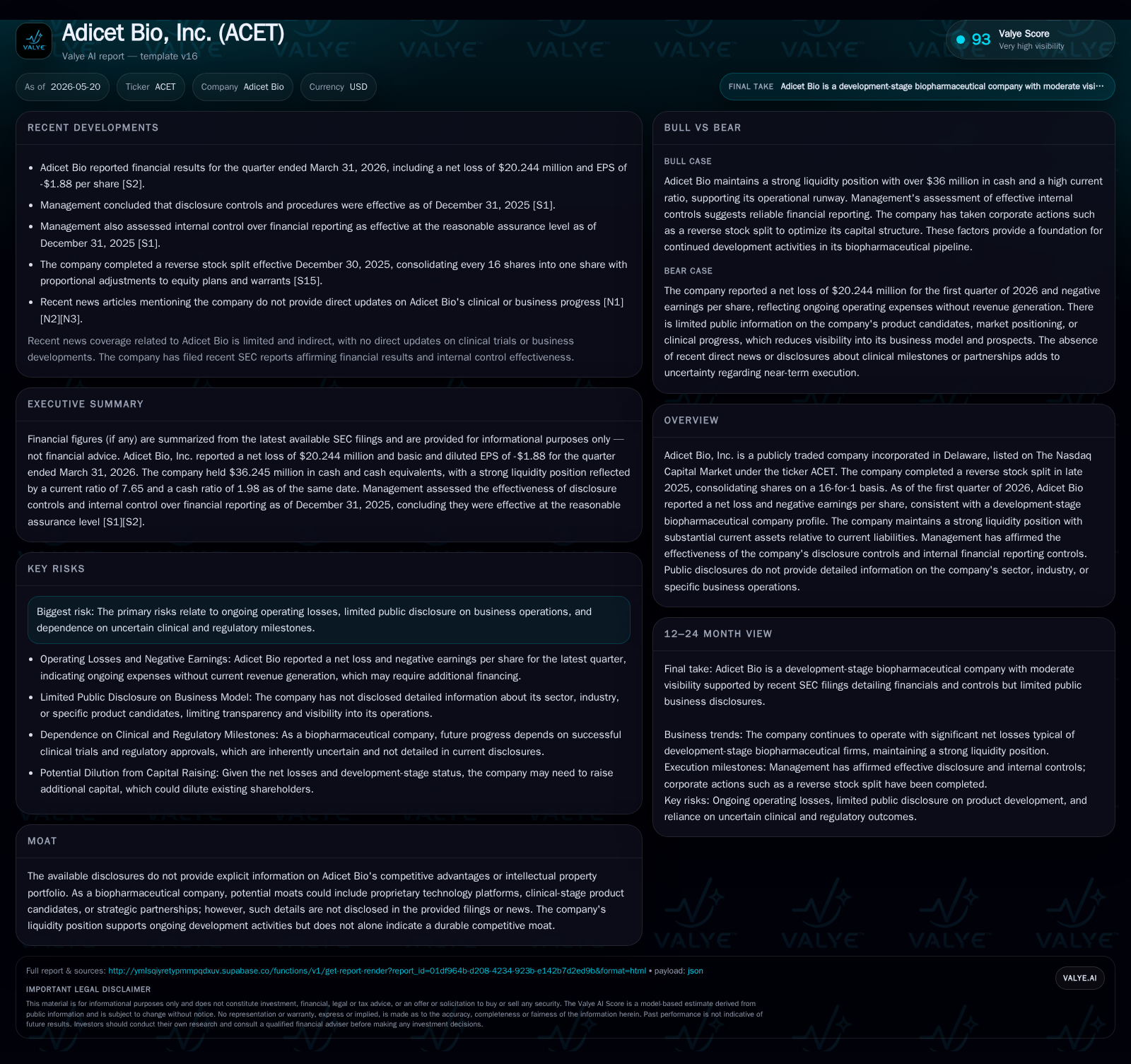
Adicet Bio’s Q1 2026 update reveals operational momentum marked by doubling enrollment in its prula-cel Phase 1 trials for autoimmune diseases and FDA agreement on outpatient dosing protocols. The company targets a regulatory filing for ADI-212 in metastatic castration-resistant prostate cancer within H1 2026, signaling pipeline maturation. With cash and equivalents of $36.2 million and a current ratio of 7.65, Adicet maintains robust short-term financial resources to support clinical development despite continued operating losses typical of early-stage biopharma [S2][S3][S6][F1].
Recent Operating Update Highlights Clinical Progress and Financial Strength
Adicet Bio’s latest quarterly report (10-Q filed May 13, 2026) underscores meaningful operational advances alongside a solid financial footing. Enrollment in the company’s lead autoimmune candidate, prulacabtagene leucel (prula-cel), doubled to more than 20 patients by December 31, 2025, demonstrating improved patient recruitment critical for clinical momentum [S2][S3]. Concurrently, the FDA agreed to permit outpatient dosing for patients with lupus nephritis and systemic lupus erythematosus participating in current and future trials. This regulatory alignment reduces logistical challenges and patient burden compared with inpatient dosing, potentially accelerating trial timelines and scalability [S6]. Management intends to engage the FDA in Q2 2026 to discuss Phase 2 pivotal trial design considerations—an essential step toward registrational data generation [S6].
In parallel, Adicet is preparing to file a regulatory submission for ADI-212 targeting metastatic castration-resistant prostate cancer within the first half of 2026 [S6]. This signals progress beyond autoimmune indications into oncology, reflecting pipeline diversification
Financially, the company reported cash and equivalents of approximately $36.2 million as of March 31, 2026, complemented by current assets totaling $140 million against current liabilities near $18.3 million [F1]
Business Model Focused on Engineered Cell Therapies Addressing Unmet Medical Needs
Adicet Bio operates as a development-stage biotechnology firm specializing in allogeneic engineered T-cell therapies targeting autoimmune diseases and cancer. The business model emphasizes advancing proprietary cellular products through complex clinical trials toward potential regulatory approval and commercialization; currently, no products are marketed nor generate revenue [S1]
Its lead candidate prulacabtagene leucel (prula-cel) leverages allogeneic T-cell technology aimed at modulating immune dysfunction in diseases such as lupus nephritis where treatment options are limited or toxic. ADI-212 pursues adoptive cell therapy approaches tailored against tumor antigens in metastatic castration-resistant prostate cancer [S1][S6].
Revenue generation is contingent on successful trial outcomes leading to regulatory approvals; meanwhile, operations rely heavily on capital markets funding given absence of commercial sales.
Industry Positioning: High Complexity Sector with Significant Barriers
The cell therapy sector is characterized by scientific complexity, manufacturing scale-up challenges, stringent regulatory oversight, and reimbursement uncertainties. While specific patent or platform protections were not detailed in filings, Adicet’s focus on off-the-shelf allogeneic T-cell therapies aligns with industry efforts aiming for scalable alternatives to autologous approaches—a rapidly evolving but high-risk segment [S1].
Regulatory pathways demand careful management of safety risks such as cytokine release syndrome or graft-versus-host disease inherent to gene-modified cell therapies. Manufacturing capabilities must meet Good Manufacturing Practice standards while scaling production—a critical operational risk factor.
Limited disclosure on competitive landscape or partnerships constrains assessment of relative positioning but reflects typical early-stage biotech transparency.
Growth Drivers Anchored in Clinical Execution and Regulatory Milestones
Key growth catalysts include accelerated enrollment in prula-cel’s Phase 1 trials indicating improved site activation and patient recruitment efficiency—vital metrics for timely data acquisition [S3][S6]. The FDA’s concurrence on outpatient dosing reduces trial complexity and could improve patient retention.
Upcoming FDA meetings planned for Q2 2026 focused on pivotal Phase 2 trial design represent important milestones defining evidentiary requirements for marketing authorization prospects [S6]. Additionally, the anticipated regulatory filing for ADI-212 within mid-2026 marks advancement toward potential accelerated approval pathways if clinical benefit is demonstrated.
These operational milestones serve as critical performance indicators driving valuation inflections beyond purely financial measures.
Risks and Watchpoints: Developmental Uncertainty and Capital Needs
Adicet faces common biopharmaceutical risks including sustained operating losses (approximately $122 million operating loss as of December 31, 2025) reflecting intensive R&D spending without product-derived income [F1]. Delays or safety issues in clinical trials could extend timelines and increase cash burn.
Regulatory approvals remain uncertain given novel biologics’ complexity. The firm’s disclosures provide limited visibility into patent protection strength or competitive differentiation [S1][S2].
Advancing late-stage trials may necessitate additional capital raises or partnerships with potential dilution or unfavorable terms depending on market conditions.
Near-Term Events to Monitor
Investors should track subsequent quarterly updates detailing further enrollment progress beyond initial Phase 1 cohorts. Outcomes from Q2 FDA interactions will be key signals regarding pivotal study designs influencing development timelines.
The timing and substance of ADI-212’s regulatory submission during H1 2026 will also be material to assessing pipeline breadth.
Operational execution around manufacturing scale-up readiness alongside announcements related to strategic collaborations or financing will further clarify capacity to sustain advancement programs [S3][S6]
Financial Summary Supports Ongoing Development Efforts
Reflecting its developmental stage, Adicet reported no revenues but recorded substantial operating losses totaling approximately $122 million at year-end December 31, 2025; net loss was about $117 million during the same period [F1]. The March quarter-end balance sheet shows cash reserves near $36.2 million with strong liquidity metrics (current ratio ~7.65), underpinning short-term solvency [F1].
This financial profile enables continued investment in clinical development but necessitates vigilance regarding cash consumption rates relative to milestone achievements.
This analysis is based exclusively on publicly available SEC filings through May 20, 2026. It provides an operational perspective grounded in documented disclosures consistent with biopharmaceutical sector dynamics but does not constitute investment advice.
Disclaimer: This is research-only, informational analysis and not investment advice. It may include AI-generated interpretation and general industry context. Always verify important details using primary sources.

Comments