
Dynatrace Integrates AI and Observability to Enhance Cloud Operations
Dynatrace’s latest quarter underscores its advancing AI-driven platform designed for hybrid and multicloud observability, strengthening its competitive moat and positioning for sustained growth.
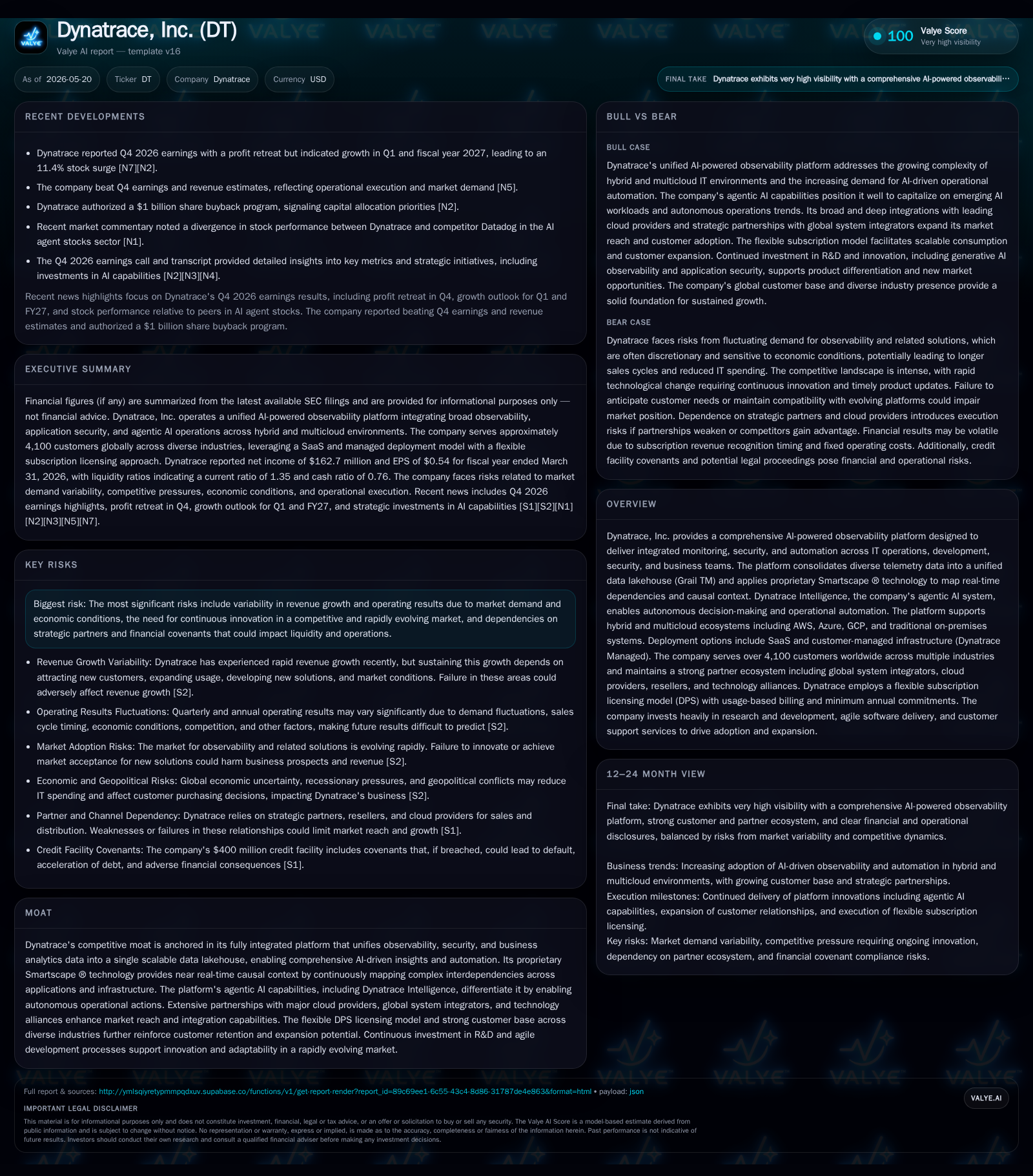
In its latest quarterly report, Dynatrace demonstrated sustained revenue growth driven by expanded customer adoption of its AI-powered observability platform. The company’s unified data lakehouse, real-time causal mapping, and agentic AI automation establish it as a differentiated player in a competitive, evolving market. Growth hinges on cloud modernization trends, increased software complexity, and deeper integration of autonomous AI operations. However, future expansion faces risks from rapid technological change, intensifying competition, and dependencies on strategic partnerships. Upcoming milestones to watch include billings growth indicators, partner ecosystem expansion, and product innovation cadence.
Latest Quarterly Highlights: Operational Momentum and Innovation
Dynatrace’s most recent quarterly filing (10-Q dated February 9, 2026) confirms sustained operational strength with approximately 19% revenue growth year-over-year. The company reported solid operating income performance that reflects disciplined expense management balancing ongoing investments in R&D for platform enhancements. Management highlights ongoing expansion in customer count and adoption intensity within existing accounts as key contributors to this growth trajectory [S2]. The subsequent May 13 event filing (8-K) reinforced these themes during the fiscal year-end earnings call: despite profit margin pressures late in the quarter due to increased investment spending, forward-looking commentary signaled confidence in demand resilience across core markets [S3][N1][N2]. This near-term momentum matters because it validates Dynatrace’s ability to execute in an increasingly complex hybrid cloud environment where demand for scalable observability with AI-powered autonomy is rising.
Business Model and Platform Architecture: Unified Observability Meets Agentic AI
At its core, Dynatrace generates revenue principally through subscription licensing of its integrated SaaS platform designed for hybrid and multicloud environments. Customers — predominantly among the largest global enterprises — pay for access to comprehensive telemetry ingestion including logs, traces, metrics, user session data, events, and more consolidated within Grail TM, the company’s scalable data lakehouse that obviates traditional indexing or schema design overheads [S1][S19]. This unified data foundation enables higher-quality AI insights by leveraging a continuously updated single data layer.
Strategically differentiating Dynatrace is the Smartscape ® technology that builds real-time causal dependency graphs capturing billions of relationships spanning applications to infrastructure components. This capability offers enterprises not just monitoring but contextual understanding of "why" issues occur — essential for effective root cause analysis [S1][S19]. Building on this foundation is Dynatrace Intelligence: an agentic AI system capable of autonomous operational decisions without human intervention. This agentic approach contrasts with competitors providing fragmented dashboards or static alerts by enabling automated remediation workflows grounded in causal context.
The company’s multi-deployment options — SaaS-hosted or customer-managed clusters — combined with broad support for AWS, Azure, GCP hyperscalers plus legacy on-premises infrastructure reflect its architectural flexibility crucial to addressing varied IT estates [S1]. Its agile development pipeline with full test automation ensures frequent high-quality releases that keep pace with rapid technology shifts while improving product quality [S4].
Industry Structure: Competitor Landscape and Market Positioning
The observability market targeting hybrid/multicloud IT environments is intensely competitive with a fragmented set of players ranging from niche specialists assembling point tools to large incumbents embedding observability into broader enterprise software suites. Rapid AI adoption has altered traditional monitoring dynamics by raising expectations around autonomous operations capabilities [S15][S17].
Dynatrace’s moat rests on its integrated all-in-one platform approach combining observability telemetry with security analytics and business intelligence atop a single scalable datastore — Grail TM. This contrasts with competitors relying on separate data silos or generic large language model (LLM)-based agents that may lack specialized operational context. Extensive partnerships with leading hyperscalers (AWS/Azure/GCP) enhance joint innovation opportunities and distribution reach. The company also leverages a robust global network of system integrators like Accenture and Deloitte to access early digital transformation projects critical for securing strategic deployments [S19][S21].
However, competition remains dynamic as rivals invest aggressively in AI-driven features or open source innovations. Additionally, some large enterprises deploy custom-built solutions using open source tooling layered with AI augmentations potentially commoditizing basic observability functions [S17]. Sustaining differentiation thus requires continued R&D vigor.
Growth Drivers: Expansion in Cloud Adoption and AI Integration
Multiple converging factors underpin Dynatrace’s opportunity set. Widespread migration to cloud-native architectures—microservices running across AWS/Azure/GCP—drives surging telemetry volumes that demand sophisticated unification beyond legacy monitoring frameworks [S1]. Increasing software delivery velocity accompanied by DevOps adoption further elevates observability importance during continuous integration/deployment cycles.
Concurrently rising cybersecurity imperatives add new layers requiring integrated runtime application security analytics alongside performance monitoring. Dynatrace’s expansion into emerging markets like log management leverages integration of log data tightly coupled with metric/tracing sources within Grail TM, addressing cost-value pain points typical of standalone log management solutions viewed as too expensive or siloed [S16][S26].
Strategically critical is agentic AI functionality enhancing operational scale by proactively automating incident detection/triage/remediation without human delay or error-prone manual processes—a key efficiency gain sought in complex hybrid IT landscapes undergoing rapid change [S1][S26].
Close penetration growth remains attainable within the existing large enterprise installed base by deepening platform adoption across new application domains or organizational units facilitated by DPS pricing flexibility allowing predictable consumption scaling [S18][S20]. Geographic expansion also offers incremental lift given nearly half revenue sourced outside US amid growing global digital transformation budgets.
Risk Factors: Sustaining Growth Amid Competitive Pressures and Innovation Challenges
Dynatrace faces significant risks that could temper future growth trajectories. Revenue growth visibility remains inherently uncertain quarter-to-quarter due to variable customer purchasing timing affecting billings recognition patterns discussed candidly in filings [S2]. The rapidly evolving technology landscape mandates relentless innovation cycles; failure to integrate advance AI functionalities at pace could erode competitive positioning especially against well-resourced rivals or generic generative AI entrants [S15][S17].
Dependence on channel partners for sales scale brings risks around partner readiness or concentration—one channel partner accounted for roughly 10% of revenue recently implying distribution vulnerability should partnership dynamics shift unexpectedly [S4]. Regulatory uncertainties loom particularly around evolving AI governance frameworks such as the EU Artificial Intelligence Act which may heighten compliance burden or limit certain algorithmic capabilities integrated into offerings [S26]. Operational execution challenges from ongoing acquisitions or scaling professional services might divert focus or inflate costs undermining margins if not managed prudently [S20].
Market-wide economic volatility may also impact IT spend cycles across sectors sensitive to macroeconomic shocks further complicating forecasting accuracy.
What to Watch Next: Upcoming Milestones and Demand Indicators
Investors tracking operational execution should monitor key subscription billings trends as reported quarterly—a leading metric reflecting end-customer consumption intensity validating expansion efficacy beyond headcount adds alone [N1][N2][S3]. Product roadmap delivery cadence remains an important signal given aggressive agile release pipeline accelerated by automated testing supporting rapid feature iteration crucial for staying ahead competitively.
Partnership ecosystem evolution particularly deepening technical integrations with hyperscalers plus training/certification ramp among GSIs can unlock new high-value sales pipelines aligning with early-stage cloud modernization projects vital for winning transformational deals [N2][S21]
Adoption patterns within large existing customers—measured through seat counts or module expansions enabled by DPS licensing model flexibility—will also serve as a bellwether for cross-organizational momentum fueling multi-year contracts expansions.[S18]
Financial Overview: Recent Performance Snapshot
As of March 31, 2026, Dynatrace reported operating income of approximately $245 million supported by strong net income near $163 million illustrating increasing profitability alongside substantial investments in innovation [F1]. Cash & equivalents totaled around $1.1 billion providing ample liquidity cushion while total debt remains modest relative to cash balances resulting in a net cash position approximated at negative $876 million net debt [F1]. Current ratio stands healthy at about 1.35 indicating sound short-term balance sheet stability supporting flexibility for R&D spend funding without strained credit reliance [F1][S2]. This financial health underpins ongoing capacity to innovate rapidly while pursuing new market opportunities through organic development complemented potentially by selective acquisition activity consistent with strategic growth ambitions conveyed in recent disclosures.
Disclaimer: This analysis is based entirely on publicly available information including SEC filings dated through May 20, 2026 along with associated earnings transcripts and does not constitute investment advice. The views expressed herein are those of the author as an industry analyst interpreting available data without speculative assumptions nor price forecast implications.
Disclaimer: This is research-only, informational analysis and not investment advice. It may include AI-generated interpretation and general industry context. Always verify important details using primary sources.

Comments