
SUNRISE REAL ESTATE GROUP Bridges Marketing Gaps for Mid-Sized Developers in China
SRRE leverages a niche outsourcing model in the Chinese real estate sector, focusing on mid-sized developers with diversified subsidiary operations and reasonable liquidity as of Q1 2026.
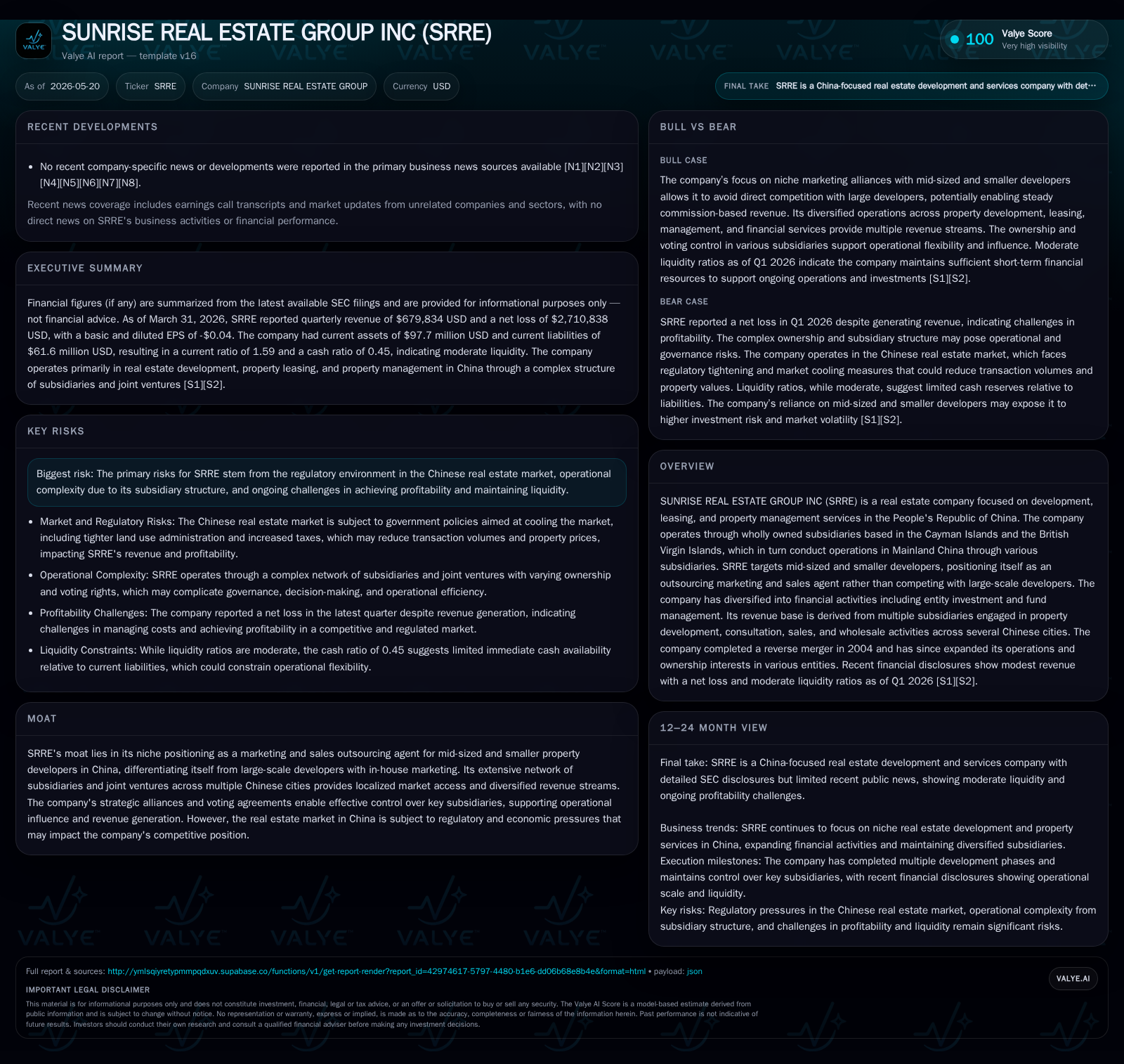
SUNRISE REAL ESTATE GROUP INC (SRRE) reported operational stability in Q1 2026 with no new risk factors disclosed and maintained a current ratio of approximately 1.59, reflecting adequate near-term liquidity. The company operates primarily as an outsourced marketing and sales agent for mid-sized and smaller property developers across multiple second-tier Chinese cities, supported by controlling voting agreements in key subsidiaries. Its business model blends commission-based agency services with selective direct property investments and leasing activities. However, regulatory tightening in China’s property market, including purchase restrictions and elevated down payment requirements, continues to constrain volume growth and requires ongoing monitoring of sales progress and policy changes. Despite net losses reported for FY2025, SRRE's diversified revenue streams and asset-backed projects provide a foundation for future recovery.
Latest Quarterly Operating Insights
SUNRISE REAL ESTATE GROUP INC (SRRE) reported steady operational conditions in its latest quarterly filing for the period ended March 31, 2026 ([S2]). The company disclosed no new risk factors during this period ([S2]), indicating that its operating environment has remained stable despite ongoing regulatory pressures in China's real estate sector.
Financially, SRRE held current assets of approximately $97.7 million against current liabilities of about $61.6 million as of quarter-end ([F1]), resulting in a current ratio near 1.59. This suggests the company maintains sufficient working capital to meet short-term obligations without significant liquidity stress amid challenging market conditions. However, SRRE reported a net loss of around $8.3 million for fiscal year 2025 ([F1]), reflecting ongoing profitability challenges.
The company's revenue base remains diversified across multiple subsidiaries engaged in property marketing, development consultation, leasing, and investment activities distributed throughout various Chinese cities.
Business Model and Operations
SRRE distinguishes itself within the Chinese real estate industry by focusing on providing outsourced marketing and sales services predominantly to mid-sized and smaller developers ([S1], [S4]). This approach allows it to avoid direct competition with large-scale developers who operate their own internal marketing departments.
Its operating structure includes wholly owned offshore holding companies (in Cayman Islands and British Virgin Islands) which control local PRC subsidiaries such as Shanghai Xin Ji Yang Real Estate Consultation Co., Ltd. (SHXJY). These entities primarily earn commission revenues based on negotiated percentages of sales prices from developer clients ([S1]).
The company exercises operational control through voting agreements rather than outright majority equity stakes in certain subsidiaries—for example, it holds an effective 80% voting interest in Linyi Shang Yang Real Estate Consultation Company Limited (LYSY), enabling strategic decision-making over land acquisitions and project development ([S15]).
Besides commission-based fees from brokerage services, SRRE has expanded into property leasing of unsold assets and selective direct investments like villa-style residential developments ([S10], [S27]). This hybrid model balances fee-for-service income with asset-backed revenue streams.
Industry Context
China's property market is heavily regulated to curb speculation through measures such as purchase restrictions limiting additional home purchases by families owning multiple properties, increased minimum down payments (at least 60% for second homes), and tightened lending policies ([S1], [S26]). These regulations dampen transaction volumes across many urban markets.
Within this constrained environment, SRRE's niche targeting of smaller developers lacking internal marketing infrastructure provides a defensible position. Large developers typically retain direct control over sales channels to protect margins; SRRE fills the gap as an external service provider whose revenues scale with partner success.
Its focus on second-tier cities like Suzhou, Wuhan, and Linyi offers localized expertise tailored to regional market dynamics (, [S10]). This geographic diversification partially mitigates risks associated with top-tier city restrictions.
However, SRRE is modest in scale relative to integrated national developers or technology-driven platform firms. Its competitive advantage lies in strategic alliances backed by voting agreements that grant influence over subsidiary operations involved in sales, leasing management, or limited development activities.
Growth Drivers
Growth opportunities for SRRE center on servicing an expanding group of smaller property developers increasingly outsourcing marketing amid rising regulatory compliance costs ([S10]).
The Linyi project exemplifies this strategy: phases 1 and 2 have achieved near sell-out status (119/121 units sold in Phase 1; all 84 units sold in Phase 2), demonstrating tangible asset monetization capabilities feeding into revenues ([S10]). In September 2020, SRRE acquired additional land at Linyi to expand future development phases ([S27]).
Diversification into property leasing adds recurring income streams from unsold commercial/residential inventory across projects such as GXL building and Huai’an Tianxi Times ([S27]). Emerging financial activities like fund management may also provide ancillary earnings growth over time.
Key growth metrics to watch include unit sales velocity at Linyi Phase 3 (34 units sold out of planned 51 as of early 2026), expansion of strategic partnerships with mid-sized developers requiring outsourced marketing support ([S10]), and conversion efficiency of land bank acquisitions into profitable developments ().
Risks and Challenges
Regulatory risks dominate due to China's tightening policies aimed at curbing speculative home purchases through ownership caps per household and elevated down payment requirements ([S1], [S26]). These constraints suppress transaction volumes and thus reduce commission-based revenue potential.
Operational complexity arises from managing numerous subsidiaries with varied equity interests governed via voting agreements rather than full ownership ([S1], [S15]). Such structures may complicate governance efficiency and decision-making speed.
Profitability challenges persist as illustrated by the FY2025 net loss nearing $8.3 million ([F1]), stemming from subdued market activity combined with costs related to ongoing development phases yet to be fully monetized.
While no material litigation is currently pending ([S5]), legal risks inherent to land acquisition processes and financing frameworks under regulatory scrutiny remain potential threats.
Outlook and Monitoring Points
Investors should monitor:
- Sales progress for Linyi Shang Yang Phase 3 where early absorption reached about two-thirds capacity by March 2026 ([S10], [S27]).
- Development activity tied to recent land acquisitions signaling management confidence but increasing capital commitments ([S27]).
- Changes in local housing policies affecting purchase restrictions or down payment requirements impacting demand dynamics ([S26]).
- Formation of new strategic alliances extending outsourced marketing services among fragmented mid-sized developer segments.
- Subsidiary performance metrics including commission margins amidst fluctuating pricing conditions ().
Financial Snapshot Summary
As of March 31, 2026, SRRE held approximately $97.7 million in current assets versus $61.6 million in current liabilities yielding a current ratio near 1.59—a moderate liquidity buffer important during cyclical pressures within China's real estate market ([F1]). Historical cash equivalents were around $8.7 million as of September 2018 but larger working capital balances appear sufficient for near-term obligations without evident refinancing stress ([F1]).
Maintaining positive cash flow will rely heavily on accelerating unit sales especially for ongoing development phases like Linyi Phase 3 alongside disciplined cost management across its complex subsidiary structure.
Disclaimer: This analysis is based exclusively on publicly available SEC filings and company data as of May/June 2026. It does not constitute investment advice or research views.
Disclaimer: This is research-only, informational analysis and not investment advice. It may include AI-generated interpretation and general industry context. Always verify important details using primary sources.

Comments